


SINGAPORE – Despite being globally competitive amid trade tensions and geopolitical uncertainty, many Asia-listed firms continue to trade below their book value, as modest shareholder returns, limited institutional investor support and corporate governance concerns weigh on investor confidence.
These findings were highlighted at the launch of the Singapore Capital Markets Initiative (SCMI), a research platform established by the Singapore Management University to advance research, policy dialogue and talent development on issues affecting the capital markets in Singapore and Asia.
The initiative, housed under SMU’s Centre for Commercial Law in Asia, also aims to act as a bridge between academia, policymakers and industry, translating academic research into practical policy recommendations and market solutions for Singapore and the region.
The launch took place during a conference jointly organised by SMU, the Organisation for Economic Co-operation and Development, or OECD, and the European Corporate Governance Institute.
SMU chairman Piyush Gupta, in his opening address at the conference, said the undervaluation of Asian companies is “not merely a capital markets issue. It is an economic issue”.
“When companies are undervalued, capital markets become less effective at performing their core function. Firms face greater difficulties raising capital to finance innovation, job creation and growth,” he said.
He added that “undervalued capital markets risk becoming underutilised capital markets”.
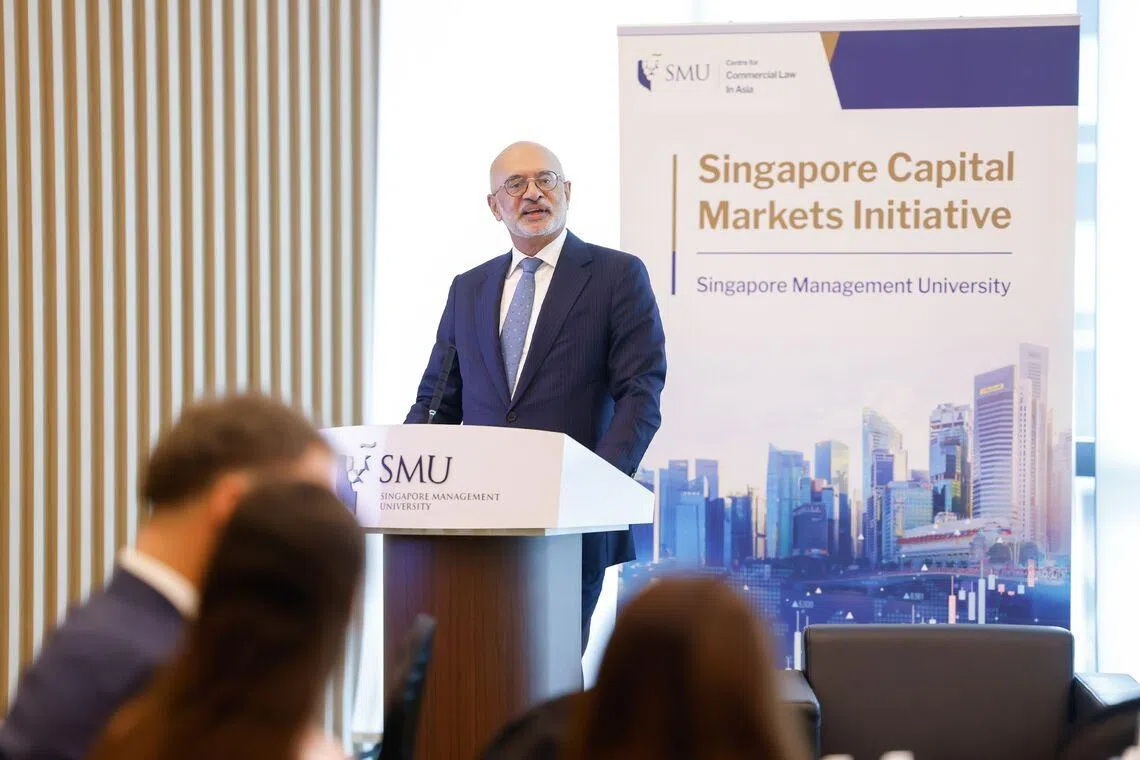
SMU chairman Piyush Gupta said the undervaluation of Asian companies is “not merely a capital markets issue. It is an economic issue”.
PHOTO: SMU
The OECD’s Asia Capital Markets Report 2026, which was released in June, found that nearly 40 per cent of listed companies in Asia traded below book value despite strong economic growth and the emergence of globally competitive firms.
The book value of a company refers to its assets after deducting its liabilities.
The report said moderate shareholder returns, concentrated ownership structures and underdeveloped domestic institutional investor bases continued to weigh on valuations across the region.
It also found that institutional investors account for only 21 per cent of market capitalisation in Asia, compared with 47 per cent globally, limiting the pool of long-term capital that can support liquidity, stewardship and sustainable value creation.
While several Asian jurisdictions have introduced “value-up” initiatives to improve capital efficiency, shareholder returns, corporate governance and market competitiveness, early results have been mixed, the report showed.
To narrow the persistent valuation discount, companies will need stronger corporate governance, better capital allocation, deeper investor participation and greater transparency, it added.
Gupta said Asia’s capital market story is “not only one of success” but also “one of untapped potential” to enhance valuations, deepen liquidity, broaden investor participation and strengthen trust and confidence.
He said stronger institutional investor bases, better governance, greater transparency and wider investor participation would be needed to unlock that potential.
Singapore is well-positioned to contribute to the next phase of capital market development, Gupta added.
“Singapore has established itself as one of the world’s premier financial centres and its stock market has recently become South-east Asia’s largest by market capitalisation, reinforcing its role as a gateway for global capital into the region,” he said.
Speaking during a panel discussion at the conference, Singapore Exchange Regulation (SGX RegCo) chief executive Tan Boon Gin said the newly launched SCMI is intended to improve liquidity, particularly in the small- and mid-cap segment, which has historically seen relatively low institutional investor participation.
Rather than replacing private investment, the programme is designed to “crowd in” more private capital and build a deeper, more active equity market.
Tan noted that Singapore had recently moved towards a more disclosure-based and market-driven regulatory regime alongside initiatives to attract quality listings and deepen investor demand.
He added that the market reforms were designed as a “holistic overhaul” combining regulatory reforms with measures to strengthen both the supply of and demand for capital.
The disclosure-based approach is part of a broader package of capital market reforms unveiled by SGX RegCo in October 2025.
The changes introduced shifted the regulatory focus towards ensuring companies make timely and comprehensive disclosures of material information so investors can make informed decisions, while reducing prescriptive rules and unnecessary market intervention.
The reforms also streamlined listing requirements, lowered the profit threshold for new listings from $30 million to $10 million, removed the financial watch list and replaced public trading queries with greater private engagement, while retaining safeguards such as disclosure queries and “trade with caution” alerts where material issues arise.
Tan cited the Equity Market Development Programme as one example of Singapore’s efforts to strengthen the equity market. Under the programme, public funds are allocated to external fund managers to invest in Singapore-listed companies, with the aim of attracting additional private capital alongside them.

