


WALLDORF, Germany – Artificial intelligence has taken over much of what used to be Fabrizio Primerano’s software engineering job. It brainstorms with his colleagues, researches competitors and writes and tests code.
But Primerano still has a job, at the German software giant SAP. It includes fewer routine tasks and more of what feels like managing and mentoring AI agents, or bots that can be programmed to act like personal assistants and, increasingly, human employees.
“It’s freeing me up to do more of this creative work,” Primerano said recently.
That is what executives of SAP, the largest software company in Europe by market value, say they want. SAP, long seen as a stoic provider of back-office products, says it is taking a lean-in approach to the technology that poses an existential threat to its coders and its business model.
Its leaders concede that AI is eliminating the need for humans to do many of the tasks its software engineers did until very recently. In a round of restructuring two years ago, SAP cut nearly 10,000 jobs, some as a result of AI, the company said. SAP would not break down exactly how many were related to AI or say what sort of jobs were eliminated.
To try to avoid eliminating more positions, they say they have encouraged workers to invent new, more valuable jobs, aided by the rapidly improving technology available to them. Company officials say that even with the previous restructuring, they have added more than 3,500 jobs on net since 2023, including new job titles like “forward‑deployed engineers,” or those who work with customers to develop AI-driven solutions.
“I’m not sure if here someone in two or three years will still code software,” chief executive officer Christian Klein said in a recent interview. He said he did not expect to operate with a smaller workforce, “but with a very, very different workforce.”
Such a strategy could be a source of hope for Europe, economists say. It might prevent large-scale job losses in some sectors, while plugging unfilled vacancies in others. Europe, an aging continent facing a long fate of slow economic growth, has a chronic lack of skilled workers.
“AI might save us from a very severe labour shortage” caused by Europe’s aging demographics, Nicola Fuchs-Schündeln, an economist and the president of the WZB Berlin Social Science Center, said.
It could be difficult for Europe to replicate SAP’s approach, if it even proves successful, at a large scale. Marcel Fratzscher, an economist and the president of the German Institute for Economic Research, agreed that it had huge potential to salve Europe’s demographic problems. But only if Europe invests significantly and quickly enough in the tech to catch up with the United States or China. Companies such as SAP largely depend on American AI models and a physical and virtual supply chain that runs through Asia and the US.
“Europe is lagging behind on adopting AI technologies completely,” Fratzscher said, “because it lacks good digital infrastructure. It lacks the skills.”
Some analysts say SAP’s AI strategy is shaky, because it remains so reliant on American AI models. The Trump administration moved in June to block foreign nationals from using two of those models, from the company Anthropic. Though the government recently reversed course and lifted restrictions, the move had sounded alarm bells for SAP and its clients.
SAP’s AI strategy is “rooted in a geopolitical fault line,” Peter M. Färbinger, the editor-in-chief of E3 Magazine, which covers the company extensively, wrote in June. “The risks for existing SAP customers are glaring.”
Investors have been pessimistic that AI will be a boon for SAP. Over the past year, the company’s stock price has plunged by nearly 50 per cent, even though its revenue and profits have grown in that time. Other organisations, such as the financial technology company Block, say they are saving money by laying off workers as their AI agents get more sophisticated. And analysts are worried that AI models have become so skilled at writing software that customers will no longer need SAP to create programs that manage billing or supply chains.
But the company is trying to go with that flow.
SAP workers use AI tools to try to improve applications for patents and to handle some customer support requests. Its AI agents code prototypes for new software, or add new features to existing programs, speeding up the process for developing products.
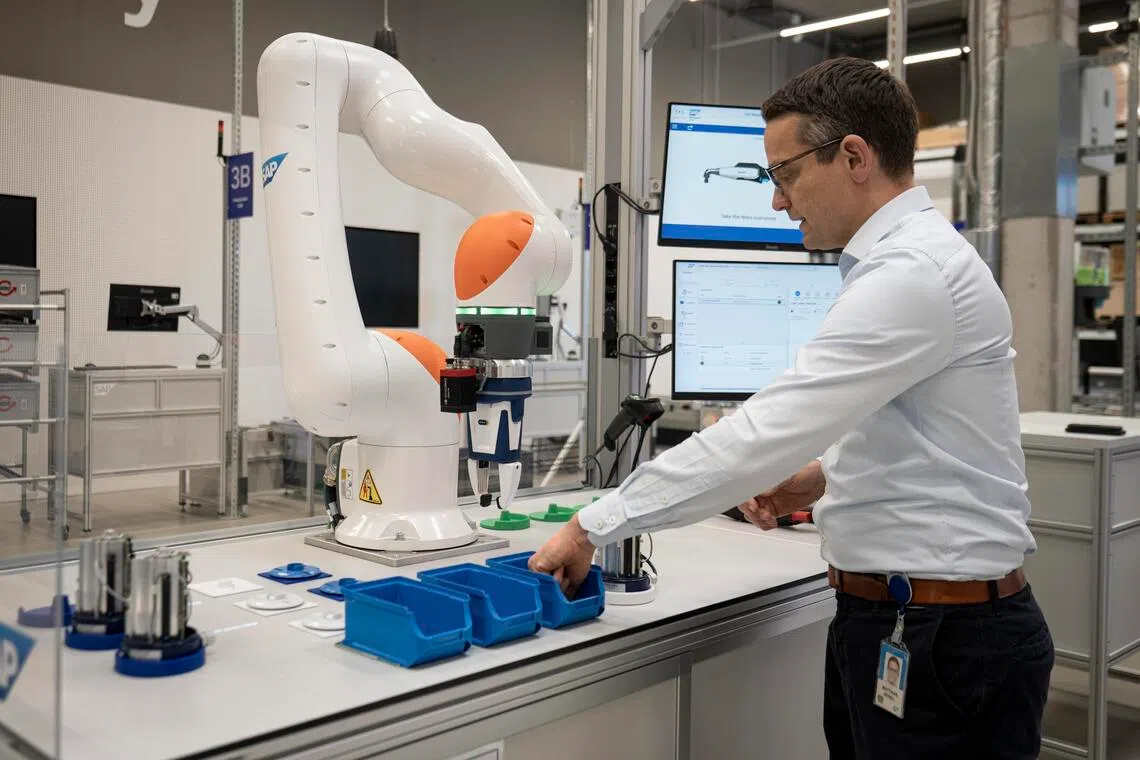
To help clients grasp how all of those agents could help their business, the company has built de facto AI-demonstration centres, including a mock factory floor to illustrate AI’s power to improve toolmaking or beer brewing.
Matthias Deindl, a SAP product management executive, said AI agents would ultimately help factories retain and automate knowledge that would have been lost as skilled workers retire, like knowing which gear to adjust when a machine starts making a certain disconcerting sound.
Lots of companies across Germany and elsewhere in Europe need that sort of breakthrough. Amid an accelerating wave of retirements, Germany is on track to lose nearly seven million workers, or about 13 per cent of its working-age population, over the next decade, according to estimates from the Organization for Economic Cooperation and Development.
Absent a politically tricky increase of highly skilled immigrants, AI offers a lifeline. But European companies have been slower than US rivals at exploring its uses, according to a recent study Fuchs-Schündeln worked on.
“AI could make firms a lot more productive,” she said. “But it’s really important that they use it.” NYTIMES

