


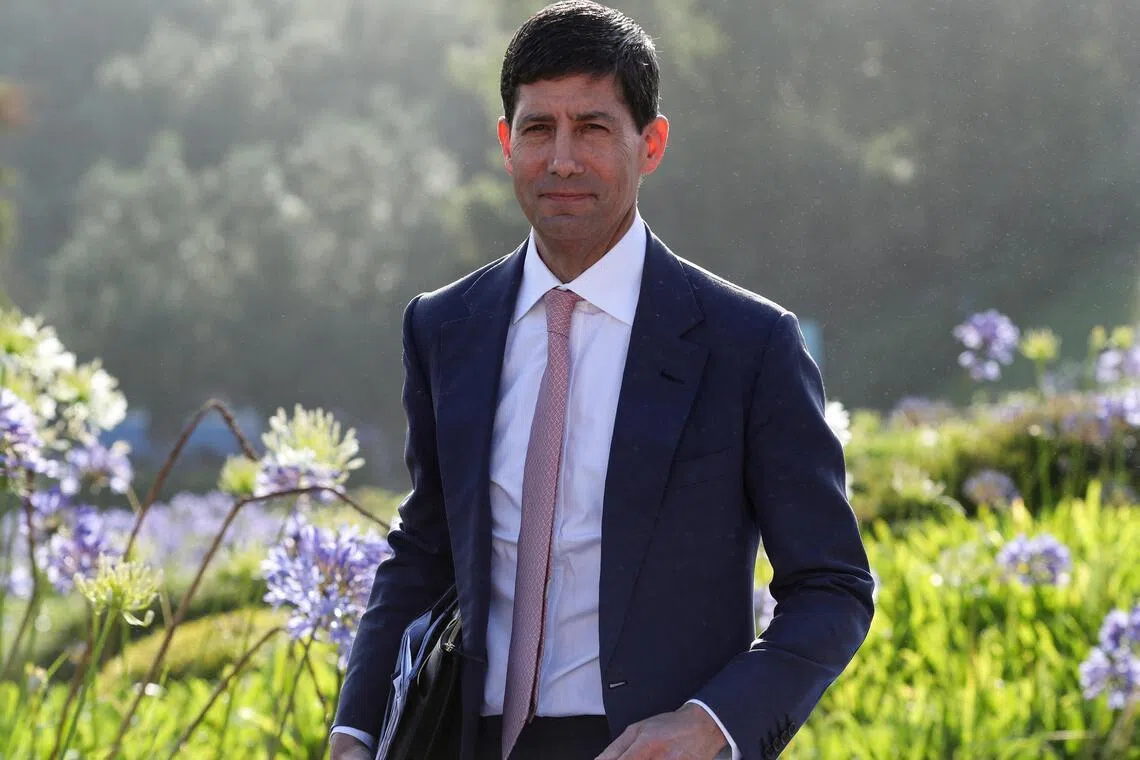
US Federal Reserve chairman Kevin Warsh said price risks have come down in recent weeks, while repeating his determination to bring inflation back to the US central bank’s 2 per cent target.
“Expectations of inflation over the first four weeks of this period have come down, inflation risks have come down,” Warsh said on July 1 at the European Central Bank’s (ECB) annual Forum on Central Banking in Sintra, Portugal. He doubled down on a message from his first press conference as Fed chairman in June that the central bank will deliver price stability.
Two-year Treasury yields fell to their lows of the session after Warsh’s remarks, and were around 4.15 per cent at 10.25am in New York.
Warsh did not cite the specific price indicators he was monitoring. The most recent reading for the Fed’s preferred inflation gauge showed a 4.1 per cent jump from a year before, with core prices, excluding food and energy, up 3.4 per cent. Energy and petrol prices, however, have plunged in recent weeks as the US and Iran engaged in peace talks.
“We’re going to deliver price stability in the US, that’s what this committee has signed up to do, and our objective is to do that,” he said. “Tactics, the strategy and the rest, that’s still to come,” Warsh said.
Warsh also emphasised the Fed’s autonomy in determining the proper policy course – in the face of consistent calls by US President Donald Trump for slashing interest rates.
“We’ve been an independent central bank for a very long time. We’re going to be an independent central bank at this moment and you’re going to see no changes on that,” he said in a panel discussion at the ECB conference.
Warsh repeated he is not going to offer “forward guidance” with regard to upcoming interest-rate policy. Asked specifically whether a rate hike is on the table at the July meeting, he said the panel moderator was “trying to get me to break this rule” on foreswearing forward guidance. “She’s going to fail.”
“We’re going to chart a new course,” Warsh said. “I want us to have a good family fight when we meet in four weeks,” he said, referring to the next policy decision.
In his initial press conference in June, Warsh said that Fed policymakers had agreed that forward guidance “was not well-suited to the current policy conjuncture”.
“At my press conference, I said we’re not going to give forward guidance because we’re meeting in six weeks,” Warsh said on a panel alongside other prominent central bank leaders. “I have an update for you,” he added, noting the July 28-29 meeting is now just four weeks away.
While Fed officials held interest rates steady in June, they did signal growing support for hikes in 2026 amid inflation running at its fastest since 2023. Updated forecasts for the Fed’s benchmark rate showed half of 18 officials projected a rate increase in 2026, though Warsh declined to offer a forecast himself.
The rate-setting Federal Open Market Committee (FOMC) voted unanimously in June to hold its benchmark federal funds rate target in a range of 3.5 per cent to 3.75 per cent. Investors are now pricing in at least one 25 basis point rate rise by end-2026.
As for whether the Fed will more permanently refrain from forward guidance, Warsh in June announced the creation of five task forces, one of which will examine communications. The others cover the balance sheet, the Fed’s use of data, productivity and jobs, and the central bank’s inflation frameworks.
Speaking on the panel, Warsh said that it is likely there will be news next week on task-force membership. Participants will include outside experts, and some individuals from outside the US, he said.
Asked about the Fed’s balance sheet, which at US$6.7 trillion (S$8.68 trillion) remains well above its pre-Covid-19 figure, Warsh said it is “no secret” that he has favoured in the past a smaller portfolio. Any changes going forward would be an FOMC decision, and would be “well deliberated publicly”, he said. He also said it would take more than 18 weeks to bring it down to size.
Turning to artificial intelligence, Warsh said it is too soon to judge whether the current investment surge is generating broad-based inflation. Ultimately, he said the new technology will spur a supply-side boom that drives productivity. How AI is impacting the economy will become clearer in the coming months, he said.
“While we might see business surveys that say ‘no big deal’, my speculation is six months from now the surveys will be saying quite the opposite,” he said. “We are in the first or second inning of this revolution. This is a big paradigm shift.” BLOOMBERG

