


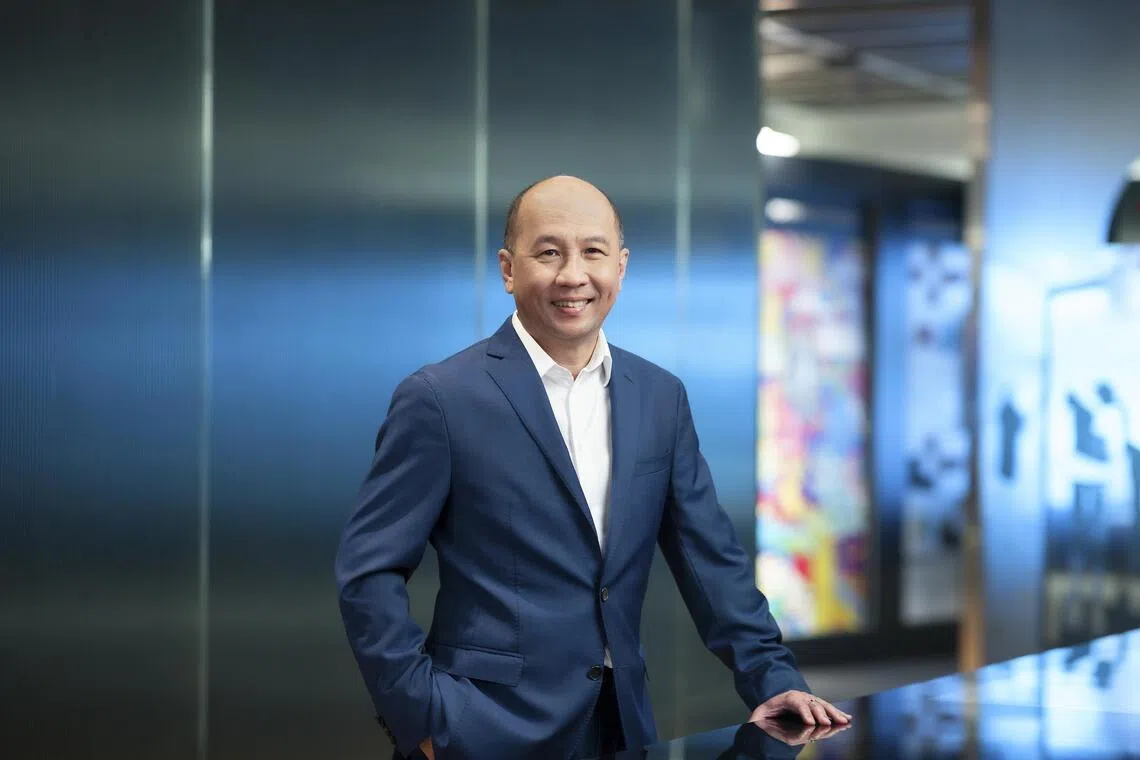
SINGAPORE – Singtel chief executive Yuen Kuan Moon was paid less in financial year (FY) 2026 despite leading the telco to higher profitability, with his remuneration reduced by around 17 per cent following several major network reliability issues during the year.
Yuen received $6.8 million for the FY ended March 31, down 16.9 per cent from $8.2 million the previous FY, according to Singtel’s annual report released June 30.
Nearly 60 per cent of Yuen’s remuneration package was in shares, while almost a quarter comprised bonuses awarded. His base salary was $1.3 million.
Singtel said that several network outages over the past year, including a major disruption in Australia in September 2025, were “material operational and reputational issues”.
The outage at Singtel’s Australian subsidiary Optus lasted 14 hours, disrupting more than 75 per cent of calls to Australia’s triple zero emergency hotline. It was later linked to several deaths.
In March, Singtel experienced back-to-back outages in Singapore with a mechanical fault affecting about 600,000 customers for over eight hours, and a separate software bug hitting around 2,000 customers the following day.
In response to these major incidents, Singtel said that the Group “remains focused on restoring customer trust, enhancing service reliability, and strengthening operational resilience across its businesses.”
In his note, Optus chief executive Stephen Rue said the telco did not “fully meet the expectations of the Australian community”, and added that the telco is committed to rebuilding trust by “upholding transparency, accountability and sustained action.”
He noted that following an independent review, Optus has improved its real-time monitoring and visibility of triple zero performance and incident response protocols, among other improvements to its operational processes.
These changes mark Optus’ stronger focus on prevention, earlier detection, faster escalation and more effective response when issues arise, Rue said.
Yuen received a lower remuneration package despite delivering stronger financial performance in FY2026, with net profit growing 40 per cent year on year to $5.6 billion, and underlying net profit – excluding one-offs – also rising 12.1 per cent to $2.8 billion.
Singtel also generated $3.9 billion in asset sales in FY2026, mainly by the sale of stakes in its Indian telco business Airtel in November 2025, which raised $1.5 billion.
The group said that it remains on track to achieve its mid-term target of $9 billion in asset sales. It has already hit $6.8 billion, following a $1 billion, or 2.8 per cent, divestment of its stake in Gulf Development, Thailand’s largest energy company, on June 23.
In their letter to shareholders, Yuen and chairman Lee Theng Kiat said the funds allow the company to “maintain a robust balance sheet, execute up to an additional $1 billion of our value realisation share buyback programme in FY2027 and continue investing in growth engines.”
While the telco is not directly affected by the Middle East conflict, geopolitical tensions are causing countries and companies to rely on different technology systems, the letter said. However, Singtel’s data centre network positions it well to serve customers operating across both Asia and Western markets.
Artificial intelligence will become a key driver of growth for Singtel.
In the coming year, the group will focus on capturing growth opportunities across the entire AI value chain, scale its data centre business Nxera and AI cloud service RE:AI to meet sovereign and regional AI demand,
The Group will continue to grow its enterprise business in Singapore, which accounts for more than 50 per cent of its revenue here.
“Our goal is to ensure that Singtel not only remains relevant but also contributes significantly to the transformation of Asia’s digital economy,” Yuen said.
“The momentum we have achieved so far will drive the next phase of higher-value growth as we deepen our sustainable differentiation and continue to innovate and create impact for our customers, partners and shareholders.”
Group chief financial officer Arthur Lang said in a note that while Singtel’s regional businesses delivered a strong performance in FY2026, the outlook for the following year is “expected to be more moderate”, with dividend contributions unchanged year-on-year at around $1.1 billion.
He cited macro risks indirectly linked to developments in the Middle East as the main uncertainty, as most of Singtel’s regional businesses are net energy importers and fluctuating energy prices could both increase operating costs and dampen consumer and enterprise demand.
He added that while the group hedges its foreign currency exposure on dividends received from its regional businesses, volatility could still exert pressure on its underlying net profit when translated back into Singapore dollars.
Shares of Singtel closed June 30 at $4.41, down around 0.7 per cent.

