


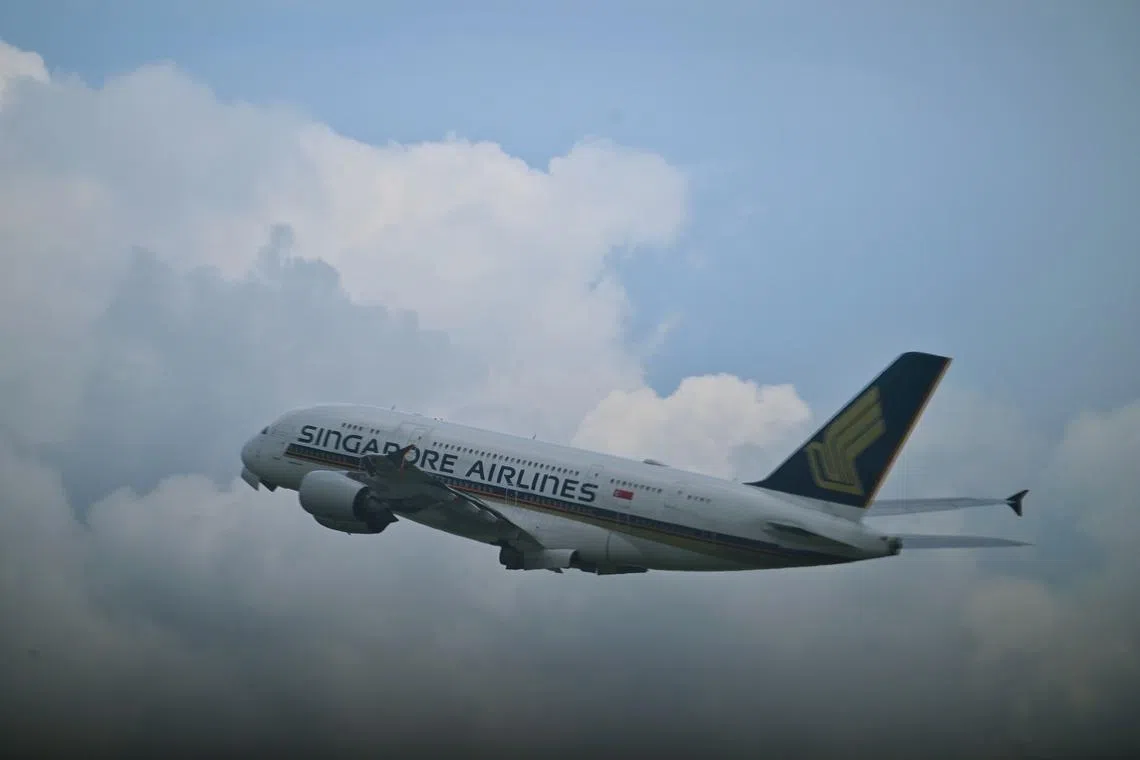
SINGAPORE – Singapore Airlines (SIA) extended its share price recovery this week, extending gains since mid-May when the carrier reported record annual revenues driven by strong travel demand.
This week’s rally came as US-Iran peace talks in Switzerland on June 22 concluded with a 60-day roadmap towards a final peace agreement, sending crude oil prices lower and raising hopes that airlines could begin resuming flights through the Middle East.
Buoyed by the prospect of lower jet fuel costs and the eventual reopening of disrupted regional airspace, SIA shares rose 5.8 per cent over the week to close at $7.65 on June 26.
Before reporting its results on May 14, SIA shares were trading at $6.27 as concerns over higher fuel costs weighed on the stock.
The carrier’s rising share price also comes as the 2026 FIFA World Cup kicks into a higher gear. The tournament, which runs from June 11 to July 19 across 16 host cities in the US, Canada and Mexico, has led to higher transpacific long haul flight demand, which has benefitted SIA.
SIA also announced on June 22 that it had successfully raised about 1.5 billion yuan (S$270 million) in low-cost financing for five years. The funds will be used for aircraft purchases, aircraft-related payments, and refinancing existing borrowings at lower rates.
There could be more volatility in store for the carrier in the weeks ahead though, as Iran and the US have continued to trade attacks in the Gulf through the week, raising fears that the ceasefire between the two countries is unravelling.
Should the war persist, SIA’s management has warned that it expects volatile jet fuel prices, the airline’s highest expenditure, to have a larger impact on costs and earnings for the 2026/27 financial year (FY).
In FY2025/26 ended March 31, SIA revealed in its annual report released on June 25 that its chief executive Goh Choon Phong received nearly $9.7 million in total remuneration, compared with $7 million in the previous year.
About 49 per cent of Goh’s package was in shares, while 35 per cent comprised bonuses awarded. His base salary was about $1.5 million.
Artificial intelligence (AI) stocks had a volatile week, as fears spread that major technology firms were overspending on AI infrastructure without seeing clear returns.
AI stocks from the US to South Korea were volatile ahead of Micron Technology’s third–quarter results on June 24, before surging after the memory chip maker reported adjusted earnings of US$25.11 per share on revenue that more than quadrupled year-over-year to US$41.46 billion (S$53.78 billion). This was well above expectations.
Micron also told investors to expect US$50 billion in revenue for its next quarter, more than the US$43.6 billion analysts had forecasted.
Its shares jumped sharply in after-hours trading on June 23, pulling up stocks like US-listed Advanced Micro Devices and Intel, as well as SK Hynix and Samsung Electronics in South Korea. In Singapore, the shares of AEM Holdings, Frencken Holdings and UMS Integration also jumped.
That rally was short-lived though. Tech stocks tumbled on June 25, when Apple announced that prices for its MacBook Neo, MacBook Air, iMac and iPad product lines would all rise, in some cases by as much as US$200, to cover the rapidly rising cost of the chips used to make them.
This also came after Micron revealed during its results that its margins had surged to 84.6 per cent, from 74.4 per cent in the previous quarter and 37.7 per cent a year ago, as the chipmaker raised prices amid an industrywide shortage of memory parts.
The move raised concerns that higher prices could dampen demand for AI-enabled devices, slowing growth in the memory chip market that has been one of the main drivers of the AI boom.
Apple shares fell despite the price increases, while chipmakers such as Micron and Nvidia also declined. The weakness spilled over to Singapore, with AEM, Frencken Group and UMS Integration ending the week lower.
Emerging market currencies like Malaysia’s ringgit also saw a volatile week with analysts expecting further ringgit weakness against the US dollar and Singdollar in the second half of 2026.
With US inflation well above the Federal Reserve’s 2 per cent target for over five years now, new Fed chief Kevin Warsh’s commitment to delivering price stability has fuelled expectations of further US interest rate hikes and a stronger USD in 2026.
That has made US assets more attractive to investors, drawing funds away from emerging markets such as Malaysia and putting pressure on the ringgit.
The ringgit has also weakened against the Singapore dollar.
The Malaysian currency was trading at 3.19 ringgit per Singdollar on June 28, close to its six-month low of 3.21 recorded on June 22.
The volatility comes as Bank Negara Malaysia said on June 24 that it would step up measures to support the ringgit.
The central bank said the ringgit’s recent weakness is mainly due to global factors, and not problems with the country’s economy. It added that foreign investors have adopted a wait-and-see stance towards Malaysian assets ahead of the upcoming state elections in Johor and Negeri Sembilan, which has contributed to the currency’s pullback in June.
Analysts are forecasting a Singdollar-ringgit exchange rate of around 3.2 to 3.25 by year end.
Sisters Race and Rhonda Wong, who are the founders of Ohmyhome, announced a restructuring of the business that will see them privatise the real estate brokerage and property-related services business, which is currently part of Nasdaq-listed Ohmyhome Ltd.
The announcement comes after the listed company disclosed in June 18 filings lodged with the US Securities and Exchange Commission that it had sold its wholly owned subsidiary, Ohmyhome (BVI) to a privately held company controlled by the sisters, for US$1.
Ohmyhome (BVI) is the holding company of Ohmyhome Singapore and its subsidiaries, which are engaged in providing real estate brokerage and property-related services in Singapore.
Ohmyhome Ltd said it decided to dispose of its subsidiary after evaluating its declining revenue and continuing operating losses, and that the purchase price of US$1 was determined based on the negative net asset position of Ohmyhome (BVI). As at March 31, the subsidiary’s liabilities exceeded its assets by US$14.77 million, filings showed.
Disclosures by Ohmyhome Ltd also showed that the sale came after it had unconditionally waived $19 million in debt owed to it by Ohmyhome (BVI).
In a statement on June 26, Ohmyhome said the move “separates the core regional property platform from the US-listed corporate shell, allowing the property business to optimise its capital structure and focus on long-term growth in Singapore”.
It added that there will be no change to Ohmyhome’s leadership team, day-to-day business operations, service offerings, or strategic direction. “Customers, partners, and employees can be assured that the business they know continues without interruption.”
Following the sale, Ohmyhome Ltd will focus on digital marketing services, including digital marketing strategy, content creation, online advertising campaigns and performance monitoring.
Shares of Ohmyhome Ltd closed June 26 at 64 US cents.
Shares of Singapore-listed property developer Frasers Property (FPL) closed the week flat at $1.09.
FPL announced on June 25 a proposal to sell its interest in five mature hotels, including Frasers House, formerly InterContinental Singapore in Bugis, and take full ownership of Fraser Suites Singapore as part of a $2.1 billion plan to restructure its hospitality business.
FPL will also retain stakes in or fully acquire properties with growth or redevelopment potential, and earmark several non-core assets for sale when market conditions are suitable.
FPL is aiming to make better use of its capital and reduce debt, which will allow it to generate better returns for shareholders over the long term, its officials said. The restructuring marks the next phase of FPL’s hospitality strategy after it took Frasers Hospitality Trust private in October 2025.
Shares of Justco retreated further this week, closing June 26 at 54 cents apiece, down 10 per cent through the week.
The co-working space provider on June 25 announced that it will open a new “the boring office” centre at The Octagon in Singapore’s Central Business District, marking the brand’s second location in Singapore and its first in the CBD.
The opening forms part of the flexible workspace operator’s expansion plans outlined in its listing prospectus following its recent initial public offering on the Singapore Exchange (SGX).
Shares of JustCo, which debuted on the SGX mainboard on May 22, were priced at 94 cents during its IPO, but opened 11.5 per cent lower at 83.5 cents despite the IPO being 3.4 times subscribed.
Shares of Starhub closed the week slightly higher at $1.09.
The telco announced on June 25 that deputy CEO Matthew Williams will succeed Nikhil Eapen as CEO, effective Jan 1, 2027.
Williams, 55, has assumed the role of CEO-designate.
Eapen, 53, will step down at the end of 2026, concluding a six-year tenure. He will remain in his position over the next six months to facilitate the handover.
Elon Musk’s newly-listed SpaceX could see more volatility in the coming week.
Nasdaq announced after the close on June 26 that SpaceX qualifies for inclusion in the Nasdaq 100, a major stock market index that tracks the performance of the 100 largest non-financial companies listed on the Nasdaq.
Should the company meet the requirements, index-tracking funds and other product sponsors would begin purchasing SpaceX shares after the market closes on July 6, with SpaceX officially joining the Nasdaq-100 before trading begins on July 7.
Shares of SpaceX closed June 26 at US$153.23, down 13 per cent through the week. The shares listed on June 12 at US$135 and briefly surpassed the US$200 per share mark the following week.

