For most people in South-east Asia, LG is associated with the comforts of home – the crisp display of an OLED television or the steady hum of a bedroom air-conditioner. While these products have made the brand a household name, fewer realise that LG is also playing a growing role behind the region’s digital infrastructure.
Beyond the home, LG technologies are now operating inside the high-security environments that support cloud computing, digital services and artificial intelligence workloads. What began as decades of expertise in cooling and thermal management is increasingly being applied to a different scale of problem: how to design and operate infrastructure that can sustain growing AI-driven computing demand.
For decades, LG has developed compressors for air-conditioners and refrigerators, alongside chillers and control systems for industrial applications. Today, that engineering foundation has extended into specialised data centre solutions.
Within these high-tech facilities, LG provides the essential networking and power distribution systems that keep servers running smoothly, alongside industrial-scale cooling units and battery storage to maximise energy efficiency.
As AI accelerates demand for computing power, these capabilities that span across network infrastructure and power management are converging into a single, integrated role.
Jaeseung Kim, regional chief executive officer at LG Electronics Asia Pacific, says: “There was an assumption in the industry that LG was entering the market from a standing start. The reality is that LG already had compressor manufacturing, a mature chiller portfolio, controls capability and group-level integration across energy, IT and building systems, all of which transferred directly into the data centre space.”
These capabilities are now being deployed at scale at hyperscale facilities across the world. The company’s global footprint includes cooling installations in North America, alongside a hyperscale development in the Middle East. Its comprehensive portfolio spans from advanced thermal management for high-performance computing to complete power and building automation systems supporting entire facilities.
This track record has translated into formal recognition from the industry’s largest operators. LG has been selected as a preferred cooling partner by leading hyperscalers, a designation that reflects not just product performance, but the operational reliability and quality standards that hyperscale procurement teams demand.
Underpinning these deployments is a global heating, ventilation and air-conditioning (HVAC) manufacturing infrastructure that few cooling vendors can match. With large-scale production facilities and established supply chains across multiple regions, LG is able to deliver solutions reliably and at pace, a critical factor as data centre developers race to bring new capacity online against tight construction timelines.
But for LG, the significance of these projects lies not just in their scale. They reflect a broader shift in how data centres are being conceived, designed and built – no longer as collections of separate systems, but as integrated environments where computing, infrastructure and operations must function together from the outset.
As AI workloads require higher computing power, data centres have evolved from simple server warehouses into highly complex, power-dense ecosystems. AI servers consume significantly more power than traditional systems, putting immense strain on local power grids, backup battery systems and security monitoring, while generating heat loads that traditional architectures cannot handle.
Meeting these demands requires more than raw cooling capacity. Drawing on decades of HVAC innovation and thermal management expertise, LG develops solutions that are specifically engineered for AI infrastructure workloads, optimising energy consumption, stabilising thermal conditions during peak compute cycles and improving overall power usage effectiveness across the facility.
This infrastructure crunch is especially evident in South-east Asia. The region is in the midst of a major buildout driven by cloud adoption, enterprise digitalisation and AI workloads. Asia-Pacific’s data centre pipeline reached a record 19.4 gigawatts in 2025, with South-east Asia accounting for a significant share of new capacity, according to a Cushman & Wakefield report.
In this tropical environment, operators face a multi-layered challenge: They must secure massive power distribution, ensure rock-solid facility security, maintain high-efficiency energy storage and keep hardware cool.
Beyond operational performance, data centre operators in the region are increasingly factoring supply chain resilience into vendor selection. With geopolitical pressures reshaping global technology procurement, LG’s diversified manufacturing footprint spanning multiple regions helps operators reduce sourcing risk while maintaining consistent infrastructure performance over the long term.
This is where LG is repositioning its role not simply as a supplier of standalone parts, but as an integrator of the physical AI ecosystem – or AI technology in physical hardware – bringing together the strengths of LG affiliates under its One LG vision.
Rather than treating computing, infrastructure and operations as separate workstreams, the One LG Solution brings them together within a single framework, giving data centre operators a more coordinated approach from planning and construction through to day-to-day operations.
The framework unifies the full life cycle of a facility across three connected layers:
-
Computing space: Delivers the vital network infrastructure and smart power distribution systems required to keep high-density AI servers online and stable.
-
Supporting infrastructure: Deploys heavy-duty cooling controls and battery energy storage to maintain peak performance while keeping electricity usage highly efficient.
-
Operation space: Ties the entire facility together under a single “brain”, integrating automated building security, fire safety, real-time energy tracking and centralised control-room monitoring.
Since late 2025, a dedicated Asia Data Centre Solutions team based in Singapore has been coordinating delivery across the region, providing customers with a single point of engagement across design, execution and operations.
The framework also extends beyond the construction phase. Through its Data Center Cooling Management software (LG DCCM), LG provides continuous monitoring, predictive maintenance and operational analytics across deployed cooling systems. Rather than waiting for failures to occur, operators receive early signals that allow them to act proactively, reducing unplanned downtime and extending the operational lifespan of critical infrastructure.
This approach is already taking shape in Jakarta, where LG is delivering a fully integrated solution for a major AI data centre developed through a joint venture between LG CNS and Indonesia’s Sinar Mas Group.
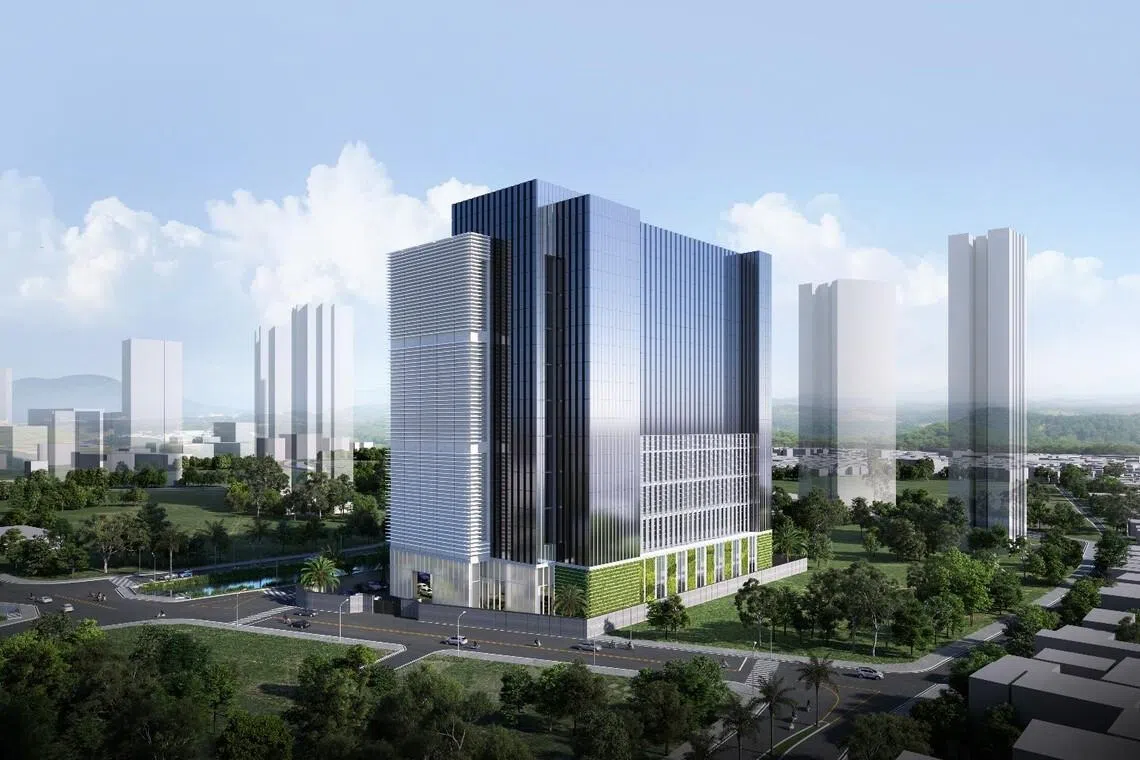
An artist’s illustration of Sinar Mas Group’s data centre in Jakarta, Indonesia, with cooling solutions provided by LG.
PHOTO: LG
Scheduled to begin operations in the second half of 2026, the facility will start at around 30 megawatts and is designed to scale up to 220 megawatts over time. Instead of adding cooling systems in separate layers, the design already integrates central plant chillers, room-level cooling and liquid cooling under a unified control system. This allows computing capacity to expand without redesigning the cooling architecture.
With LG Electronics working together from the outset, the project is delivered as one coordinated system rather than separate packages from different vendors. This reduces the gaps that often arise when different parties are responsible for different parts of a data centre’s performance.
“This project in Jakarta demonstrates LG’s ability to lead large-scale, essential infrastructure initiatives for AI data centres,” says Kim. “Through seamless collaboration across the group, and leveraging our advanced technologies, we will continue to expand our presence as an ecosystem integrator of physical AI.”
For LG, the execution of initiatives like the one in Jakarta underscores what the company views as a fundamental shift in how modern facilities must be delivered. Its strategy is built on the premise that the market is moving away from buying standalone components – towards a model where computing, infrastructure and operations work together from day one.
By positioning itself across the entire stack, LG aims to ensure that every piece of the data centre ecosystem functions as a unified whole.