


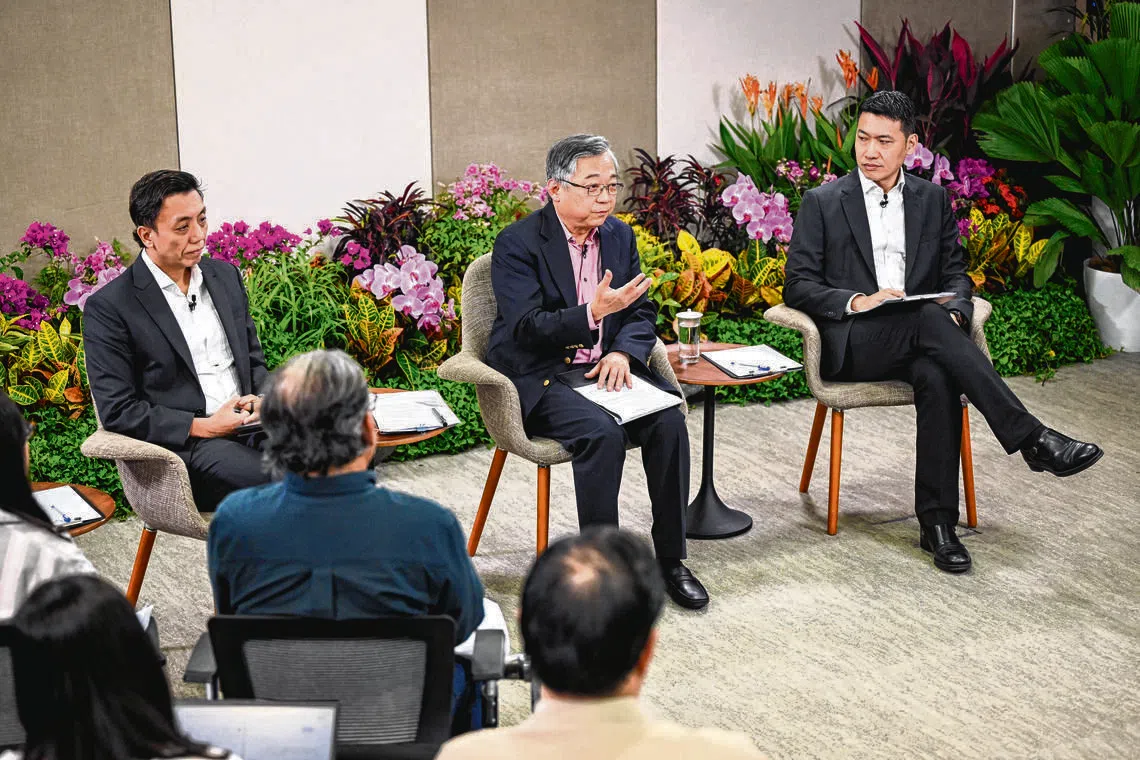
SINGAPORE – Supporting workers earlier after retrenchment, helping them adapt to artificial intelligence (AI) and developing new engines of growth were among the strategies outlined by the Economic Strategy Review Committees in their final report released on June 24.
The report caps a year-long review of Singapore’s economic strategy and concludes that the Republic must move faster to adapt to a fundamentally changed global environment, to sustain growth and rising living standards in the years ahead.
Eight thrusts spanning jobs, skills, AI adoption, business growth and economic resilience had been outlined earlier in May.
The committees, set up in August 2025 to refresh Singapore’s economic strategies for the next phase of growth, said they made their recommendations after more than 80 consultation sessions.
The Government will study the recommendations and work with industry partners to put them into action, said the Ministry of Digital Development and Information in a statement.
The report said that Singapore has to go beyond just maintaining its position as a global hub. It also has to take bets in new and emerging areas.
“Not every investment will succeed, but we must persist – because the cost of inaction and missed opportunities will be far greater over time,” the report said.
To do this, the report suggested that Singapore has to attract companies from leading industries so they are anchored here.
Singapore is already a key node in the semiconductor industry, and this success model can be replicated in other sectors.
Singapore should also invest in emerging technologies to create new growth engines.
Promising areas include quantum technologies – building on Singapore’s existing strengths in semiconductors and advanced manufacturing – as well as space technologies, which leverage its capabilities in aerospace and satellite systems, the report noted.
Singapore can also expand into high-value trust-based services, meeting the growing demand for services like cybersecurity, AI governance, audits and assurance, compliance and risk management.
With AI set to reshape economies the way electricity or the internet did, Singapore “need not compete to build the biggest frontier AI model or host the largest AI data centres”, the report said.
“Instead, we should position Singapore as a trusted hub where AI solutions are developed, tested, and deployed to tackle real-world problems at scale.”
The Government has already set up a National AI Council to launch national AI missions across key areas. In addition to this, the report recommended that Singapore works to attract leading AI companies and talent to develop solutions and scale these solutions from Singapore.
It also suggested developing leading companies as AI champions. These companies can undertake full-scale AI transformation before serving as role models for others in the industry.
To enable faster economy-wide AI adoption beyond large companies, trade associations and chambers can help coordinate demand and data among smaller companies – many of whom struggle to access support schemes – so shared solutions can be developed.
Singapore is already a leading maritime and aviation hub and a trusted financial centre. “But in a more fragmented world, connectivity alone is not enough. Global supply chains are being reconfigured,” the report noted.
It recommended that Singapore develop sea and air hubs that integrate physical infrastructure with digital, AI-enabled systems.
“The goal is to offer the fastest, most reliable and best-coordinated end-to-end flow of goods in the region, making Singapore the preferred choice for shippers and manufacturers.”
When it comes to energy, Singapore should also extend its role as an energy hub, the report said.
“The recent Middle East crisis underscores the importance of Singapore as a reliable and well-connected energy hub,” it added, referring to the oil flows that were disrupted when the crisis effectively blocked the Strait of Hormuz, a vital global shipping channel.
The report added that Singapore must build capabilities in emerging energy domains, such as liquefied natural gas trading, hydrogen and ammonia, and sustainable aviation fuels.
Jurong Island can also be developed as a premier testbed for low-carbon technologies.
But beyond reinforcing Singapore’s leadership and attracting global companies, firms here, especially start-ups, also need help to grow into next-generation leaders, the report said.
It said the Republic should promote the development of different forms of private capital, such as venture debt and private credit, to help start-ups grow.
New investment and partnership tools can also help home-grown companies to scale so they become the industry leaders of the future.
Those wanting to expand overseas should also be supported, giving Singapore workers the chance to gain experience abroad, too.
“We should set an ambitious target to significantly increase the number of Singapore-headquartered companies with more than $1 billion in revenue,” the report said.
The report also laid out strategies to help workers in an increasingly complex, digitalised and AI-enabled world.
“We should prioritise AI technologies that augment workers,” it said, referring to investing in AI in roles where human capabilities such as judgement, interaction and trust remain central.
AI can also unlock career opportunities that did not previously exist.
But sectors that are resilient to AI-disruption should also see better wages and increased quality so they are attractive to workers.
These include jobs in early childhood education, allied health and social services, which will remain important sources of employment, the report said.
Singapore can also work at creating “bridges” or pathways for workers in at-risk jobs to jobs in more resilient occupations, to help workers to transition to new roles if they are displaced.
There could also be earlier intervention in retrenchment support, the report said.
“Transition support cannot begin only after a worker loses his or her job. Earlier intervention significantly improves the chances of redeployment.”
Companies are currently required to submit a mandatory retrenchment notification to the Government within five working days after notifying affected workers.
But the report said the Government, employers and workers’ unions should cooperate to encourage advance notifications and shorten these notification timelines.
“Ideally, support should begin before workers leave their jobs,” it said. “This will give affected workers more time, more options, and greater confidence to navigate transitions successfully.”
When it comes to continuous learning, the courses that workers take should also be integrated with their job needs, the report added.
Lastly, the report said that building energy resilience is vital and Singapore has to prepare for a low-carbon future.
“We will focus on areas where we can lead, invest in new engines of growth, and position Singapore as a trusted hub for value creation,” the report said.
“We will also build a more dynamic enterprise ecosystem, create more good jobs, strengthen support for workers through transitions, and enable continual skills upgrading.”
It added that Singapore also has to reinforce its resilience in energy, supply chains and partnerships, so it can ride out disruptions.

