


SINGAPORE – Markets cheered the first notable steps towards a peace deal in the war between the United States and Iran, as both sides signed an agreement on June 18 that could herald the reopening of the Strait of Hormuz.
The Straits Times Index (STI) hit a 52-week high on June 18 to close at 5,212.84, having rallied strongly from 4,988 a week earlier.
However, it moderated slightly to close at 5,192.7 on June 19, after rising over 3 per cent during the week.
The US and Iran announced on June 14 that a framework for a peace deal had been put in place, including the reopening of the Hormuz, a major shipping channel for global oil and gas flows.
The effective closure of the Hormuz over the past few months has caused an energy crisis with skyrocketing oil prices past US$100 a barrel, and resulted in global inflationary pressures.
On June 18, the US released the 14-point agreement that President Donald Trump signed with Iran’s president, Masoud Pezeshkian, that would also allow ships to pass through the strait toll-free for 60 days.
Oil prices responded by falling below US$80 per barrel of Brent crude for the first time in three months.
Syfe head of investment and advisory Ritesh Ganeriwal said: “The US-Iran peace deal sent oil back to early March levels and triggered a jump in equities, with Asia rallying led by oil-dependent Korea, Japan and India.”
Japan’s Nikkei index was up nearly 8 per cent over the week to hit a high of 71,250 on June 19, while South Korea’s Kospi index jumped by 5 per cent.
However, Hong Kong’s Hang Seng Index was the outlier, falling 3 per cent over the week.
Phillip Securities research manager Glenn Thum said oil prices will still be closely watched, as a sustained pullback would ease pressure on inflation expectations and give investors more confidence around the path of interest rates. “In Singapore, that would be more helpful for companies exposed to fuel and financing costs, although the market will still need to see whether the de-escalation holds,” he said.
He added that Singapore shares have steadied over the week as investors took some comfort from the easing of tensions between the US and Iran, which helped calm worries around energy supply and oil prices. “For now, the move looks more like a recovery from last week’s caution than a broad change in the outlook for equities,” he said.
But another major signal the market received in the past week was the decision by the Federal Open Market Committee, led by new Federal Reserve chair Kevin Warsh, who on May 22 took over from Jerome Powell, who served since 2018.
The committee voted unanimously to keep the benchmark interest rate steady at 3.5 per cent to 3.75 per cent.
Syfe’s Ganeriwal called the decision “sober messaging”, noting that nine out of 18 Fed policymakers now project a rate hike this year. “The message for now is clear: the inflation threat isn’t going away, even if the war ends,” he said.
However, he also noted that a rate hike this year is not certain, and the bar to trigger one is high. “If the peace deal holds and oil stays contained, the Fed may find less reason to hike.”
JP Morgan Asset Manager chief market strategist of the Asia-Pacific Tai Hui said analysts continue to expect no rate adjustments from the Fed in 2026, as the committee “appears comfortable remaining patient given where policy rates are”.
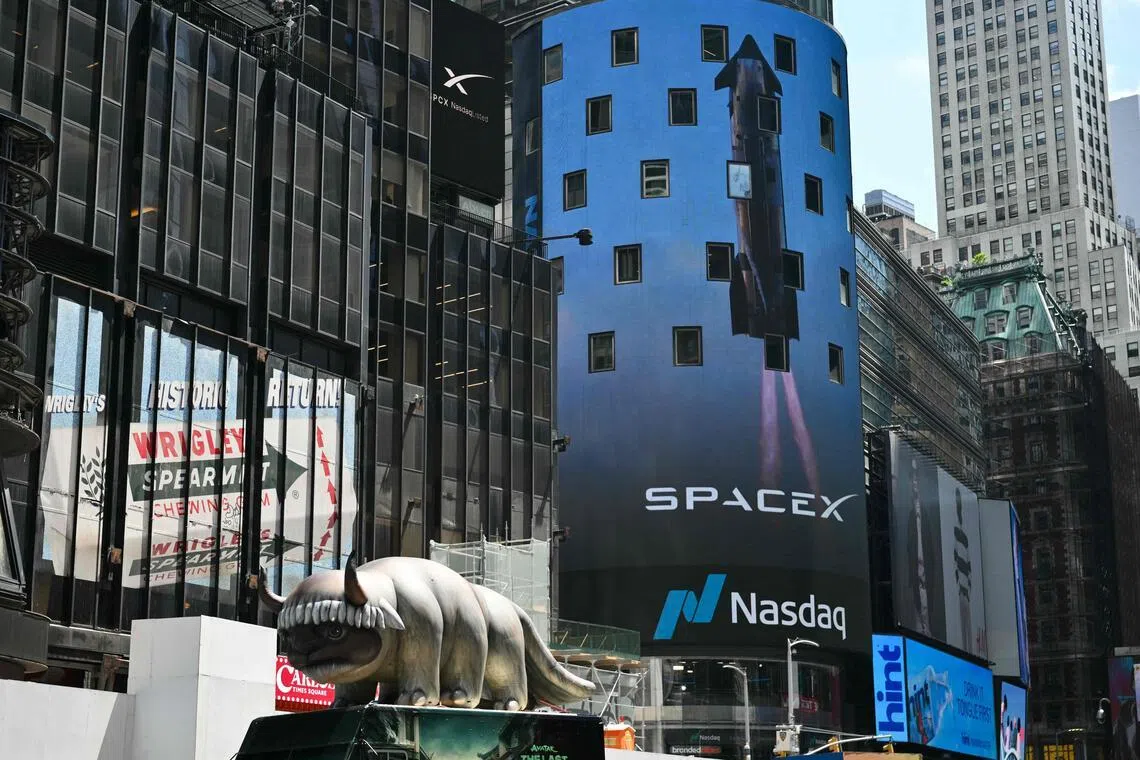
Markets were also abuzz following the listing of Elon Musk’s SpaceX on June 12 on the Nadaq.
The stock concluded its debut trading session at US$160.95, marking a nearly 20 per cent jump from its offer price.
It also pushed the company’s valuation up to over US$2 trillion (S#2.58 trillion), making Musk the world’s first trillionaire on paper.
SpaceX was trading at US$188 on June 18, some 17 per cent higher than its price on June 13.
Phillip Securities’ Thum said: “The strong reception to SpaceX’s initial public offering (IPO), together with strong buying from South Korean investors, suggests that demand for major global growth names is not limited to the US.
“Asian investors are also looking for exposure to companies with scale, visibility and a clear long-term market.”
He added that for Singapore, the more relevant read-across effect is on companies that can show a credible path to long-term growth, especially as markets focus more on quality.
Closer to home, Singapore companies rode the wave of the market rally over the week, with the three Singapore banks up 3 to 4 per cent, although their share prices moderated slightly on June 19.
Conglomerate Jardine Matheson said on June 16 that it would grow its dividend by at least 5 per cent annually until 2030. It also launched a US$500 million share buyback programme.
These initiatives were among the shareholder-return and portfolio-recycling targets that it announced at its Investor Day held in Hong Kong.
The company has a primary listing on the London Stock Exchange. Its businesses include DFI Retail Group, which runs supermarkets, Hongkong Land and Mandarin Oriental.
Meanwhile, Lum Chang Creations said it is planning to launch a placement of up to 35 million shares to raise proceeds of up to about $26.6 million. The company made this announcement on June 18 after its earlier request for a trading halt.
The placement aims to increase the company’s public float as it prepares to transfer its listing from the Catalist board to the SGX mainboard.
Lum Chang Creations had previously said it wanted to transfer to the SGX mainboard to attract more investors. But on June 8, Lum Chang said it is considering the transfer in light of existing market volatility.
On the other hand, Temasek-backed data centre operator ST Telemedia Global Data Centres (STT GDC) announced on June 16 that it has entered the South Korean market, with the launch of a 30 megawatt AI-ready data centre in Seoul.
The new data centre comprises around 40,000 sq m of gross floor area and started full commercial operations in June.
The facility is designed to support a range of hyperscale and enterprise deployments, including evolving high-density workloads.
Earlier in February, it was reported that the data centre operator is being acquired by private equity company KKR and Singapore telecommunications company Singtel.
The markets will be waiting for the peace deal between the US and Iran to take effect and for the Strait of Hormuz to reopen.
“Let the oil flow!” Trump said on June 14 on Truth Social to celebrate the peace deal.
Analysts will be watching to see if oil prices stabilise or continue to slide below US$78 a barrel of Brent crude.
They will also be looking out for guidance on whether there will be interest rate hikes in the coming months.
Unlike Powell, new Fed chair Warsh did not provide forward guidance on June 17, marking a definite shift away from how previous policy statements were written.
Singapore’s inflation data will also be out on June 23. Analysts have already raised their inflation projections for 2026 over concerns of supply chain disruptions caused by global events.
The Economic Development Board will also publish industrial manufacturing data for May, which will reveal if the tech-heavy momentum has been carried forward.

