


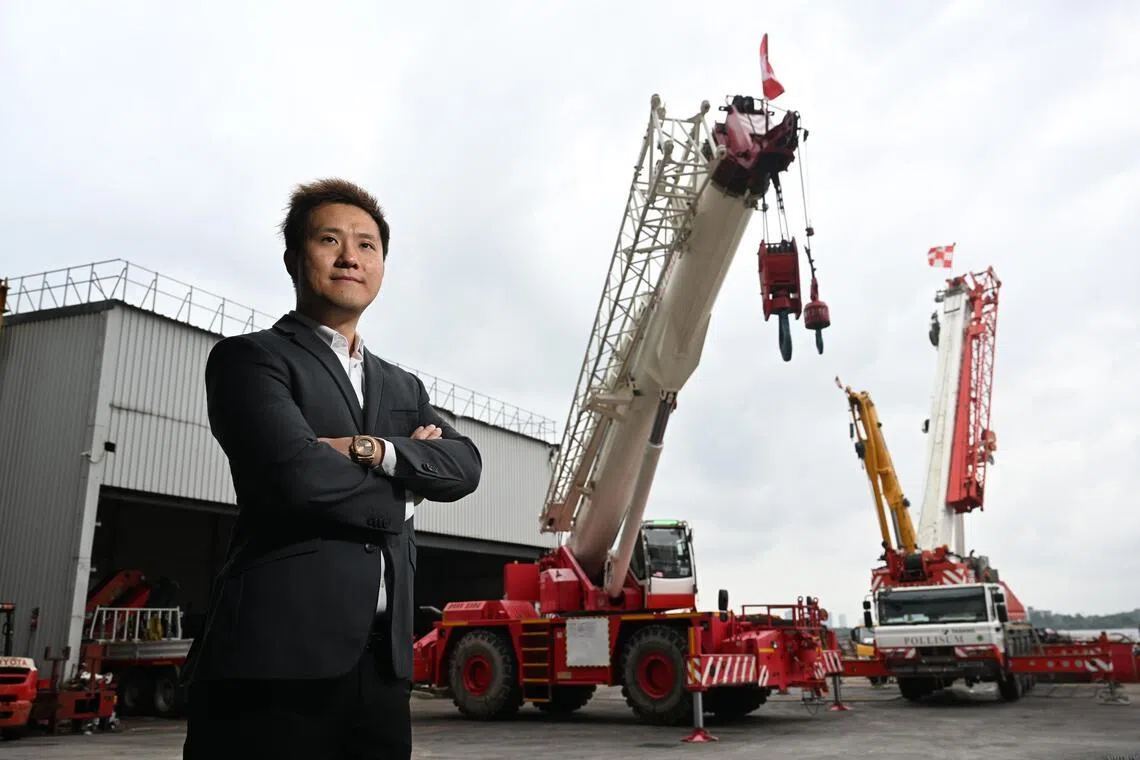
SINGAPORE – Joining a Big Four accounting firm might be the corporate dream for most young Singaporeans.
But Chris Ang left his job as an auditor at one such firm to eventually join his family’s business in the construction sector.
Now 38, he is the chief executive officer of Pollisum Group, which specialises in crane leasing and transport.
Under his leadership, the company returned to profitability and was ranked by The Straits Times and global research firm Statista among Singapore’s fastest-growing companies in 2024, 2025 and 2026.
Ang cut his teeth in 2016 at a Malaysian transport business newly acquired by Pollisum, where he handled sales and operations.
With that foundation, he joined Pollisum full-time in 2018.
Ang says he found the transition from a corporate job to running a company challenging, especially as the firm was struggling then and needed a new strategic direction.
“In a big company, everything is structured. But running a family business required me to take a more hands-on approach, with a greater responsibility for decision-making and problem-solving,” he says.
“I was unfamiliar with running a business, let alone having knowledge of the crane industry. I had to rely heavily on my colleagues and draw on my parents’ experience. The learning curve was steep.”
“Looking back, the hardest part wasn’t managing the numbers, but it was understanding the crane industry, making the right decisions and managing people. But that’s also the most rewarding part. Observing my team’s growth alongside the company’s validates my decision to make the transition,” he adds.
The company, which Ang’s parents started in 1984, now has around 400 employees, many of whom are crane operators who work long hours under difficult conditions, he adds. He believes that engaging his employees’ families and recognising their support are important in building company culture.
“When one of our colleagues was battling late-stage cancer, we stood by him and his family, visiting them personally and assuring them of 12 months of financial support after his passing,” he says.
“What I am proudest of is not only the financial growth, but also the culture that grew alongside it. From the beginning, my vision has always been people-orientated, with the goal of motivating achievers and creating a better future side by side with my team.”
Ang, who is a certified public accountant and has a degree in accounting and finance from the University of London, is married with a four-year-old daughter.
A: I was introduced to investing through stocks, beginning with a CapitaLand real estate investment trust. I started with stocks to understand markets and how businesses grow. I also invest in property for long-term value and stability.
But to me, people are the most important investment, so investing in my family and employees is vital.
A: I suffered a $10,000 loss in stocks during a company’s liquidation.
A: I spend most of my time focusing on my company’s growth and contemplating how to improve its financial position.
My best financial decision was to shut down Pollisum’s logistics department and transfer the fleet to our leasing division. Logistics demanded heavy, round-the-clock monitoring, but the margins were not up to expectations.
By letting go of something that drained time and resources, and doubling down on leasing, where we had strong expertise, we transformed from just breaking even to being profit-making.
The lesson? Don’t be afraid to cut what doesn’t work, and focus on where you add the most value.
A: Growing up, I was given a fixed allowance, which meant I had to find ways to stretch every dollar.
For example, I collected video games when I was younger. I started with just five games that my parents bought me, and by trading up with my neighbours, I managed to snowball that into a collection of more than 100 games.
That experience taught me two key lessons that shape my outlook on investing today: Always look for value and focus on growing what you already have.
These principles guide me in how I approach both business and financial decisions.
A: To be a successful business owner.
A: It was when a friend borrowed money from me and didn’t pay it back. Because of that, I wasn’t able to buy the things I wanted at the time, and I realised just how important money is in enabling choices and independence. That experience taught me to value money and think carefully before lending or investing it.
A: I’d buy every one of my employees a path to retirement, with enough financial freedom to carry them all the way there.
A: I live with my family – seven of us – in a freehold landed property in Bukit Timah with a built-up area of 10,000 sq ft on a 4,000 sq ft plot.
A: I drive a red McLaren GT.
A: A Patek Philippe 5711/1R watch.
A: It means working hard now, and enjoying later.
A: When I started working, I tended to go for the cheapest options for travel, food and hotels.
Over time, my focus has shifted to getting the best value for my money, where I prioritise comfort, convenience and experiences that bring real satisfaction.
A: A perfect day would be walking into the office where the team is motivated, excited and cheering because we have hit our monthly target.
A: My life would largely stay the same. I’d be back at work, focused on growing the business and supporting our people. Money is important, but for me, the real value is in what we build, the team we nurture and the impact we can make together.
A: I would use a portion to buy food, quick supplies or items, and resell them at a higher price.

