


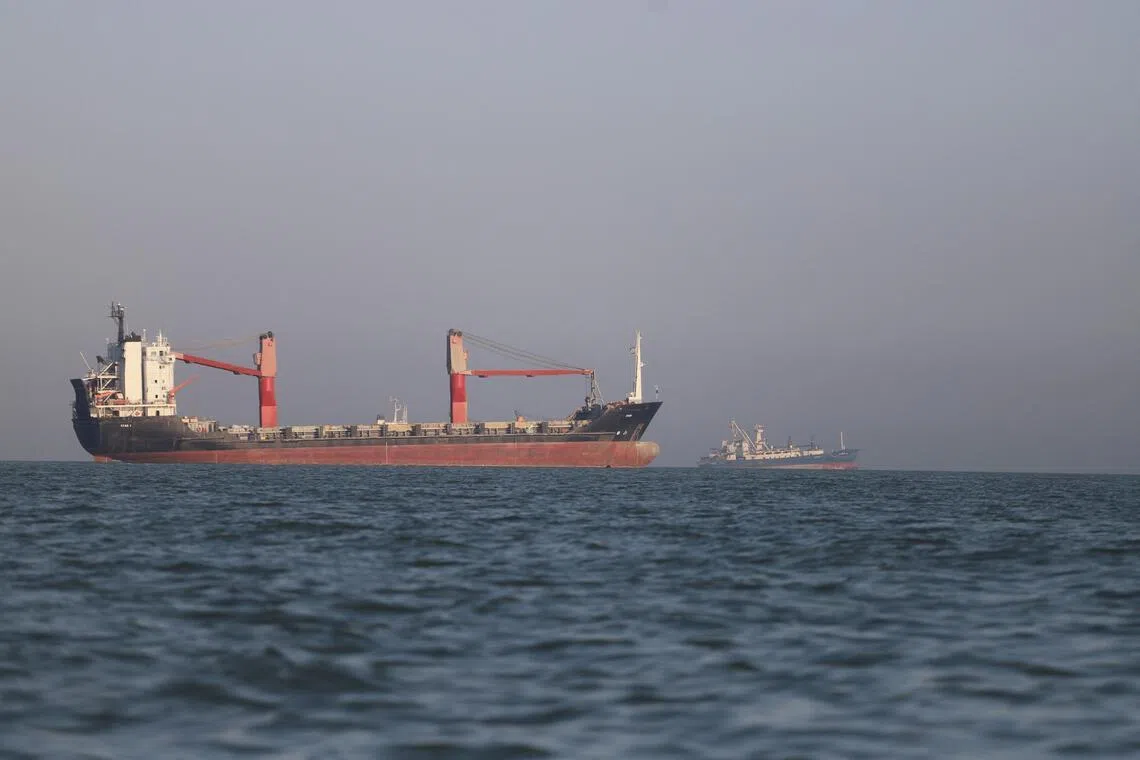
COPENHAGEN, Denmark – Any agreement allowing Iran to charge fees in the Strait of Hormuz would set a “dangerous precedent” for global trade, Vincent Clerc, the chief executive of shipping giant Maersk, said in an interview this week.
Iran has threatened to monetise its continuing control of the strait, the door to the Persian Gulf. Now with the United States and Iran moving toward an agreement to restore transit in the gulf, whether Iran can charge for passage remains an outstanding issue. President Donald Trump has said that ships cannot be subject to any tolls, in accordance with international law. Iran has said it will impose fees, something that it did not do before the war.
The preliminary deal, expected to be signed by both sides on June 19 in Switzerland, would start a 60-day ceasefire while negotiators hash out what to do about Iran’s stockpile of highly enriched uranium, its proxy war with Israel and other issues.
A senior US official disclosed the text of the agreement on June 17. It says, in part, that Iran would offer “safe passage” of ships in and out of the gulf “free of charge” for 60 days. Further, it said that Iran would talk to Oman and other states in the region “to define the future administration and maritime services” in the strait.
Clerc said any provision that allowed Iran to charge for passage would “create, in my book, a very dangerous precedent.”
“If any geographical point can be suddenly weaponised and leveraged for money, and then closed again at the whim of a certain government or authorities, of course, that’s for us – it’s a concerning development,” he said. “You have to wonder then what’s next.”
Iran’s threats have shifted how companies and countries view the world’s vital maritime points. There is no cheaper way to move goods than by sea. But, Clerk said, “if people start to weaponise certain routes, it’s going to quickly erode this.”
Maersk, the second-largest shipping container company by capacity, has sailed ships through every major maritime trade chokepoint across the globe. Founded in 1904, the company operates more than 700 owned or chartered vessels and brought in US$54 billion in revenue in 2025. Its ships carry goods from Asia to Northern Europe and the Mediterranean, between Europe and North America, and between China and the Persian Gulf.
Twenty-four vessels went through the Strait of Hormuz on June 16, more than on any day so far this month, according to Windward, a maritime analysis firm. The traffic was a sign that ship operators were feeling more confident after the US and Iran announced a ceasefire deal, the firm said.
Among the ships that exited the strait were at least two Iranian supertankers, which left the perimeter of the US Navy blockade with a combined 3.8 million barrels of Iranian oil, according to TankerTrackers, a maritime data company. They were Iran’s first crude oil exports in two months.
Still, far fewer ships were moving than the 130 ships that went through the strait daily before the war. Major shipping companies said they would wait for more clarity on the agreement before deciding to move their ships.
One of Maersk’s ships, the Alliance Fairfax, got out of the Persian Gulf in May under US protection, but the company has deemed it too risky for the other ships to leave.
Clerc said he would not allow any of Maersk’s five ships to pass through the strait until it was clear what routes they should take to avoid sea mines. He would also need assurances from Iran that it would not attack.
“There’s been a couple of times where it was declared open and was not really open, so we don’t want to find out by having our people in harm’s way that it’s not open,” Clerc said. More than 100 seafarers are on board the five stranded ships. Since the war began, drones hit Maersk terminals in Bahrain and Oman. Two ships were also hit – one by shrapnel and debris, and another in the hull by a drone, he said.
With access to the Persian Gulf cut off, Maersk employed workarounds. It has delivered 44,000 containers of goods such as furniture, electronics and food to Gulf countries by rail and truck. Cargo is unloaded from ships at the Red Sea port of Jeddah, from where it is driven across Saudi Arabia to Kuwait, Qatar and Bahrain. Truckers have come for the work from Jordan, Iraq and Turkey to meet high demand. Other products are unloaded in Salalah, Oman, and driven to the United Arab Emirates.
But the land routes cost Maersk about US$1,000 extra per container. Over time, this will lead to an erosion of profits for retailers and higher costs for consumers, Clerc said. NYTIMES
-
This article originally appeared in The New York Times.

