


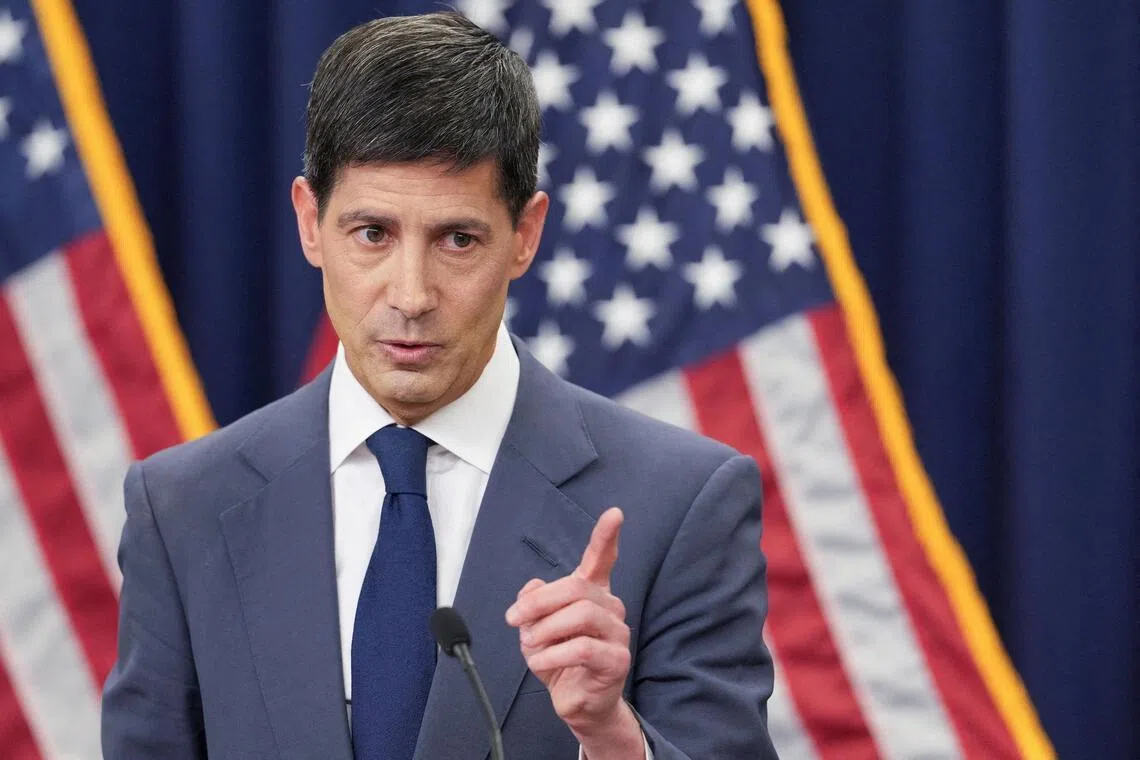
WASHINGTON – Federal Reserve chairman Kevin Warsh opened a new era of US monetary policy on June 17, with officials agreeing to leave interest rates unchanged despite inflation stuck well above their target but also launching an ambitious review that could reshape how the central bank makes decisions and communicates with the public.
Warsh, who took over as Fed chief from Jerome Powell in May, made an immediate imprint in organising a unanimous consensus around a stripped-down policy statement that jettisoned any forward guidance on what actions the central bank might take in the near term, although new quarterly projections, eschewed by Warsh himself, showed nine of 19 policymakers now anticipate a rate hike by the end of 2026.
Indeed, the shortened document issued by the policy-setting Federal Open Market Committee heralded a return to a format similar to that used by former Fed chairman Alan Greenspan and clearly reflected Warsh’s disdain for expansive communication about what’s to come, and desire to let financial markets act with less input from the central bank.
Forward guidance, Warsh said at his debut press conference, is not “well suited” to the current economic moment.
“I can’t give you any forward guidance about what we’re going to do next,” he said. “The good news is we’ll be meeting in six weeks,” a refrain that may become his calling card when asked about the future.
The statement’s description of the economy also showed Warsh’s influence, touching on issues he has emphasized in the run-up to his nomination by President Donald Trump. “Productivity growth and capital investment are strong,” the statement said, and while acknowledging inflation was “elevated relative to the Fed’s 2 per cent goal,” it attributed that in part to “supply shocks that have driven price increases in certain sectors, including energy.”
In the midst of a hawkish policy turn, the language highlighted forces that Warsh has argued could allow rates to fall over time, if productivity lets companies provide goods and services more efficiently, and the easing of energy costs helps lower inflation.
The statement marks a turning point not just in leadership at the central bank but in a monetary policy outlook that since the fall of 2024 had been geared to lower borrowing costs from the elevated rates used to help tame inflation that hit 40-year highs during the Covid-19 pandemic. Fed observers took immediate note of the shift.
“The changes to the policy statement were profound,” Thomas Simons, chief US economist at Jefferies, wrote in a note. “The word count dropped substantially and the modest amount of forward guidance present showed two-way risks to the next move for policy. Policy statements became much wordier after the GFC (Global Financial Crisis), so this is a return to a more Greenspan-era style of post-meeting communications.”
Warsh had promised to shake things up at the Fed, and his first steps in doing so came through the announced formation of five task forces. They will review communication, the Fed’s balance sheet, the data sources on which it relies, productivity and jobs, the impact of artificial intelligence and other transformative technologies, and the central bank’s inflation approach.
Investors will have to learn to make do with less Fed “signaling,” a healthy change, argued Rick Rieder, chief investment officer of global fixed income at BlackRock, if it comes alongside improved data collection and analytics, areas that are among the focus of the five task forces.
But, as Warsh himself said, change can be risky, and his first press conference and policy announcement was met with a sell-off on stock markets and a sharp jump in short-term bond yields.
The decision to leave rates unchanged – and the outlook for a possible rate hike from nearly half of the Fed policymakers – means there is very little prospect for Warsh to be able to deliver the rate cuts that Trump has said he expects. Investors now think the Fed might raise rates as soon as September.
“It is fair to conclude that President Trump got duped,” said Neil Dutta, head of economics at Renaissance Macro Research, wrote in a note.
Trump, critical of Powell for not sharply cutting rates, withheld judgment on the new Fed leader and said he would be “guided by what (Warsh) wants.”
There may eventually be easier monetary policy under Warsh, but it will come nowhere near as fast or be as loose as Trump demanded from the Powell-led Fed.
New projections show inflation slowing sharply next year, allowing rates to end 2027 where they are now, and easing modestly further in 2028.
“The Committee will deliver price stability,” the policy statement said, a commitment that Warsh reaffirmed at his press conference meant meeting the current 2 per cent target.
But he cautioned against reading too much into rate projections that may themselves have a limited future.
Projections among Fed officials showed the policy interest rate, which has been set in the 3.50-3.75 per cent range since last December, would rise slightly by the end of t2026.
The outlook for inflation for the end of 2026 was marked up to 3.6 per cent from 2.7 per cent, before it was seen falling to 2.3% next year – consistent with the statement language attributing high prices to supply disruptions that would typically be expected to pass.
Economic growth was marked down slightly, with the unemployment rate expected to end the year at 4.3 per cent, compared to 4.4 per cent in the Fed’s March projections. REUTERS

