



Japanese companies agreed to raise wages by an average 5.26% in this year’s annual labor negotiations, marking a third straight year of pay increases above 5%, according to preliminary data released by the Japanese Trade Union Confederation, known as Rengo.
The result follows average wage hikes of 5.10% in 2025 and 5.28% in 2024, levels not seen in Japan for decades as companies face persistent labor shortages and higher living costs.
Major manufacturers, technology firms and automakers were among employers agreeing to substantial pay increases during the annual shunto wage negotiations. Several large companies, including Toyota Motor Corporation and Hitachi Ltd., accepted union demands in full or largely met workers’ requests.
Wage growth has become a key focus for Japanese policymakers seeking to support household spending and sustain inflation around the Bank of Japan’s 2% target. Rising pay has been viewed as an important condition for maintaining domestic demand as the economy adjusts to higher prices.
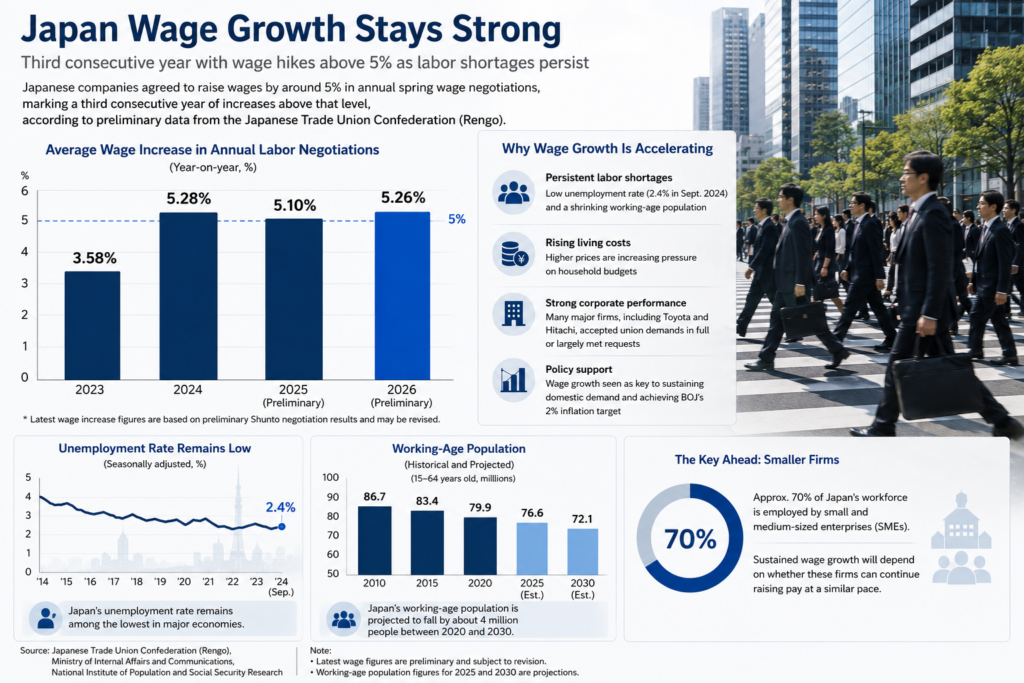
Japan’s unemployment rate remains low by international standards, while demographic pressures continue to shrink the country’s working-age population. Many employers have reported increasing difficulty recruiting and retaining workers, particularly in manufacturing, construction and service industries.
Economists say the durability of the wage-growth cycle will depend in part on smaller firms, which employ roughly 70% of Japan’s workforce and often face tighter profit margins than large corporations. Whether those businesses can continue raising pay at a similar pace is expected to be a key issue for the economy in the coming years.
SOPHIA KIM
US ASIA JOURNAL

