


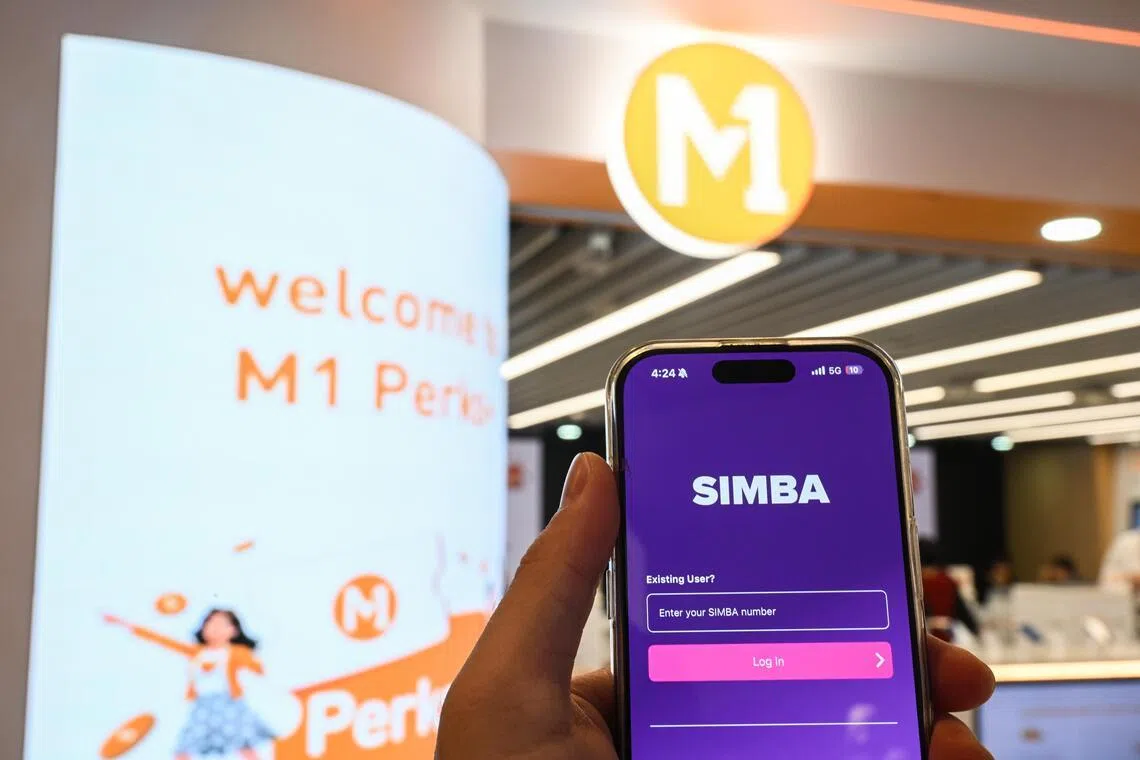
SINGAPORE – The proposed acquisition of telecommunications business M1 by fellow telco Simba collapsed this week, after regulators suspended their review of Simba’s $1.43 billion bid amid a probe into an alleged breach.
Tuas Limited, the Australian-listed owner of Singapore telecommunication operator Simba, said on May 22 it has terminated its sale and purchase agreement to buy M1 from Keppel.
Had it gone through, the deal would have marked the first telco consolidation in Singapore’s history and potentially eased intense competition among the country’s four telcos, which has eroded prices and weighed on profitability.
Following the collapse of the sale, Keppel pushed back plans to divest M1 by one to two years and launched a 90-day turnaround plan focused on aggressive cost cuts and automation to improve the telco’s performance.
Shares of Keppel climbed 5.11 per cent through the week to close at $10.91 on May 22.
Shares of another local telco, Singtel, fell 4.97 per cent over the week to close at $4.59 on May 22.
This comes after the group posted a net profit of $2.2 billion for the second half ended March 31, down 20.9 per cent from $2.8 billion a year earlier, missing analysts’ estimates. This came on the back of a 2.7 per cent year-on-year increase in revenue for the period, to around $7.3 billion.
Although Singtel’s enterprise business has seen resilient growth and accounted for over 50 per cent of the telco’s domestic revenue, its local consumer business has weakened amid an aggressive price war among the four telco operators in an extremely saturated market.
Singtel said on May 21 that it is seeking to understand whether regulators would allow it to take part in any merger or acquisition involving the other telcos in Singapore.
At a media briefing to announce Singtel’s results, chief executive Yuen Kuan Moon told The Straits Times that the telco would be keen to “participate in market consolidation” if it gets the green light from the Infocomm Media Development Authority (IMDA).
Mr Yuen said it would not be sustainable for Singapore to have four telco operators, which is more than that in larger markets like Thailand, Indonesia and India that have already undergone consolidation.
He said Singapore would benefit from the consolidation of its telco market.
Mr Yuen’s comments signalled an openness to future industry consolidation involving Singapore’s four mobile operators – Singtel, StarHub, M1 and Simba – although he did not elaborate on any target.
Mr Kwek Leng Peck, cousin of City Developments Limited chairman Kwek Leng Beng and uncle of CDL chief executive Sherman Kwek, has been appointed vice-chairman of the company with effect from June 1.
In exchange filings on May 18, CDL announced that its board had also reappointed the 69-year-old as a non-independent, non-executive director.
Mr Kwek Leng Peck had served as a non-independent, non-executive director of CDL from 1987 to October 2020, when he resigned from the board after a disagreement with his nephew Sherman Kwek over CDL’s investment in Sincere Property Group.
The Chinese property developer eventually collapsed, forcing CDL to write down its $1.78 billion investment in Sincere in 2021, and book a loss of $1.9 billion for the year.
CDL later sold its stake in Sincere for a token sum of $1.
In its business update for the first quarter of 2026 released on May 18, the developer posted weaker Singapore property sales with 242 units worth a total of $609.6 million sold. This was down from 795 units worth $1.9 billion in the first quarter of 2025.
The latest quarter’s sales were driven mainly by the January launch of the 246-unit freehold Newport Residences. The developer noted that the comparable quarter last year had benefited from the launch of the larger 777-unit The Orie.
Newport Residences achieved an average selling price of about $3,200 per square foot, with 192 units, or 78 per cent of the project, sold to date.
Shares of CDL rose 3.94 per cent through the week to close at $8.17 on May 22.
Bread manufacturer Gardenia Foods will retrench 141 employees at its manufacturing facility in Pandan Loop after announcing on May 20 that it is shifting its bakery production to Johor Bahru as part of efforts to “enhance operational efficiency and maintain competitiveness amid an increasingly challenging global environment”.
Production at the manufacturing facility will cease on June 30. Singapore will remain Gardenia’s central hub for key corporate functions with about 250 employees.
Gardenia in Singapore is fully-owned and operated by mainboard-listed QAF, which announced a 15 per cent year-on-year rise in its 2025 net profit to $40.3 million.
Gardenia’s move comes after Tiger Beer maker Asia Pacific Breweries Singapore said in March that it would scale down its brewing operations in Tuas and move them to Malaysia and Vietnam. The move would affect 130 employees over the next two years.
Also in March, beverage brand Yeo Hiap Seng laid off 25 employees at its Senoko facility after announcing plans to shift its can manufacturing operations to Malaysia.
Several other companies conducted layoffs last week, citing AI-related restructuring and efficiency efforts.
Standard Chartered disclosed that it plans to eliminate close to 8,000 support roles over the next four years as it ramps up its use of artificial intelligence (AI) to streamline operations.
Its chief executive Bill Winters also drew flak for his remarks about using artificial AI to replace “lower-value human capital”.
The Asia-focused lender did not confirm if staff in Singapore will be affected by the job cuts, but said it remains committed to supporting business growth in Singapore and Asean.
Fellow lender HSBC also came under the spotlight last week, after its chief executive Georges Elhedery said that AI would “destroy certain jobs and create certain jobs”.
In an interview with The Business Times, DBS Bank chief executive Tan Su Shan said that even as concerns grow that AI could lead to jobless growth, the lender remains committed to supporting younger workers.
DBS announced on May 19 that it plans to hire 500 young local talents this year through its management associate, internship and traineeship programmes.
Meanwhile, Meta’s latest wave of layoffs hit Singapore in the early hours of May 20, with affected employees notified via e-mails at 4am as the tech giant’s push into artificial intelligence triggered a sweeping restructuring.
The company did not respond to ST’s queries on the number of employees affected here, but ST understands from former employees that more than 100 jobs were cut.
GIC-backed flexible workspace operator JustCo made its debut on the SGX on May 22.
The counter opened at 83.5 cents, 11.2 per cent below its IPO price of 94 cents, with around one million shares traded. It later closed at 77.5 cents, down 17.6 per cent from its IPO price, with 10.9 million shares changing hands.
Justco is SGX’s fifth listing this year and second mainboard debut.
Meanwhile, luxury watch retailer the Hour Glass posted a net profit of $103.8 million for its second half ended March 31, up 39 per cent from $74.4 million a year earlier, supported by stronger sales.
Revenue for the six-month period rose 16 per cent to $722.8 million, from $622.6 million in the corresponding period a year ago, the company said in a bourse filing on May 22.
Shares of Hour Glass edged up 2.5 per cent through the week to close at $2.46 on May 22.
Frencken fell by as much as 15.5 per cent to $2.57 shortly after the market open on May 19. The company reported a net profit of $8 million for the first quarter of 2026, down 20.2 per cent from the year-ago period. Revenue fell 6.4 per cent to $202 million over the same period.
This was mainly due to lower revenue contributions from the semiconductor and analytical life sciences segments of Mechatronics Europe, the company said.
The shares pared losses to end the week at $2.96.
Singapore’s final first-quarter 2026 gross domestic product data will be released on May 25, with economists polled by Bloomberg forecasting growth of 5.2 per cent year on year.
The Republic’s consumer price index data for April will also be released on the same day, with economists polled by Bloomberg forecasting headline inflation at 2.0 per cent year on year, up from 1.8 per cent in March.
Core inflation is expected to come in at between 1.6 per cent and 1.7 per cent year on year, compared with 1.7 per cent in March.

