


RIAU ISLANDS – Indonesian economic agency BP Batam is behind an Instagram page targeted at investors looking to operate on the island.
Among its posts are special appeals to Chinese businesses – which have emerged as a growing and powerful source of capital.
A reel titled “Batam really welcome to Chinese investor” focuses on the appointment of an investment ambassador for the Chinese market. Addressing viewers in Mandarin, she expresses confidence that an engagement with Batam will result in great success.
The page also spotlights data centre investments by businesses that are headquartered in China.
“The pipeline of serious Chinese investor interest in Batam is growing,” the directorate of investment of BP Batam told The Straits Times.
“Our engagement with the Chinese market has become noticeably more structured. Our visibility within relevant industry circles has improved, and we are having more substantive and advanced conversations with Chinese enterprises than we were 12 months ago,” it added.
The agency said it has seen a pick up in enquiries from firms “with serious industrial footprints” in the advanced manufacturing, precision electronics, maritime fabrication and green industries.
Chinese investment in Batam has soared from under US$1 million (S$1.3 million) in 2013, when Chinese President Xi Jinping’s Belt and Road Initiative spurring the internationalisation of its companies was proposed.
Investment from the mainland posted a nearly fifteen-fold surge from US$17.3 million in 2022 to US$253 million in 2024, according to official figures, before easing to US$74.6 million in 2025.
This comes as businesses face rising costs and weakening consumer demand at home, compressing their profit margins, said Mr Aniello Iannone, an Indonesian and South-east Asian politics lecturer at Diponegoro University.
He also pointed to concerns about potentially higher US tariffs on products which originate from China.
Mr Iannone said: “Within this conjuncture, Batam acquires a very particular function. The trajectory of Chinese investment is not gradual diversification. It is a structural repositioning of productive capital under geopolitical stress.
“What I find analytically more significant than the volumes is the sectoral composition. Solar panels, e-bike batteries, data centres, aluminum smelting, advanced manufacturing – these are the sectors at the very centre of current geopolitical competition.”
China is Batam’s biggest supplier, providing goods critical for manufacturing, including machinery and electronic components. The US, the world’s single largest consumer market, is Batam’s top export destination.
Within the solar industry, a substantial share of exports leaving Indonesia for the US originates from Batam-based firms ultimately controlled by Chinese executives, Mr Iannone said.
A Bloomberg report in July 2025 found that six such firms were among Indonesia’s 10 largest exporters of solar cells and panels to the US.
Because the equipment was assembled in Indonesia, instead of China, the products were allowed to enter the US market tariff-free.
This changed when the US Commerce Department in April announced preliminary tariffs on solar imports from Indonesia, India and Laos. The three countries accounted for US$4.5 billion of solar imports into the US in 2025, making up around two-thirds of the total.
The move adds to earlier US tariffs on solar imports from Cambodia, Thailand, Malaysia and Vietnam, in efforts to limit the alleged dumping of unfairly cheap products in the US.
Ms Helena Ma, who advises Chinese family offices on investments, said Batam’s Tembesi Innovation District, developed by a subsidiary of Singapore’s Sembcorp Industries and Batam-based real estate firm Panbil Group, has particularly drawn interest.
She told ST the industrial park provides “good infrastructure and renewable energy for Chinese manufacturing-related activities – a natural extension of China’s supply chain”.
Singapore remains Batam’s top foreign investor, a position it has held since the 1990s, followed by Taiwan and China.
Investors from the Republic put 16.6 trillion rupiah (S$1.2 billion) into Batam in 2025, which was more than 10 times that of Taiwan-based investors.
But there is a recognition among Batam officials that a number of Singapore-based investors have links to the mainland, according to industry sources in Indonesia.
Take DayOne Data Centers, which is behind the development of infrastructure at the Nongsa Digital Park and Kabil Industrial Tech Park.
The Singapore-headquartered firm was formerly the international arm of Chinese data centre giant GDS, until it was deconsolidated as a subsidiary in January 2025. The Chinese firm still holds a 35.6 per cent non-controlling stake in DayOne.
A spokesperson for the Nongsa Digital Park said: “While Singapore remains a key partner, given the strong bilateral relationship and proximity, the investment base today is becoming more diverse with increasing interest from other regional players.”
On a recent trip for businesses to Batam and Bintan, organised by the Singapore Manufacturing Federation and commercial real estate developer Gallant Venture, China was given plenty of air time.
Mr Jeremy Chen, senior manager at Gallant Venture, which owns and manages the Batamindo Industrial Park and Bintan Industrial Estate, said interest from firms looking to diversify their operations from China has been growing for several years.
“We have attracted a lot of companies, especially because of the China-plus-one strategy that has been going on since 2018 when the US trade warfare started,” he said.
Over in Bintan, participants were taken to a factory which processes coconuts for China’s Luckin Coffee.
Mr Chen hinted at more collaboration with China in the days ahead. “There’s a lot of trade between Indonesia and China.
“Companies from China want to invest in selected industrial parks. We have earmarked close to 2,000 hectares of land (in the Bintan Industrial Estate) consisting of resource infrastructure and power plants for Chinese investors,” he said.
Participants on the trip also spoke of stronger Chinese interest. One attendee said he was regularly making arrangements to take Chinese business executives to Batam and Johor, which has also seen rising investment in data centres.
Another attendee was scouting out the terrain for Shenzhen-based firms interested to expand beyond China.
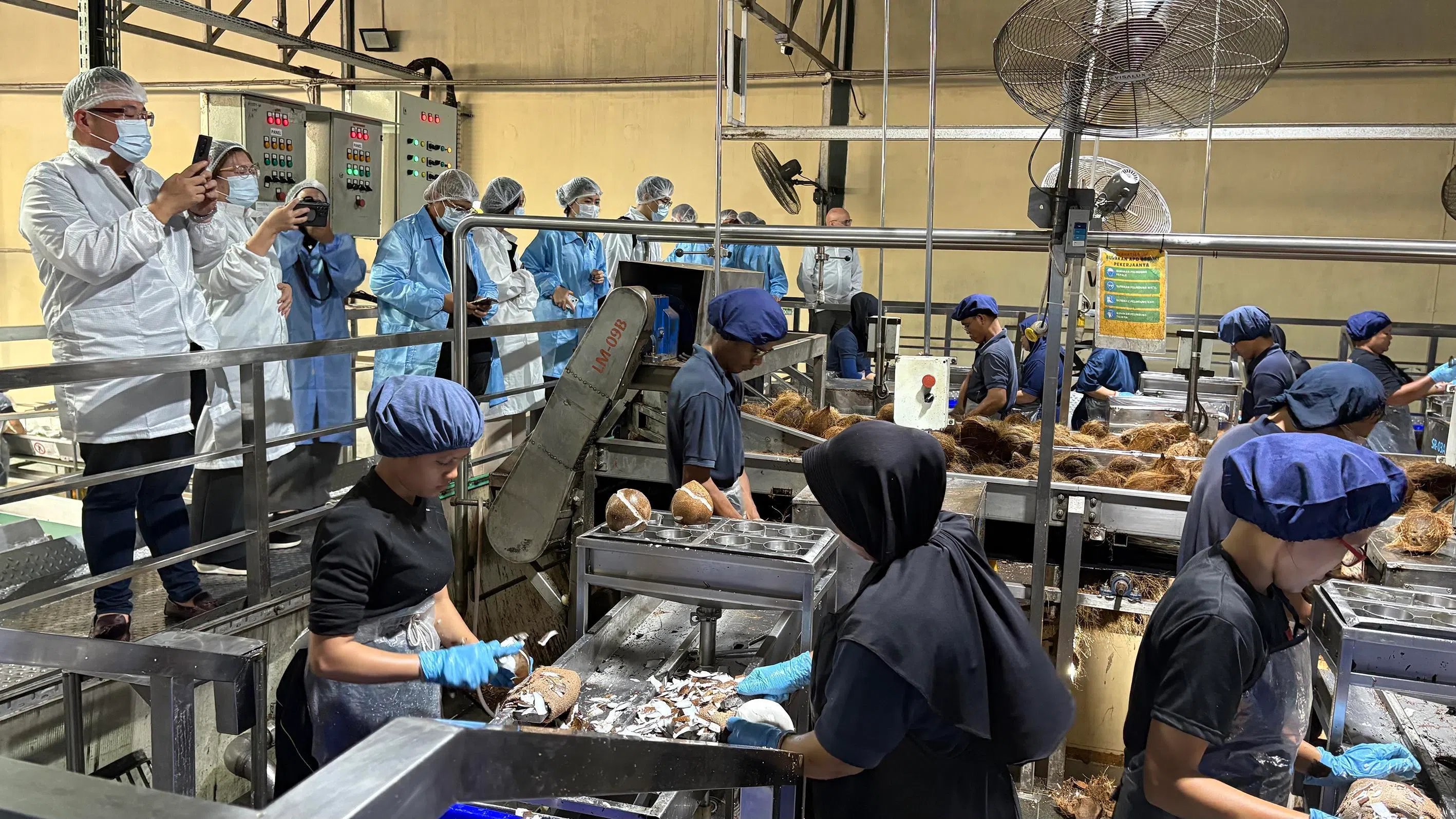
Participants of a Singapore Manufacturing Federation and Gallant Venture business trip on April 9 were taken to a factory in Bintan which processes coconuts for China’s Luckin Coffee.
ST PHOTO: ANNABELLE LIANG
The interest has translated into investment. In the first quarter of 2026, Batam recorded a total investment realisation, where deals move beyond paper value, of 17.4 trillion rupiah (S$1.3 billion). This was more than double of what it saw a year earlier.
The Batam, Bintan and Karimun (BBK) region has also seen increasing interest from Singapore companies adopting a “twinned operations” model, by pairing domestic activities with lower-cost bases in Indonesia.
Supporting this is the Integrated Sourcing Initiative in the US-Singapore free trade agreement, which has been in force since 2004. It allows electronics and medical device components procured from the BBK region to be included in Singapore’s customs area for shipment to the US.
Batam, as well as parts of Bintan and Karimun, have also been designated as free trade zones, allowing duty-free imports and exports.
Mr Jeff Seah, executive director at e-waste recycling and IT asset disposal firm Redux, said he sees the presence of semiconductor manufacturers, data centres and solar farms as a “pull factor” for expanding from Singapore into the BBK region.
“Someone needs to close the loop for them when technologies reach their end of life,” he said.
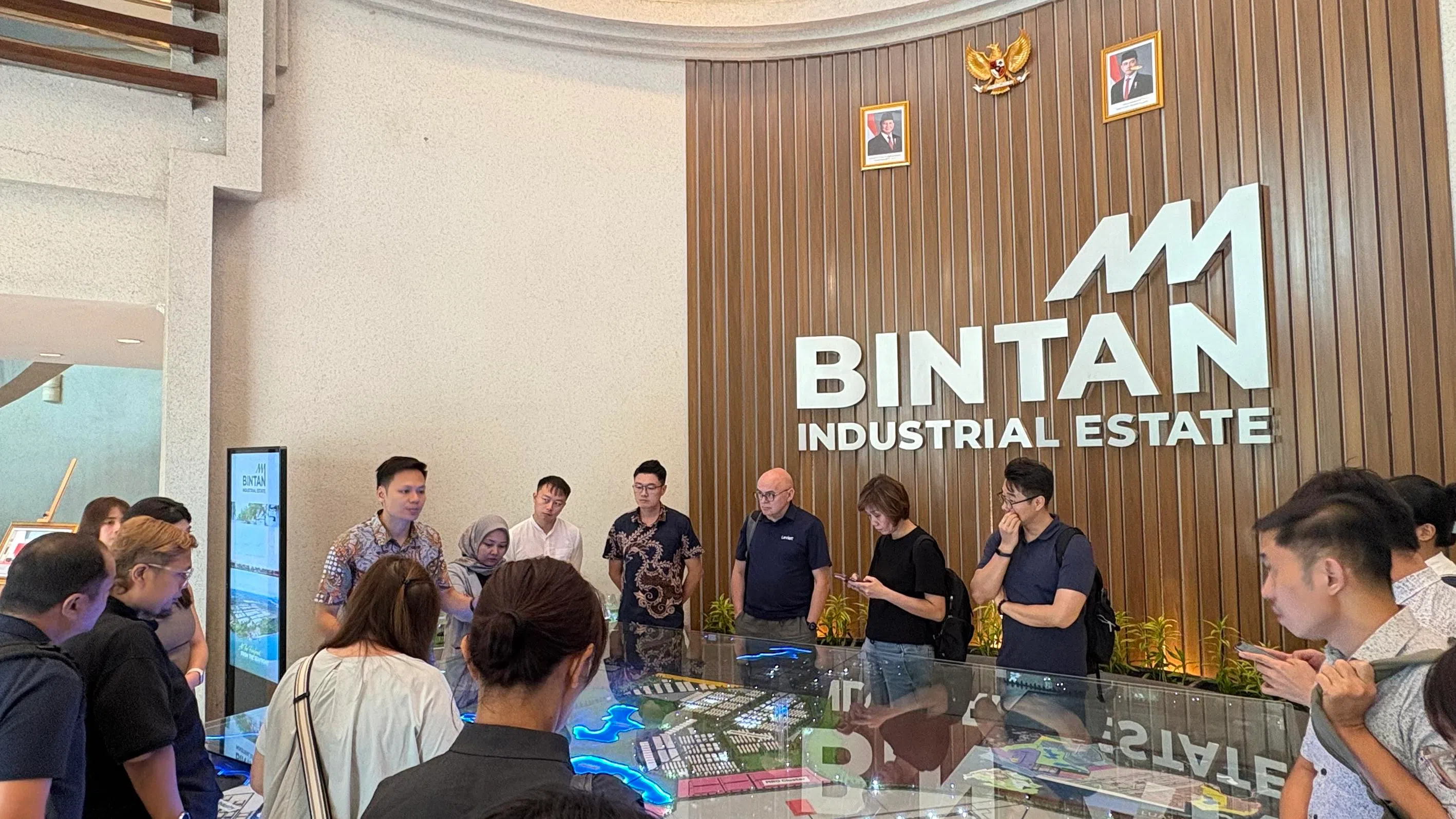
Participants of a Singapore Manufacturing Federation trip getting an overview of the Bintan Industrial Estate in Indonesia on April 9.
ST PHOTO: ANNABELLE LIANG
BP Batam said the increasing cost and complexity of doing business has pushed many multinational companies (MNCs) to rethink their footprint.
It said firms were seeking “complementary locations that offer cost efficiency without sacrificing connectivity or regulatory quality”.
Economist Intelligence Unit analyst Tay Qi Hang noted that the Indonesian government has been deliberate about positioning the country as non-aligned, that is seen as “an asset for MNCs trying to diversify away from China without explicitly picking sides”.
He said: “The caveat is if Washington extends tariff pressure to goods routed through Indonesia. Some of the Chinese manufacturing foreign direct investment could prove transient.”
BP Batam said it has made efforts to connect with more Chinese businesses by participating in industry events, engaging enterprise associations, and working with Indonesian diplomatic missions in China.
It also provides potential investors with information on matters like incentive structures and licensing pathways.
Ms Ma said: “From the Chinese point of view, Batam is a nexus that links Singapore with Indonesia.
“Indonesia traditionally has always been popular with Chinese outbound investment for low costs on land and labour, a growing consumer market, and robust growing young populations.”

