


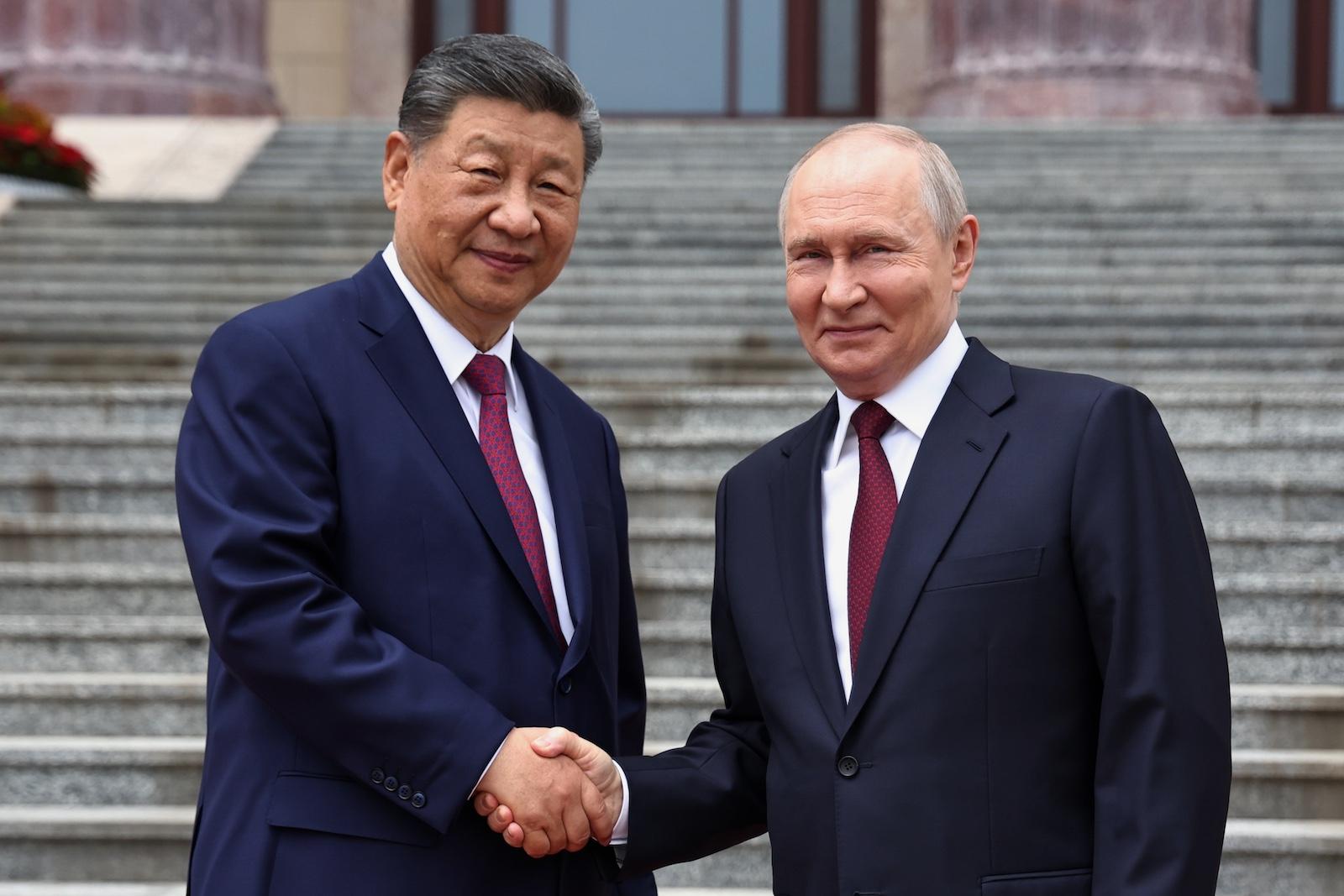
Chinese President Xi Jinping and his Russian counterpart Vladimir Putin on Wednesday criticized Japan for what they view as its “current course toward accelerated remilitarization,” saying it poses “a serious threat” to regional peace and stability.
The two leaders also said in a joint statement after their talks that they are wary of “extreme provocations” by Japan’s right-wing forces, including pushing for revisions to the country’s three non-nuclear principles that prohibit Tokyo from possessing, producing or permitting the introduction of nuclear weapons.
The document on strengthening bilateral comprehensive strategic coordination was signed by Xi and Putin following their summit in Beijing. Their warning against Japan came as Sino-Japanese ties have been strained over Prime Minister Sanae Takaichi’s remarks last November on a Taiwan contingency.
Beijing has been voicing its stance through various channels, including diplomacy and media, that Takaichi’s remarks “openly challenge the postwar international order.”
The comments by Takaichi, a security hawk, were interpreted as suggesting Japan could deploy its defense forces to support the United States if Taiwan came under attack by mainland China, which claims the self-ruled island as part of its territory.
While meeting the press together with Putin on Wednesday, Xi said China and Russia must “oppose all provocative acts that deny the outcomes of the victory of World War II and attempt to justify and revive fascism and militarism.”
During the meeting at the Great Hall of the People, the two leaders reaffirmed their countries’ unity and agreed to boost energy cooperation amid crude oil price surges triggered by the U.S.-Israeli war against Iran, according to the two governments.
Xi said the situation in the Middle East is “at a critical juncture” and called for ending “all hostilities,” China’s official Xinhua News Agency said. Putin said Russia remains a reliable supplier of resources amid the Middle East crisis, Russia’s Tass news agency said.
The U.S.-Israeli strikes against Iran, which began in late February, have led to the effective closure of the Strait of Hormuz, a key energy chokepoint. Xi was quoted by Xinhua as saying that renewed fighting should be avoided and negotiations should continue in order to ease disruptions to the energy supply.
Xi said China and Russia should “take a strategic and long-term perspective” and “work to make the global governance system more just and equitable,” the Chinese Foreign Ministry said.
In their summit, which came days after a meeting between Xi and U.S. President Donald Trump in Beijing, the Chinese and Russian leaders also agreed to extend the bilateral Treaty of Good-Neighborliness and Friendly Cooperation, which was signed in 2001, the ministry said.
The treaty, originally effective for 20 years and covering security cooperation, among other areas, was previously extended for five years in 2021.
In addition to their joint statement on strengthening coordination, Xi and Putin signed another that advocated for a multipolar world, along with 40 cooperation documents.
In the first joint statement, the two countries also expressed their opposition to threatening the security of North Korea through diplomatic isolation, economic sanctions and military pressure.
They urged relevant parties to stop escalating regional tensions and take concrete measures to eliminate the risk of war on the Korean Peninsula.
Moscow and Pyongyang have been bolstering their military cooperation since Russia launched a full-scale invasion of Ukraine in February 2022. China is North Korea’s longtime economic benefactor.
Putin confirmed his readiness to take part in an Asia-Pacific Economic Cooperation forum summit to be held in the southern Chinese city of Shenzhen in November, Tass quoted a Kremlin spokesman as saying. Russian presidential aide Yury Ushakov also said Putin may meet with Trump during the APEC summit.
The Russian leader invited Xi to visit his country next year, Tass said.
During his 25th visit to China, Putin also met with Premier Li Qiang, who expressed China’s readiness to expand trade and deepen cooperation with Russia in such fields as energy, agriculture and green and low-carbon development, according to Xinhua.
The Russian leader last visited Beijing in September to observe a military parade marking the 80th anniversary of Japan’s surrender in World War II.
China and Russia have been strengthening their ties in recent years, with Beijing opposing Western sanctions on Moscow over its war against Ukraine.
© KYODO

