


Experts say the time has come for Japan and South Korea to adopt a more pragmatic approach to their bilateral relationship, given the common challenges they face, such as the unilateralist tactics of U.S. President Donald Trump and the growing military and economic clout of China.
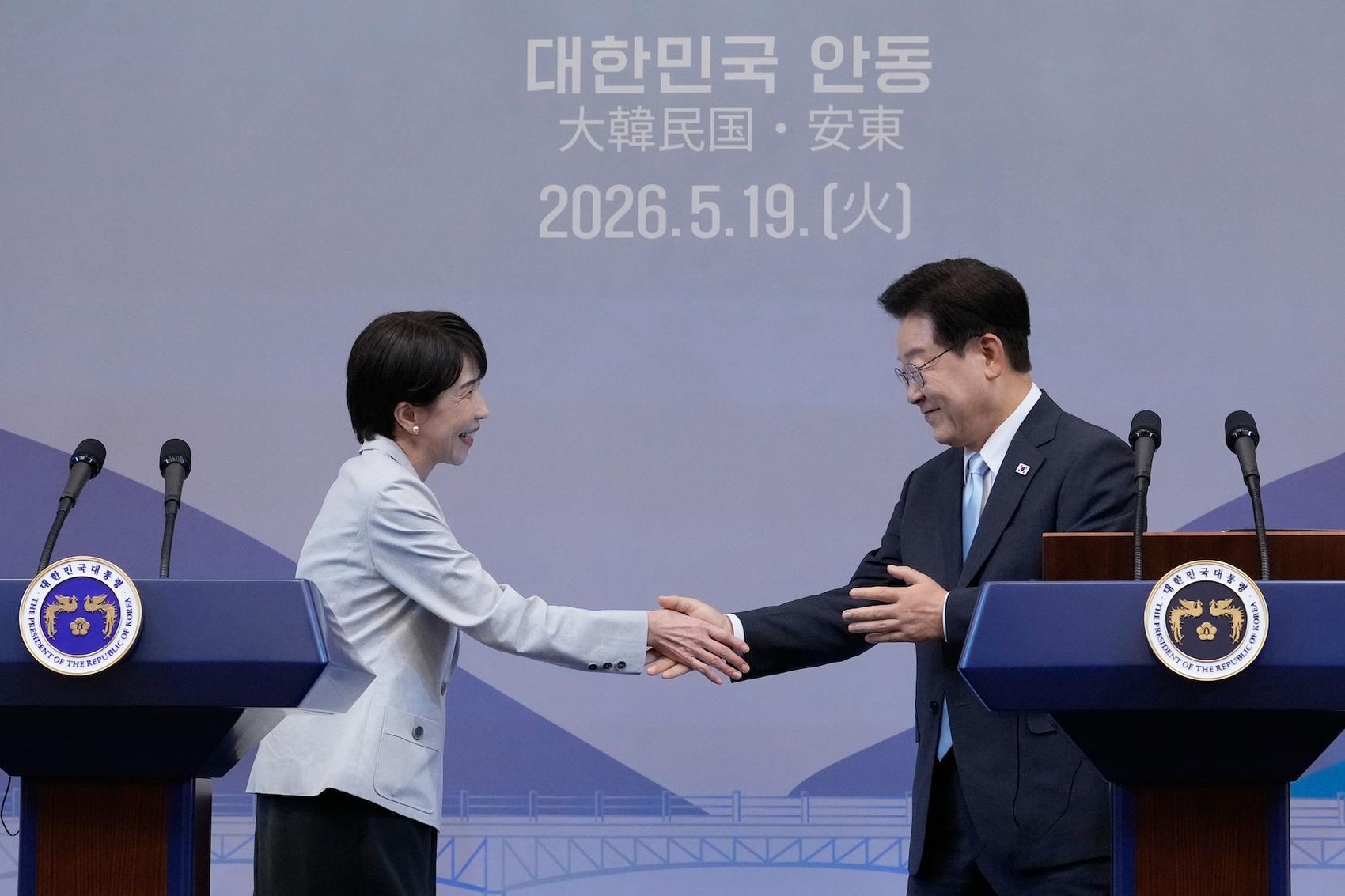
Japanese Prime Minister Sanae Takaichi, a staunch conservative, stressed the unchanged positive trajectory of the bilateral ties during a meeting Tuesday in South Korea with President Lee Jae Myung, previously regarded as a hard-liner toward Japan.
The two countries have spent recent years mending ties, which suffered a sharp downturn, especially over wartime issues and territorial disputes. But experts say that the relationship must now evolve beyond mere gestures of friendship to achieve more tangible results in areas such as trade and defense.
At the summit in Andong, Lee’s hometown, much of the focus centered on economic security cooperation, including efforts to ensure stable energy supplies, amid Middle East tensions following U.S.-Israeli strikes on Iran in February.
At a joint press conference with Lee after the talks, Takaichi said that, given the current global situation, it is important for Japan and South Korea to “take the initiative in strengthening deterrence and response capabilities” of trilateral cooperation with the United States.
Hideki Okuzono, a professor of international relations at the University of Shizuoka, said the remarks reflected Takaichi’s recognition that Tokyo and Seoul must move away from their “overdependence” on Washington.
He said cooperation between Japan and South Korea is being driven by a “fundamental U.S. transformation,” in addition to China’s growingly assertive behavior, North Korea’s nuclear and missile development and Russia’s invasion of Ukraine.
“As its recent military actions targeting the Iranian and Venezuelan leaders showed, the United States has become increasingly willing to ignore principles such as the rule of law,” Okuzono said.
Until a few years ago, relations between Tokyo and Seoul were at one of their lowest points. Disputes over compensation for alleged forced labor during Japan’s colonial rule of the Korean Peninsula from 1910 to 1945, as well as other historical and territorial issues, had strained relations between the two countries.
The feud was particularly serious in the late 2010s under then Prime Minister Shinzo Abe, Takaichi’s political mentor, and then President Moon Jae In, who belonged to the same liberal party as Lee.
The tide began to turn after the conservative Yoon Suk Yeol became president of South Korea in 2022. The following year, Yoon announced a solution to the wartime labor issue, and reciprocal visits between the two countries’ leaders resumed after a decade-long hiatus.
Relations have remained stable after Takaichi and Lee took office in October and June last year, respectively. They have already met in person four times as leaders.
Okuzono said that Takaichi has shown that the momentum to improve relations can continue regardless of who the leaders are, as the bilateral relationship enters a new phase requiring “concrete results.”
He added that Tokyo is placing greater importance on its relations with Seoul amid the lack of prospects for improving its relations with China. Tensions with China have been mounting since Takaichi’s parliamentary remarks last November suggested that a Taiwan contingency could prompt a response by its defense forces.
China’s pressure campaign in response included tightening its restrictions on exports to Japan of dual-use items, which can be used for both civilian and military purposes, possibly including rare earths that are essential for high-tech industries.
Tomoyoshi Nakajima, a professor at the University of Niigata Prefecture’s Economic and Social Research Institute for Northeast Asia, cited Trump’s return to the White House last year, as well as his relations with China, as factors that have brought Tokyo and Seoul closer together.
According to Nakajima, Japan and South Korea are particularly concerned that the multilateral export controls on advanced semiconductors to China, which were strengthened under former U.S. President Joe Biden, could be reversed by Trump.
Nakajima described the matter as a potentially serious security threat and said that Tokyo and Seoul, as U.S. allies, could cooperate in urging Washington to prevent China from obtaining cutting-edge semiconductors and related technologies.
Experts point to the Comprehensive and Progressive Agreement for Trans-Pacific Partnership and an acquisition and cross-servicing agreement, or ACSA, as areas where Japan and South Korea could achieve the most tangible progress going forward.
The 12-member CPTPP is a Japan-led free trade pact that came into force in 2018 after the U.S. withdrawal the previous year during Trump’s first presidential term. South Korea has been considering applying for membership.
An ACSA deal simplifies the process of sharing food, fuel and ammunition between forces of two nations, a key step for deeper defense cooperation.
Meanwhile, Okuzono, who is well-versed in South Korean politics and diplomacy, predicts that both issues will likely face psychological resistance among many South Koreans and take time to resolve.
He said that South Korea’s potential accession to the CPTPP would likely require lifting its ban on seafood imports from eight Japanese prefectures, which was imposed after the 2011 Fukushima Daiichi nuclear power plant disaster.
“Food safety remains a highly sensitive issue in South Korea and public concern is extremely high,” and therefore easing the restriction would not be easy, he said.
Okuzono also said that South Koreans remain wary of deepening defense cooperation with Japan, their former colonial ruler, adding that Tokyo would need to “carefully explain” the necessity of such cooperation.
© KYODO

