


SINGAPORE – Undergraduates interested in the finance sector can apply to join a new programme aimed at preparing young talent for an AI-enabled financial sector, as Singapore steps up efforts to future-proof the workforce.
The Young Talent Programme for AI in Finance (YTP-AIF) was launched by the Institute of Banking and Finance (IBF), with support from the Monetary Authority of Singapore, at the Financial Industry Fiesta 2026 on May 19.
Deputy Prime Minister Gan Kim Yong, guest of honor for the fiesta, said that access to internships or work-study programmes “should not depend only on students’ ability to source opportunities on their own, or on whether they can afford to delay graduation for a longer attachment”.
“We, therefore, want to explore more structured pathways that integrate industry exposure into formal studies,” added DPM Gan, who also serves as Minister for Trade and Industry and chairman of MAS.
The programme was designed to equip students with both applied AI and financial sector skills that are in demand. It will be supported by Amazon Web Services (AWS), which will provide the computing resources on its AWS Academy platform, and Bloomberg, which co-developed the masterclass curriculum. Bloomberg will also offer students access to its data science and analytics platform.
Commencing in August 2026, the pilot run of the programme will open 100 spots for interested Year 2 to Year 4 undergraduates across the six autonomous universities.
Undergraduates from Singapore Management University and Nanyang Technological University can earn academic credits from completing the programme and are not required to pay course fees.
Students from National University of Singapore, Singapore Institute of Technology, Singapore University of Social Sciences, and Singapore University of Technology and Design may also sign up. However, they will not receive academic credits and fees may apply.
IBF hopes to step up its partnership with these universities in the future.
The YTP-AIF will be carried out in four phases, with the first three stages occurring during universities’ term time.
The first phase of the programme begins with masterclasses taught by SMU and NTU to help participants get an understanding of AI and its applications within the financial sector.
Under the guidance of industry experts, participants will move on to programme’s second phase, where they will use AI and mock datasets to tackle real-world issues.
In the programme’s third phase, participants will present their solutions to 20 participating financial institutions, including local banks DBS, OCBC and UOB, global lenders JPMorgan Chase and Goldman Sachs, and insurance companies such as Prudential.
Participants are expected to commit to the three-month programme during term time.
For the programme’s final phase, selected participants will be offered internship, traineeship or full-time opportunities during the respective financial institution’s hiring cycles.
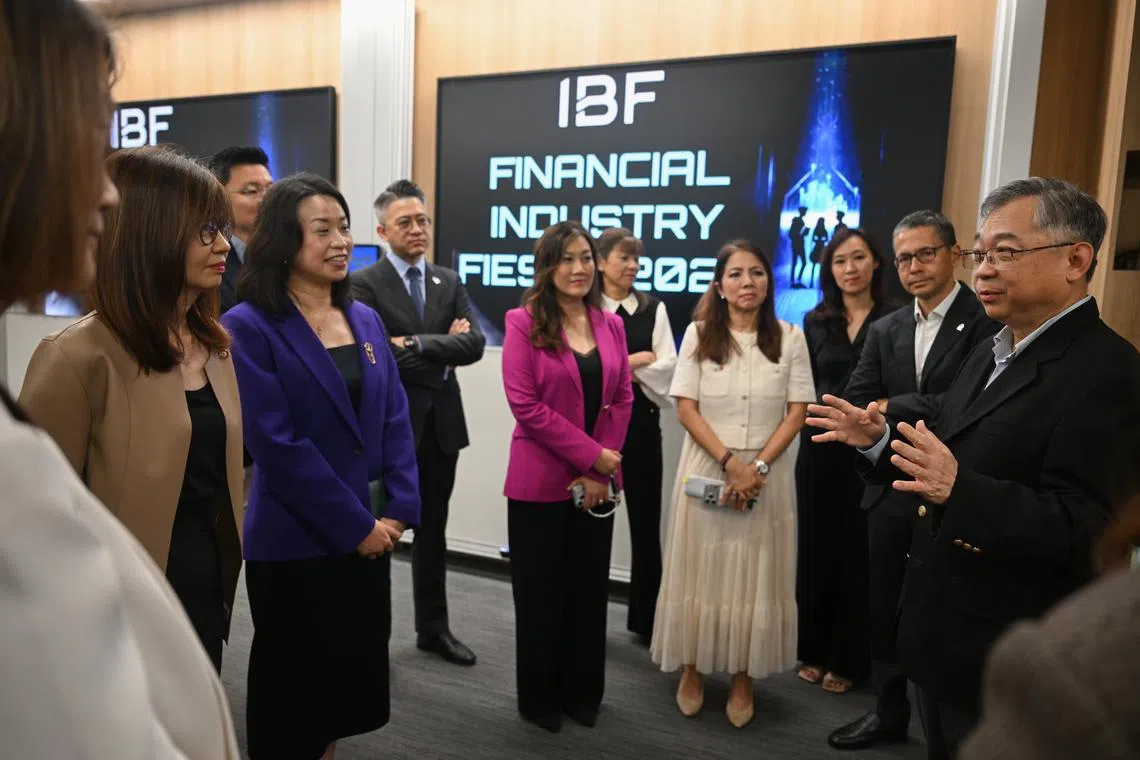
Deputy Prime Minister Gan Kim Yong at the Financial Industry Fiesta 2026 at SMU on May 19.
ST PHOTO: SHINTARO TAY
Some attendees at the Financial Industry Fiesta who spoke to ST seem excited for this opportunity.
Mr John Sim, a Year 3 banking and finance student from NTU said that internship hunts have been increasingly competitive because of the reduction in opportunities offered by employers, but is hopeful this programme would help.
“So many things are changing (with AI) and a lot of us cannot keep up with them. I believe these programmes are really good in helping us match our qualifications with the employer’s needs, and hopefully the job search will be a lot better for us,” the 23-year-old said.
Mr Sang Rui Hong, a quantitative finance undergraduate from NUS, expressed similar thoughts. He said: “Integrating AI into the finance sector is very relevant in today’s times. And with the training, it exposes us to some of the relevant skills needed for jobs in the future.”
Speaking at the fiesta, IBF chief executive officer Carolyn Neo said that the institute has “ramped up young talent development efforts” by partnering with financial institutions to hire and train fresh graduates, provide industry exposure for students, and build work-study pathways for polytechnic graduates.
One example is the UBS Singapore University Programme for Employability and Readiness, or UBS-Super. The programme combines structured training, on-the-job experience and mentoring.
Through the programme, the Swiss bank plans to take in more than 30 university and polytechnic graduate trainees in areas such as global wealth management, investment banking, risk control and human resources.
Altogether, MAS and IBF have worked with around 20 financial institutions to make more than 1,000 internship and traineeship positions available over the next one year.
DBS will hire more than 500 “young local talents” through the company’s various internship and traineeship programmes, said its chief executive officer Tan Su Shan. This would bring the numbers of such employees brought in by the bank to nearly 1,600 between 2024 and 2026.
Ms Lee Hwee Boon, OCBC’s head of group human resources, said the lender will welcome more than 500 university and polytechnic students across its internship programmes in 2026, with the number of internships “increasing year on year”.
“Our interns can also benefit from the strong coaching and mentoring culture at OCBC. More senior colleagues can help them understand nuance and context so that they develop a stronger sense of judgment to make better decisions,” she added.
For more information about the application process for YTP-AIF, and the programme timeline, visit www.ibf.org.sg.

