


SINGAPORE – Madam Chung, 90, is keen to sell her Singtel special discounted shares (SDS) after learning about the move to close the scheme run by the Central Provident Board (CPF) by year-end.
The move, announced on April 7 and approved by Parliament on May 7, will allow Singaporeans who bought these shares in 1993 and 1996 to directly own them.
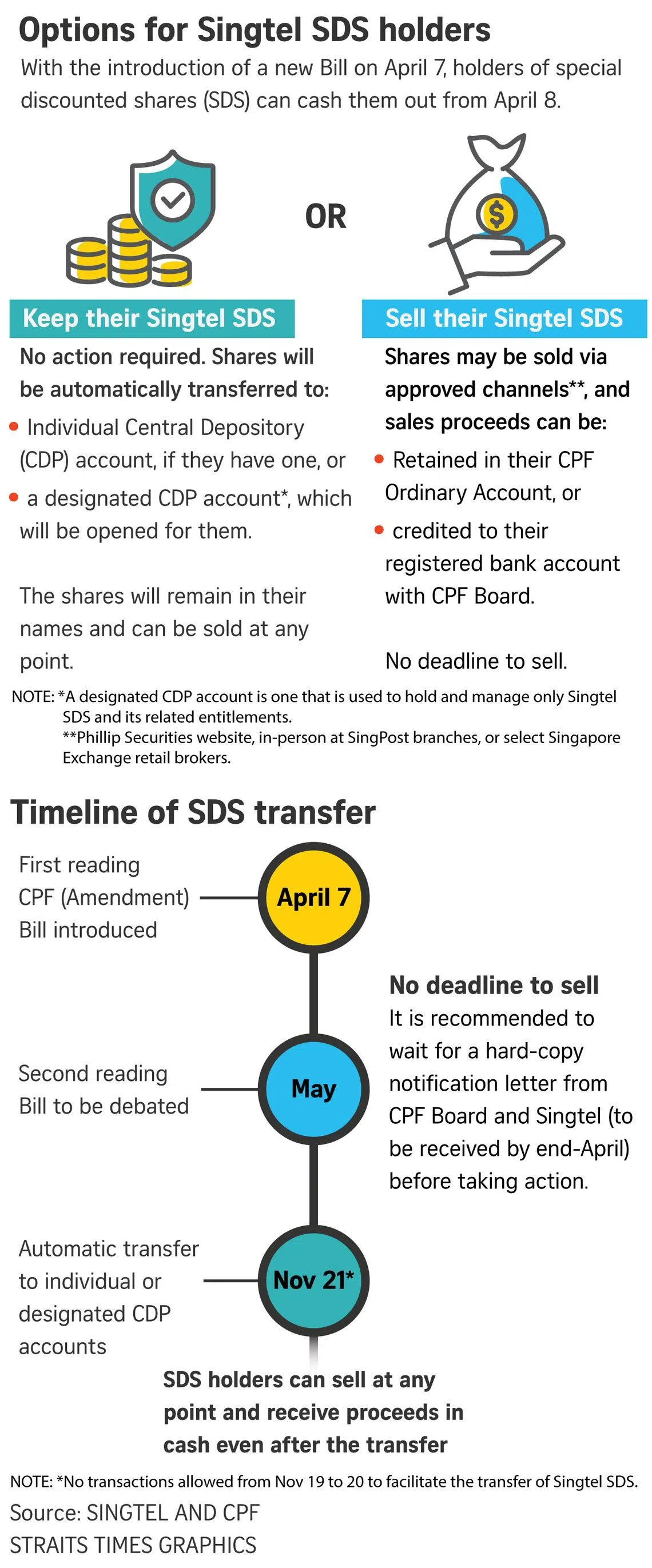
This means they have the option of either selling the shares fully for cash now, or having them transferred from the CPF Board to their individual Central Depository (CDP) accounts on Nov 21, 2026, to be sold later on.
But much of these details are lost on Madam Chung, who declined to give her full name.
“I want to sell my Singtel shares because I am so old, I don’t want to keep so many things. But I don’t know how to do it,” she told The Straits Times, adding that she did not understand the letter Singtel and SingPost had mailed to her home.
The letter, which was seen by ST, had detailed instructions on the options available to SDS holders in the four official languages. But the wordy nature and lack of visual aids has made it difficult for some seniors to grasp what to do, ST understands.
Madam Chung is among the approximately 615,000 CPF members aged 50 and above who hold these shares.
Other elderly holders who spoke to ST said they are unsure whether to continue holding the shares, while some said they do not fully comprehend the sale process.
Singtel said it plans to reach out to over 20,000 older and less digitally savvy SDS holders who may require greater assistance.
It is partnering with the Agency for Integrated Care, which has already begun conducting house visits since last week as part of these outreach efforts.
Meanwhile, some SDS holders who own odd lots are also concerned about not being able to sell their shares in the future, due to current restrictions on board lot sizes, which require shareholders to sell their shares in quantities of 100.
This is the case for 81-year-old Mr Tan Ying, who holds 1,490 shares. “It is very messy to sell the odd lots in the market. The commissions you pay can be more than the sale proceeds you get from the sale of 90 shares,” he said.
But retiree Angela Goh, 65, said she was able to sell 1,490 shares via the Phillip Securities website, as she was worried that the queues at the post offices might be too long.
After receiving her letter from Singtel in the post on April 17 and registering her intention to sell, she received an SMS confirmation on the same day.
Ten days later on April 27, she received another SMS from Phillips Securities confirming that her shares were sold successfully and the money would be credited to her bank account within seven business days. The proceeds, around $7,000 for 1,490 shares, were transferred the very next day.
“The instructions were clear and the online process was very smooth,” she said.
Others told ST that they had already sold the majority of their shares before the changes to the scheme, and were left with small quantities of odd lots that may prove difficult or inconvenient to sell.
Since April 8, SDS holders are able to visit selected SingPost outlets or log on to the website of brokerage firm Phillip Securities to register their intention to sell their shares. They can also choose to sell them via select Singapore Exchange (SGX) retail brokers.
Sales of SDS are subject to a 0.24 per cent commission fee by Phillip Securities, or a flat $17.95 fee if the transaction is processed in-person at a SingPost outlet.
When ST visited several post offices over the past two weeks, there were elderly people spotted registering for appointments to sell their shares in an orderly manner, with staff at booths available to guide them.
Ms Rebecca See, assistant vice-president for retail at SingPost, said that staff will guide SDS holders through the online system to complete the selling process.
SDS holders have full autonomy to keep their shares, sell their shares or make an enquiry at the booth, she said.
One of the most common questions from SDS holders is how many shares they own, she said. Staff would then help them access their SDS information through Singpass.
“Some elderly will come to the post office to find out more about the process before coming down again to carry out their decision,” she said.
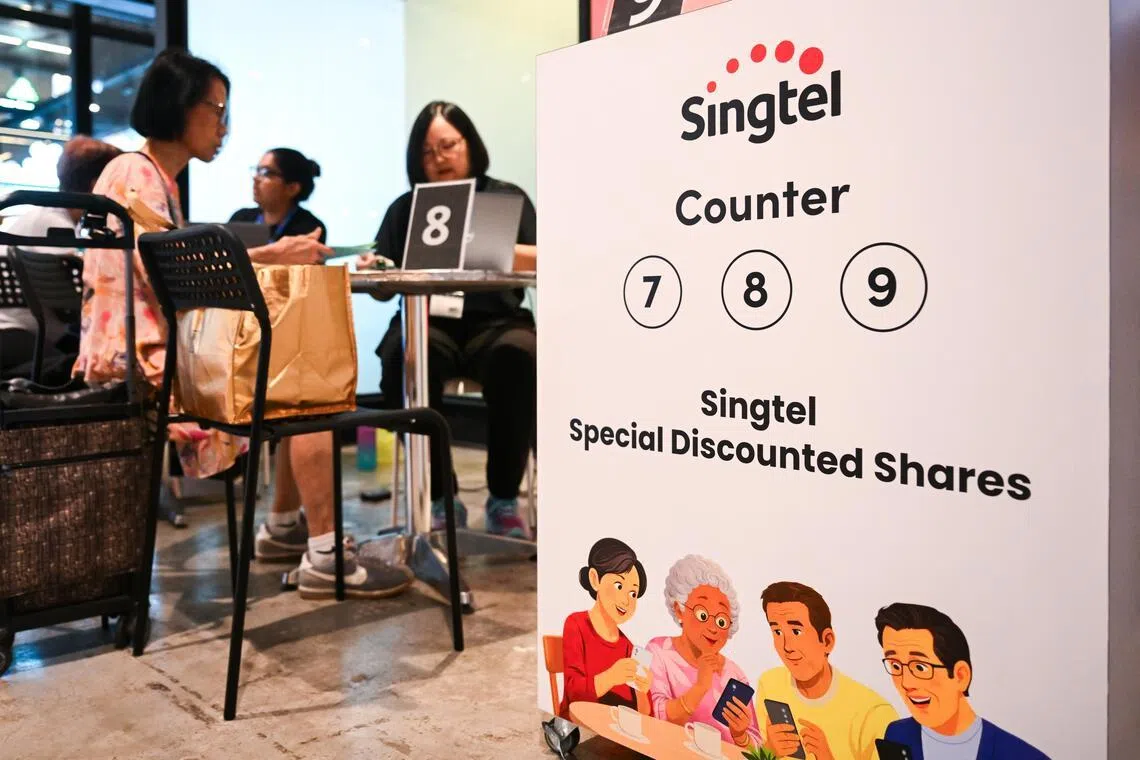
Singtel said that in the past month, there were around 60,000 walk-in enquiries about its special discounted shares at the 36 SingPost branches across the country.
ST PHOTO: SHINTARO TAY
The elderly are also not pressured to make their decisions on the spot and can return with their loved ones to make further enquiries, she added.
In a statement on May 7, Singtel said that there were around 60,000 walk-in enquiries by SDS holders at the 36 SingPost branches across the country in the past month.
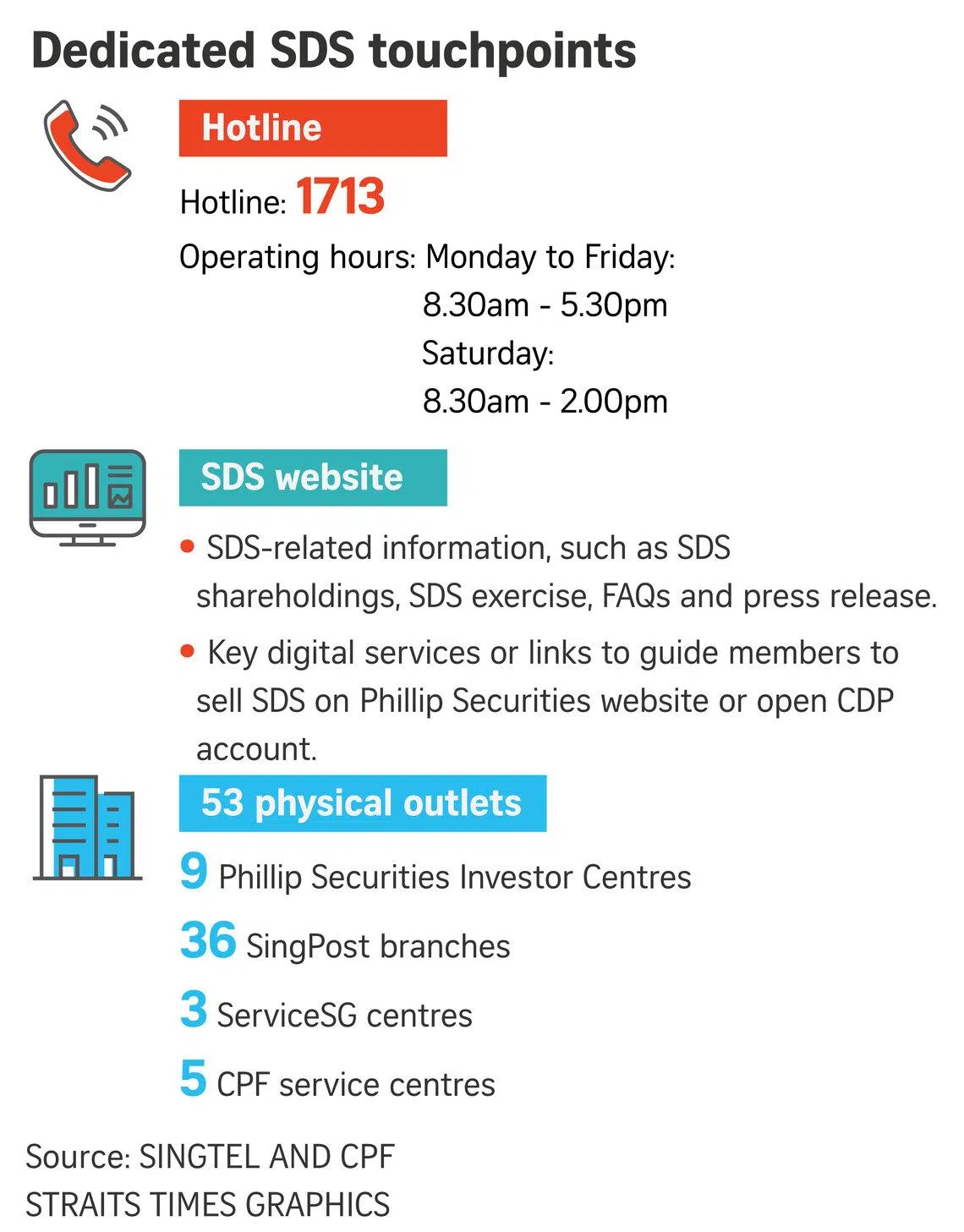
The telco’s dedicated SDS hotline also received some 6,800 calls as at end-April, with 300 calls daily on average.
Author David Soh, 70, said he sold his SDS via the CPF e-services portal and that the process “fast”.
He decided to make the move as the telecommunications industry is evolving rapidly, driven by technological shifts, intense competition and the need to overhaul legacy business models to generate sustainable returns.
“With uncertainty ahead, I guess I did the right thing by selling,” he said.
For 63-year-old executive assistant Lee L.K., it is an opportune time to sell her shares for cash as she is not savvy with investments.
“If I can exchange the shares for cash, why not take the cash now? The economy is not very good. Nobody can foresee the market,” she said, adding that she finds the online instructions for selling clear.
She plans to use the funds from about 1,000 SDS she currently holds to help with her day-to-day expenses.
According to Singtel and CPF, the median SDS holder owns around 1,360 shares, which includes both batches and accumulated loyalty shares. They would be worth around $6,300 as at May 8, with the telco’s share price at $4.69.
They would have also received around $5,000 in cumulative dividends since 1993. CPF said this alone would have more than covered both the CPF savings used to purchase the Singtel SDS, as well as the interest that holders would have otherwise received in their CPF Ordinary Account.
Singtel said some 83,000, or 13 per cent of all SDS holders, have sold their shares since the launch of transfer exercise. It added that the selling of its SDS has slowed considerably over the month of April, with daily volumes averaging some 4.5 million shares this week – about 11 per cent of its average daily trading volume.
Some SDS holders who are more financially savvy have opted to keep their shares as they see them as additional investments.
One of them, Mr Ho C.K., said he is unlikely to sell his shares and will instead hold them for dividend income to build up his retirement funds.
The 62-year-old civil servant, who declined to share his full name, said that he had subscribed to both tranches of SDS that were offered to Singaporeans in 1993 and 1996, totalling around 750 SDS, valued at about $3,400 based on the current share price.
Investors who held on to their shares bought in the first tranche in 1993 were rewarded with 10 per cent more shares at four separate qualifying dates – 1994, 1995, 1997, 1999 – ultimately adding 40 per cent more shares over time.
“It depends if you need the money. If you need the money, you may sell,” Mr Ho said, adding that the SDS’ value is not a substantial amount to him.
Similarly, Mr Yap Tay Soon, 77, said he will continue to keep the shares and collect dividends.
The retiree said that there is no loss to holding on to the shares and he is not worried by share price fluctuations. “As a major government-linked company, I don’t think Singtel’s shares will drop drastically so it is definitely a better option to just keep them.”
Another shareholder, who only wants to be known as Mr Liew C.B., said he had transferred his discounted shares to CDP “a long time ago” to combine with his other Singtel shares.
“SDS are few in number as you know. Selling them is too troublesome,” said the 75-year-old former management professional. The retiree added he cannot recall the exact number he owns but estimated it at around 1,337 shares.
Procurement manager Toh Yong Soon, 51, also plans to keep his SDS, given the sentimental value tied to them.
They were a memorable 21st birthday gift to himself as he had met the criteria to be a shareholder at the time of purchase in 1996.
Since then, he has considered the shares as part of his savings and assets. “It’s like Ah Gong (grandfather)’s gift to his grandchildren. How can I sell them?”

