


SINGAPORE – Mr Tee Hongda has never attended an annual general meeting (AGM) even though he holds shares in Singapore-listed companies such as Singtel and OCBC.
The 37-year-old communications specialist finds AGMs too time-consuming and often held during working hours, and prefers to follow company developments on his own.
“I don’t attend AGMs because I understand the companies enough. But if there’s an interesting development in the industry, I would attend to hear what the executives have to say,” Mr Tee told The Straits Times.
“Hypothetically, if I invest in SpaceX, it’ll be pretty cool to be able to attend these events in a space station or space shuttle, and meet like-minded people to talk about space,” he said, given that he has an interest in space technology.
For many individual investors like Mr Tee, most AGMs in Singapore are staid events that offer shareholders little incentive to attend physically beyond voting on resolutions and receiving routine corporate updates.
Over the years, AGMs have developed a stereotype of being little more than a free buffet that draws crowds of retiree shareholders, earning them the moniker of an “annual general makan”.
This has had the effect of downplaying the importance of the AGM as a platform for companies to properly engage investors and share valuable information, according to people who spoke to ST.
Yet the AGM may be a listed company’s only chance each year to engage both their retail and institutional shareholders.
While the AGMs of many blue-chip companies and some smaller firms are well-attended every year, many are treated less as a meaningful forum and more as an exercise to tick off a compliance checkbox, say observers.
That risks undermining efforts by regulators to strengthen company-shareholder engagement and address undervaluation in the stock market, they added.
The AGM provides a platform for shareholders to engage the company, raise questions and hear updates on its performance and outlook. It is also where they vote on key resolutions, such as approving financial statements and appointing or re-electing directors.
Singapore Exchange’s (SGX) regulations stipulate that companies must hold their AGMs within four months of their financial year-end with at least 14 day’s notice. But there are no strict rules on the manner in which they are organised.
Analysts say the perceived value of AGMs for both companies and shareholders must improve, with changes needed to make them more effective platforms for shareholder engagement, and to support the Value Unlock programme launched in November 2025 to help companies maximise shareholder value.
Among the programme’s initiatives is amplifying companies’ market presence through better communications via channels such as outreach events, media engagement and investor relations.
Already, retail investor interest in attending AGMs and asking questions is on the rise, regardless of whether food or freebies are dished out. Younger investors such as university students are also showing up at these sessions.
Companies must therefore improve both the quality and accessibility of their AGMs to meet rising investor interest and changing shareholder expectations.
On that front, the Securities Investment Association (Singapore) helms an initiative of sending questions relating to strategy, financial, operations, governance and sustainability to selected companies ahead of their AGMs to encourage shareholders to raise follow-up questions and other substantive issues.
In 2026, 250 companies received and responded to these questions, said SIAS president and chief executive David Gerald.
“Engagement is fundamentally a two-way process,” he said.
“At a minimum, shareholders should receive a substantive presentation from management, together with sufficient and unhurried time for questions and discussion.”
Mr Low Seng Joo, a 71-year-old retiree who has attended 12 AGMs so far this year, said shareholders should also be sufficiently prepared when attending AGMs, for example by reading the companies’ annual reports beforehand.
That would allow shareholders to ask more meaningful follow-up questions, and enable management to provide more insightful responses that benefit those in attendance, instead of fielding superficial queries or requests for information already available in annual reports.
A part-time investor who is completely self-taught, Mr Low makes time to attend AGMs to better understand companies’ strategies and their outlook.
He observed that recent AGMs have shown an improvement in the quality of engagement with shareholders, with more investors – especially the younger ones – keen to ask good questions.
“I find that I come away being very informed and I’ve learnt a lot.”
For many other retail shareholders, attending an AGM is often a challenge, with most sessions scheduled on weekday mornings or afternoons, when few can afford to take time off work.
These sessions are also typically held as physical events, and few provide the option for shareholders to attend virtually.
This may explain why AGM attendees tend to be older, often aged 60 and above, with fewer work commitments. Younger shareholders, by contrast, may have to miss these meetings and lose the chance to raise questions with management.
Singapore Institute of Directors (SID) chief executive Emily Poon said that AGMs are usually held during working hours for practical reasons, as companies need to coordinate the availability of directors, senior management, auditors and service providers. Daytime scheduling also allows for a smoother execution of administrative and regulatory processes.
While the timing of AGMs may be a challenge for retail investors, experts said the clustering of AGMs within the same week, or even the same day in some cases, as a more significant issue.
In Singapore, companies must hold their AGMs within four months of their financial year-end. For companies with a Dec 31 financial year-end, the deadline is therefore April 30.
As a result, many firms schedule their AGMs close to this cutoff, leading to a concentration of meetings in the final two weeks of April.
In their guide to listed companies, SGX, SID and SIAS that it is “best practice to take into consideration the convenience of shareholders when arranging the time and venue for the meeting.”
But this clustering further limits shareholders’ ability to attend multiple meetings and reduces overall participation, Mr Gerald said.
“Deconflicting AGM schedules would be an important first step to improving investor engagement, but it requires collaboration between the listed companies.”
While this may be unlikely, Mr Gerald said the existing deconflicting mechanism for large AGMs could be extended to more companies. Regulators could also consider measures to curb excessive clustering during peak periods, such as capping the number of meetings held each day.
Holding a hybrid AGM could help alleviate some of these concerns, although costs and organisational complexity could deter companies from adopting virtual AGM formats, said Ms Lee Khai Yinn, head of continuing sponsorships at SAC Capital.
This is because hybrid AGMs require specialised audiovisual setups as well as secure identity verification and voting systems to ensure fair participation for both in-person and virtual attendees.
Companies would also need to guard against unverified or duplicate participants in hybrid Q&A sessions, particularly when contentious issues are raised, she added.
“These factors may also give rise to certain legal risks. As such, physical AGMs offer a higher level of control and a lower risk of disruption compared to virtual formats.”
Some companies have adopted hybrid arrangements for their AGMs.
Mr Royston Yang, senior analyst at non-profit research house Corporate Monitor, noted that Vicom and ComfortDelgro were able to rotate answering questions from both the floor and those submitted online.
Shareholders attending in person should also be able to file questions online with apps like Pigeonhole, with these questions visible to everyone so they can see the relevant issues. “It would also ensure that the chairman or CEO cannot pick and choose the questions they want to address,” Mr Yang added.
Most AGMs are not open to media coverage. In March and April, ST was only invited to attend those organised by the three Singapore banks as well as CapitaLand Investment.
At City Developments’ AGM on April 29, ST relied on a shareholder’s account, as the session was not open to the media. Requests to attend a few other AGMs were turned down.
Allowing the media to attend AGMs enables more timely and accurate reporting for shareholders who are unable to attend, and given that meeting minutes are typically released a month later.
For larger listed companies with significant public interest and a broad retail base, it also comes down to transparency. Allowing media coverage, particularly from shareholders’ perspectives, can help bridge the gap between management and investors, and even attract potential new shareholders.
National University of Singapore professor Mak Yuen Teen said: “At the end of the day, it’s up to the company whether to allow the media to attend, but for the big companies, many of them should be quite open to it.”
Citing the Value Unlock initiative, he added that the media also helps to connect companies with their shareholders, especially as investor engagement becomes a key focus.
“If you don’t allow the media at AGMs, how can the media facilitate investor engagement and provide a balanced account?”
He noted that without reporters, other stakeholders such as corporate governance experts like himself can discuss the AGMs online.
Prof Mak added that some global companies even allow non-shareholders to attend AGMs virtually so they can attract fresh interest from people who have yet to become investors of the company.
Some people would like to learn about a company before investing in it, he said.
He added that some firms also allow selected observers to attend AGMs and ask questions, as it can be helpful to the company to gain different perspectives.
Under the Companies Act, companies must ensure that minutes of all proceedings from general meetings – including AGMs – are entered into the minute books within one month of the meeting.
Separately, under the SGX listing rules amended in 2023, listed companies are expected to publish AGM minutes on SGXNET and, if available, on their corporate websites within one month after the general meeting.
The minutes should include substantial shareholder questions and the corresponding responses from the board or management.
DBS Bank uploaded its AGM minutes on SGX on April 29, following its meeting held on March 31. This turnaround of about one month is generally consistent with market practice for timely disclosure.
But some market watchers reckon that companies should consider releasing AGM minutes sooner on a voluntary basis so shareholders who are unable to attend can access timely information rather than wait weeks for updates.
These gaps could soon narrow, with the regulatory arm of SGX looking to require all listed companies to maintain a website for key investor-facing documents, such as annual reports and annual general meeting minutes, so that information is easily accessible on a centralised platform.
There is some debate over whether companies should allow AGMs to be recorded by attendees, including the media and other observers, to provide more immediate and complete access to information for analysis and decision-making.
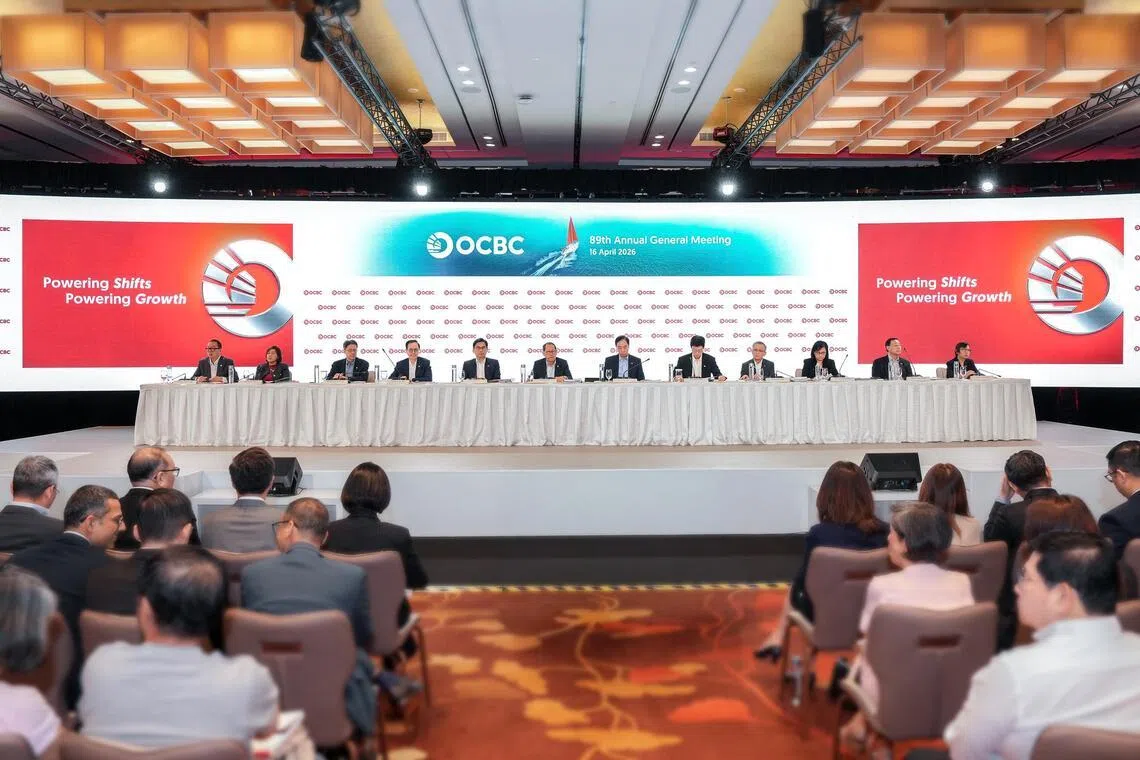
OCBC Bank’s AGM was held on April 16 at the Sands Expo & Convention Centre.
PHOTO: OCBC
Most firms currently do not prohibit recording, although at OCBC Bank’s AGM on April 16, the media was not allowed to record proceedings.
Prof Mak recalled that there used to be arguments against making the minutes of meetings public, but that this became accepted practice after Covid-19, so that those who wanted to view the minutes would not need to go down to the company’s office physically.
He said: “If the company is confident in what they say, they should allow people to record their AGM. Just assume that everything you say is on record.”

