


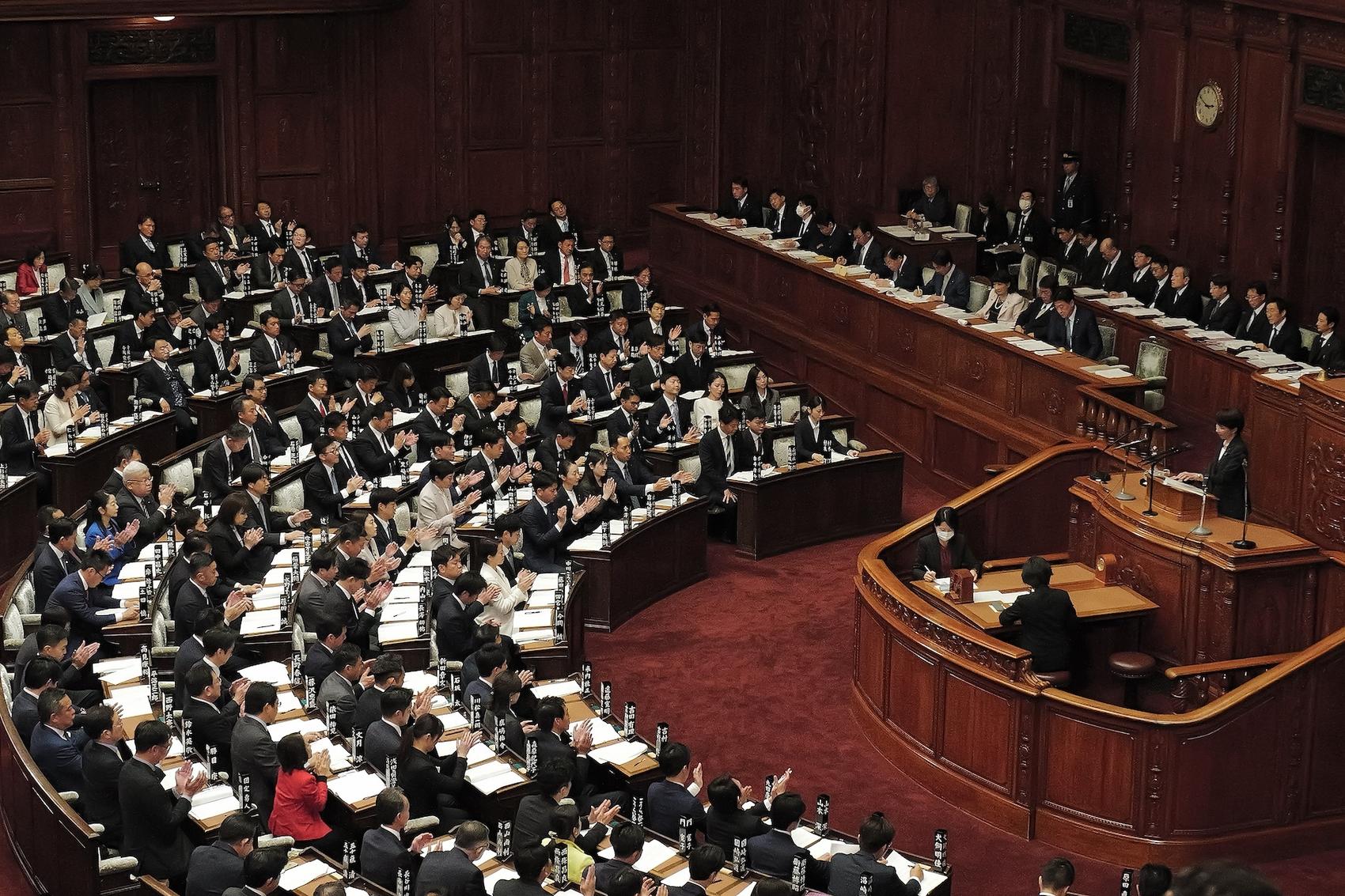
Japan’s ruling coalition led by Prime Minister Sanae Takaichi may be tempted to renege on its promise of realizing full-fledged electoral reform, with little incentive to change the system that helped cement her hold on power after a historic landslide victory in February.
Takaichi’s resolve in pursuing a system that would allow the election of multiple candidates in a district appears increasingly in doubt as her Liberal Democratic Party secured over 80 percent of the 289 single-seat constituencies in the Feb. 8 House of Representatives election.
Some view the 30-year-old electoral system for the lower house as unfit because it favors larger parties like the LDP, while a multiple-seat district system would better reflect the growing momentum of smaller parties.
Political experts warn that ongoing discussions on electoral reform may conclude in a manner favorable to the ruling camp, such as by the reduction of proportional representation seats, a move that would put smaller opposition parties at a disadvantage.
The single-seat district system “distorts votes in favor of the majority,” said Nobusuke Yasuno, an associate professor at Nihon University College of Law. That tendency has “appeared in an extreme form.”
Under the current electoral system for the 465-seat lower chamber, there are 289 single-seat constituencies and 176 seats decided by proportional representation in 11 blocks.
In the Feb. 8 general election, the LDP and the Japan Innovation Party secured more than three-quarters of the lower house seats amid Takaichi’s high popularity, well above the two-thirds threshold required to override the House of Councillors, in which the coalition remains a minority, when pushing through bills.
The LDP won in 248 of the 289 single-seat constituencies, or around 86 percent, garnering just about 49 percent of the total vote. Each voter cast two ballots — one to choose a candidate in a single-seat constituency and the other to select a party in a proportional representation block.
Japan used to have a multi-member district system, under which two to six representatives per district were elected.
It was replaced in 1996 by the current system after being blamed for fueling factional rivalries within the LDP and driving money politics. The LDP has held power almost continuously since its foundation in 1955.
The push to revisit the old framework was reignited by Takaichi’s predecessor, Shigeru Ishiba, who called in January 2025 for a “cross-party review” of the system to “better reflect a broader range of public opinion.”
Before the LDP’s leadership contest on Oct 4, Takaichi supported the idea of changing the system to make it more accessible to new candidates.
On Oct. 20, the day before Takaichi became prime minister, the LDP and the JIP agreed in their coalition deal to consider replacing the current system combining single-member constituencies and proportional representation with multi-seat districts “to establish an electoral system that fits with the times.”
Since the sweeping election victory that Takaichi claimed gave her a mandate to press ahead with her policy agenda, however, discussions on introducing multi-member constituencies have largely been sidelined.
Yasuno argues that the ruling parties now have little incentive to pursue reforms that would increase the chances for opposition parties to win more seats in constituencies.
In an apparent sign of such reluctance, the ruling parties are increasingly focusing on another item in their coalition agreement — slashing the number of lower house seats.
In a bill submitted in December, they proposed cutting 10 percent, or at least 45 seats, with 25 constituency seats and 20 proportional representation seats set to be automatically reduced if no agreement is reached within a year.
Since the general election, the ruling coalition’s focus has shifted more toward the proportional representation segment. The JIP, which saw many constituency-elected members like the LDP, has drawn a backlash for calling for cuts in proportional representation that would disadvantage opposition parties.
The main opposition Centrist Reform Alliance and the Democratic Party for the People obtained most of their seats and the Sanseito party and Team Mirai all of their seats via proportional representation.
When asked in parliament in March whether the ruling bloc was attempting to reshape the electoral system in its favor by targeting proportional representation seats, Takaichi said the matter should be deliberated in the Diet.
Katsuhiro Musashi, a political science professor at Doshisha University, said the JIP is more eager to cut lower house seats and realize electoral reform, adding the LDP may have decided to go along with the idea to reach a coalition agreement.
He sees the ruling camp’s push for the multi-seat constituency system as a “political tactic” to temporarily attract support from opposition parties. If broader electoral system reform is shelved after the push to curb lower house seats is realized, “that would be a natural outcome,” Musashi said.
© KYODO

