


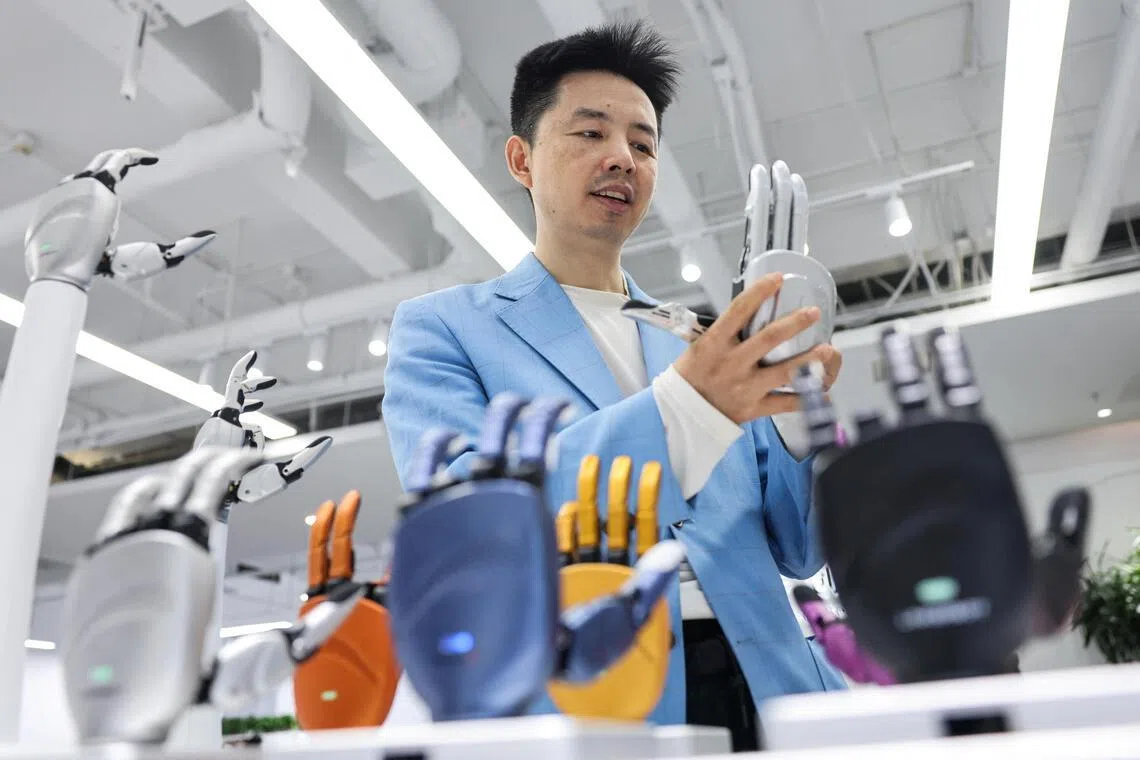
BEIJING – Chinese robotics start-up Linkerbot, the global market leader in highly dexterous robotic hands for humanoids, will seek a US$6 billion (S$7.6 billion) valuation in its next financing round, double the valuation in a just-closed funding, the company said.
Linkerbot completed what it called a “series B+” funding round last week that valued it at US$3 billion. It did not say when the next funding round will be launched or whether it was targeting the previously undisclosed US$6 billion valuation in a private investment round or in an initial public offering (IPO).
Prominent early backers of the two-year-old unicorn include Alibaba’s Ant Group and Sequoia spin-off HongShan Group, while state-backed Zhongguancun Science Park Fund, Bank of China Asset Management and Fosun Capital participated in the latest round, the company said in a statement on April 30.
Linkerbot currently holds over 80 per cent of the global market share in high-degree-of-freedom (DoF) robotic hands, and plans to scale production “soon” to 10,000 units a month from almost 5,000 currently, chief executive officer Alex Zhou told Reuters in an interview.
Investor interest in China’s humanoid robotics industry has surged in 2026 year after market leaders such as Unitree demonstrated their products’ staggering technical advances during a widely watched TV performance and the Beijing humanoid robot half-marathon in April. Unitree filed for a Shanghai IPO in March, seeking a valuation of up to US$7 billion.
Unlike competing humanoid makers such as X Square Robot that focus on training robotic hands for household chores, Linkerbot specialises in high-value human craftsmanship.
“We aren’t just making hands. Our goal is to replicate the entire library of human dexterous skills within our hardware,” Mr Zhou said, referring to the firm’s LinkerSkillNet platform, which he claims is the world’s largest real-world dexterous manipulation dataset.
The platform is a multimodal data collection system that converts human skills into standardised, reusable capabilities for robotic hands, containing over 500 skills so far.
“The hand is the most complex part of the whole humanoid robot. Elon Musk described on several occasions that the part was taking more than half of their whole engineering effort for Tesla’s Optimus,” said Georg Stieler, head of robotics and automation at technology consultancy Stieler.
Mr Musk promised that the latest Optimus model, to be launched this spring, will have “the manual dexterity of a human”.
Inspired by his childhood fondness for Doraemon, the Japanese cartoon robotic cat who holds an infinite array of gadgets in his pocket, Mr Zhou envisions his robots playing the piano, giving massages or even doing dentistry: skills he says are a “value-add that is at least triple that of basic labour”.
Linkerbot’s hands can already rapidly turn screws, grasp deformable soft objects, thread a needle and engage in high-precision manufacturing. The company supplies some of China’s leading humanoid robot makers as well as some foreign industrial giants, which the company declined to disclose due to NDAs.
Its basic O6 light-weight model can carry a 50kg load despite weighing only 370g, performance that Mr Zhou said was a key advantage for industrial applications where miniaturisation and strength are required.
Besides industrial settings, Linkerbot’s hands are used by research institutes and leading global universities. The company has over 400 employees and five factories in Beijing and Shenzhen, and is developing intelligent production lines where robotic hands manufacture other hands.
A major obstacle to the widespread factory use of humanoids is their cost, at US$100,000 to US$150,000 per unit for the leading industrial models from Unitree, AgiBot and UBTech, analysts say. But Linkerbot says its hands are more easily deployed.
“Chinese factory owners are extremely pragmatic. They’ve realised that for most factory work, two arms and a pair of dexterous hands are enough,” said Mr Zhou. “Currently, many of our customers simply mount our hands onto existing robotic arms rather than buying a full humanoid,” he said. REUTERS

