


SINGAPORE – Stock market competitions, like seminars and training programmes, educate young investors about markets and investing.
Held in a fun and safe virtual environment, these competitions foster interest in the stock market and investing.
For young investors, the draw includes prize money, the chance to secure an internship, mentorship from industry experts, and opportunities to sharpen their investment and analytical skills.
Mr Fong Zhi Heng is a third-year economics undergraduate at the National University of Singapore and a two-time champion of stock market competitions.
In 2025, he jointly won the UBS Finance Challenge for Hong Kong and Greater China and, in the same year, was part of a team of five students that took home the Singapore and South-east Asia title at the CFA Institute Research Challenge.
Mr Fong, who spoke to The Straits Times from Sweden, where he is on an exchange programme, said stock market competitions allow him to gain “work experience”.
“I major in economics, but I know that eventually I want a career in finance,” he said.
However, it is not easy to land an internship with no work experience.
“How then do I get that work experience? One of the ways is through stock market competitions, where I can show employers that while I might not have ‘on-the-ground’ work experience, I do have an interest in the finance field,” he said.
That was how Mr Fong got started. The CFA Institute Research Challenge was his first stock market competition. He benefited from being paired with a CFA-licensed professional who mentored him in research writing and presentation skills.
“Industry professionals gave us feedback on our work,” he said, adding that their feedback showed him just how differently professional investors think compared with how he did.

Mr Fong Zhi Heng, an economics major on exchange in Sweden, hopes to eventually pursue a career in finance.
PHOTO: FONG ZHI HENG
Mr Fong also picked up tips at the UBS Finance Challenge, where UBS analysts guided participants on the stocks they cover.
As part of the challenge, his team had to deliver a “sales pitch” during the finals, which was a first for him. They had to “sell” their stock to the judges as if pitching to a client, rather than simply presenting their investment thesis.
“For these two competitions (the CFA and UBS challenges), the skill sets were similar; we had to pitch a stock, but the audience was different,” said Mr Fong.
“That is the beauty of some of these stock market competitions. You might not get that kind of exposure during an internship,” he added.
Mr Fong noted that he also learnt to take a broader view when analysing a stock, including by looking at the industry the company is in and the wider economic environment.
“This competition reminded me that just because a company is the best doesn’t mean its stock will move,” he said. There may be other reasons for share price inertia, such as underlying macroeconomic conditions, he added.
Sohei Capital, a team of four first-year business students from the Singapore Management University (SMU), was the champion of the inaugural Fullerton/SGX Value-Up Singapore Equities Challenge.
The competition ran for six weeks, from January to March 2026, with winners announced on the sidelines of the Investment Management Association of Singapore conference.
The team – comprising Mr Kam Pak Wai, Mr Ryan Pang, Mr Terence Har and Ms Heidi Tan – walked away with $10,000 in prize money.
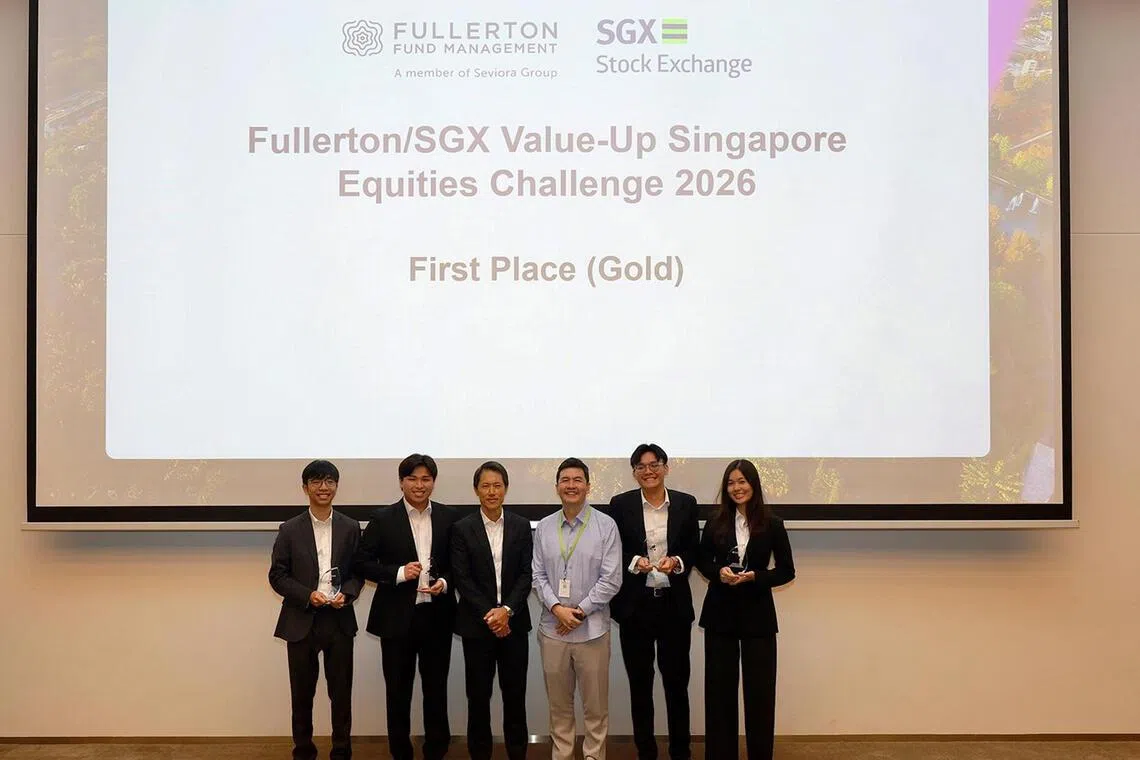
Sohei Capital was crowned champion of the Fullerton/SGX Value-Up Singapore Equities Challenge. From left are contestants Kam Pak Wai and Ryan Pang, judges Chan Kum Kong and Ken Goh, and contestants Terence Har and Heidi Tan.
PHOTO: INVESTMENT MANAGEMENT ASSOCIATION OF SINGAPORE
The students do not qualify for internships at Fullerton as they are not graduating in 2027. However, up to 10 eligible participants from the competition will be offered internships.
Perks aside, the Sohei Capital team members said they gained valuable insights, such as realising the importance of going beyond conventional research to uncover hidden gems.
Ms Tan said there was limited data on UMS Integration, the stock they picked for their pitch. “There were far fewer analyst reports and company filings that we could look at,” she added.
They had to be resourceful and use alternative methods to evaluate the company.
For example, Mr Pang 3D-rendered a map of the company’s factory site in Penang, and the team used the image to assess how UMS differed from its peers.
They found that UMS benefits from lower land costs and wages in Malaysia, compared with peers that typically manufacture semiconductor equipment in European countries, such as the Netherlands.
Mr Pang noted that the students also learnt to look at stocks through a wider lens.
“Key management is very important,” he said. “What is your founder, chief executive or chief financial officer doing? How friendly are they towards shareholders? What is the working relationship with suppliers or clients?”
These are important questions that have to be answered.
“Management is not a major consideration for US stocks, but Singapore’s market is a different ball game,” he added.
Ms Tan said that beyond building their equity research skills, the opportunity to network and share perspectives with industry experts was invaluable.
“We were chatting with one of the guys from Fullerton and found out he was our senior at SMU. He shared how he does his job.”
She added: “Gaining these different perspectives by talking to more people is underrated.”
Following the competition, the SMU students plan to take a closer look at small- and mid-cap stocks in Singapore. All team members currently invest only in US markets, except for Mr Pang, who also invests in Singapore.
Ms Tan said all four talked about “taking a position in UMS”.
Mr Har added: “Previously, if you told me to invest in the Singapore market, I would just buy the banks, collect the dividends and call it a day.”
However, now that he sees “a lot of alpha” in small- and mid-cap stocks, the Singapore market is much more interesting to him.
“Instead of being the diversifier part of my portfolio, Singapore equities can actually be the core of the portfolio,” he added.
Mr Kam, who is slightly more risk-averse, will wait for greater certainty before entering the Singapore market.
“Singapore is very interesting after this competition. I will enter soon. I am just waiting for a better time,” he said.
Mr Fong, the two-time stock market champion, will apply the skills he picked up from the competitions – such as identifying stock catalysts – to his investments. He currently invests in Singapore and US markets.
“I will use those skills in my own portfolio to test whether my investment thesis actually plays out,” he said.

