


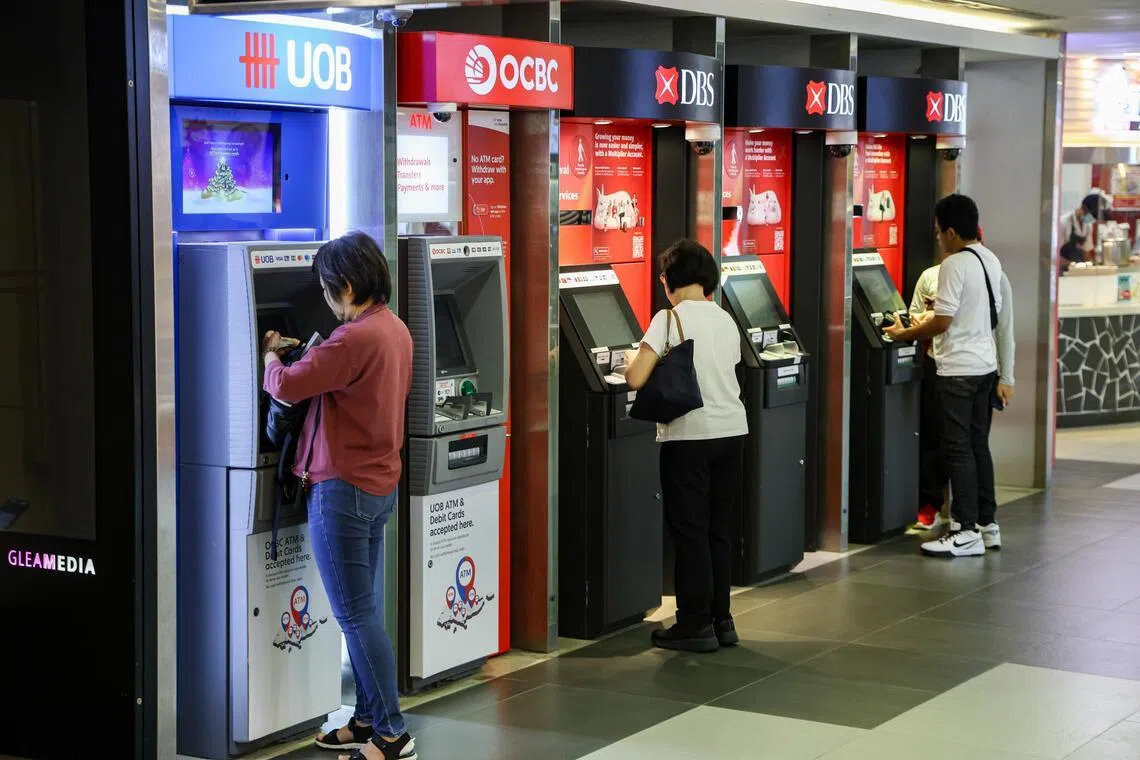
SINGAPORE – Banking stocks gained during the week as the US Federal Reserve held rates steady, with robust first-quarter results from DBS further lifting investor confidence.
The Fed kept interest rates unchanged for a third straight meeting in late April, as policymakers grappled with uncertainty from the Middle East conflict and persistently high inflation, partly driven by rising global energy prices.
A pause in the pace of rate cuts helps banks stabilise their net interest margins (NIMs) – a key profitability gauge – which are expected to experience less severe compression in 2026 compared to 2025.
DBS’s first-quarter profit came in better than expected, growing 1 per cent to $2.93 billion on record wealth management fees. The dividend payout of 81 cents per share was also higher than the 75 cents in the year-ago period.
Analysts noted that DBS left its 2026 guidance largely unchanged – guiding for flat total income and high single-digit growth in commercial non-interest income – while indicating potential upside.
They also said stress tests show DBS Group’s loan book remains healthy, with no need to set aside more money for potential losses for now, easing concerns about the impact of the Middle East conflict.
DBS led the week’s gains among its peers, jumping 2.8 per cent to close at $58.50 on Apr 30. OCBC rose 0.9 per cent to $21.90 while UOB inched 0.4 per cent higher to $36.15.
Shares of City Developments Limited (CDL) lost 4.2 per cent to end the week at $8.16.
The property developer held its annual general meeting (AGM) on April 29, where some shareholders aired concerns about the role of its directors and the progress of a strategic review.
National University of Singapore professor Mak Yuen Teen told The Straits Times, which was not permitted to attend the AGM, that he had concerns about whether there was a conflict of interest regarding Mrs Wong Ai Ai, who is an independent non-executive director and chair of the Nominating and Remuneration Committee at CDL.
This is because Mrs Wong also sits on the board of SWI Capital Holding, which invests in sectors such as commercial real estate and digital infrastructure, and has exposure to markets including Britain, where CDL also owns properties under its hotel unit.
SWI Capital, which listed in Amsterdam in February, also holds a majority stake in Stoneweg European Real Estate Investment Trust (REIT), which owns commercial properties across Europe, while CDL has a stake in IREIT Global, which owns similar assets in Europe. The two REITs are listed on the Singapore Exchange and are seen as competitors.
According to Prof Mak, the board responded that it is common for directors to sit on multiple boards where potential conflicts may arise.
He added that he had asked if Mrs Wong had sought clearance from CDL chairman Kwek Leng Beng before accepting her appointment at SWI Capital, but said he did not receive a clear response.
Prof Mak also asked who was appointed to carry out a strategic review for the company, and if there was a formal request for vendors to submit proposals for the service.
The board also said it has selected Teneo, a global strategic advisory and communications firm, to lead the process, and that a request for proposal was not carried out.
Group chief executive officer Sherman Kwek told shareholders that the strategic review – which aims to boost shareholder value – will be discussed at a board strategy meeting in May, with details expected to be unveiled by end-June, according to The Business Times.
Mr Kwek said the review was “timely” after the company faced difficulties in 2025 including a highly publicised internal dispute, BT reported.
CapitaLand Investment (CLI) also held its AGM in the same week.
Shareholders raised concerns over a rumoured merger with Mapletree Investments and mounting pressures in China’s real estate market.
Responding to one shareholder who noted that Mapletree may not be the right fit for CLI, chairman Miguel Ko replied that CLI remains committed to pursuing meaningful mergers and acquisitions.
Independent director Anthony Lim also noted that the board would not only have to address the views of its minority shareholders but those of its majority shareholder, Temasek, when assessing potential deals.
Investors also questioned CLI’s China strategy and its plans to monetise assets, after sharp declines in valuations reduced its profit from $479 million to $145 million in 2025.
In response, CLI China CEO Puah Tze Shyang said that rents in China have been on a downward trajectory and softer performance at CLI’s business parks in China was partly due to an oversupply of commercial space in several cities.
But the firm is starting to see early signs of recovery, particularly in the retail sector. The hotel and rental apartment sectors are also expected to rebound more quickly, although the recovery for business parks and offices would take longer, he said.
CLI shares fell 2.5 per cent to close at $2.78 on Apr 30.
Other property stocks also declined over the week, as the Fed’s decision to keep interest rates unchanged signalled that rates could remain higher for longer, keeping borrowing costs elevated.
UOL inched 0.4 per cent lower to $10.63, while Frasers Property dropped 2.6 per cent to $1.14 and Singapore Land Group was down 0.5 per cent to $3.74.
Shares of several Catalist-listed companies rose this week as they announced that they will move to the mainboard of the Singapore Exchange (SGX) next week.
Pawnbroker MoneyMax Financial Services on Apr 30 said it will transfer to the mainboard on May 6, after its placement of 53 million new shares on Apr 27 met the requirements for the move.
Its shares rose 10 per cent over the week to close at 94.5 cents.
The placement drew strong demand from institutional investors, including Fullerton Fund Management, Lion Global Investors and Eastspring Investments – fund managers selected by the central bank under a $6.5 billion programme to invest in Singapore-listed stocks.
SAC Research said that a mainboard listing acts as a transformational milestone in a company’s corporate lifecycle and fundamentally alters the stock’s risk profile and institutional accessibility.
“By satisfying the stringent compliance, governance, and market capitalisation criteria required by the mainboard, MoneyMax will more likely be on the radar of institutional investors, pension funds, sovereign wealth mandates, and passive algorithmic exchange-traded fund indices,” the research firm noted on Apr 30.
But it warned of potential risks including volatility in gold prices as a severe correction in spot prices would exert immediate downward pressure on the balance sheet.
Shares of consumer lifestyle group Aspial Lifestyle rose 5.7 per cent over the week to 45 cents following the firm’s announcement that it will transfer to the mainboard on May 4.
Following MoneyMax and Aspial Lifestyle, electrical products retailer and distributor Choo Chiang will move to the mainboard on May 7.
Choo Chiang shares rose 2.2 per cent this week to close at 46 cents after the announcement on Apr 29.
Shares of Lum Chang Creations jumped 5 per cent over the week to $1.03 as the firm convened an extraordinary general meeting to get shareholders’ approval for its proposed transfer to the mainboard.
The urban revitalisation specialist on Apr 30 said the move could elevate the company’s local and global corporate profile, support the company’s medium to long-term business plans as well as broaden access to investor base.
Shares of Wilmar International slid 7.2 per cent over the week to $3.61 after it posted a 22.8 per cent fall to US$265.6 million in net profit for the quarter ended Mar 31.
The firm on Apr 29 attributed the fall in profit primarily to “temporary unrealised mark-to-market losses from hedging activities caused by the Iran war” and weaker contributions from associates and joint ventures across China, Europe and South-east Asia.
Wilmar said that the losses are expected to reverse in coming quarters when physical transactions are settled.
Meanwhile, Sheng Siong shares inched 0.3 per cent higher to end the week at $3.03 after the supermarket operator on Apr 29 reported a 12.6 per cent increase in first-quarter net profit to $43.4 million.
Revenue grew 12.4 per cent to $452.8 million, mainly supported by the 12 new stores that opened in 2025 and higher festive sales in the Lunar New Year and Hari Raya periods, the company said in a business update on Apr 29.
Next week, focus will turn to UOB and OCBC’s earnings reports after DBS set the tone.
Investors will be watching whether UOB and OCBC can match DBS’s performance, particularly on NIMs, loan growth, and asset quality. Any signs of pressure from a “higher-for-longer” interest rate environment will also be closely scrutinised.
Beyond earnings, guidance on credit costs, dividends, and outlook for regional growth will likely shape sentiment for the sector in the near term.

