


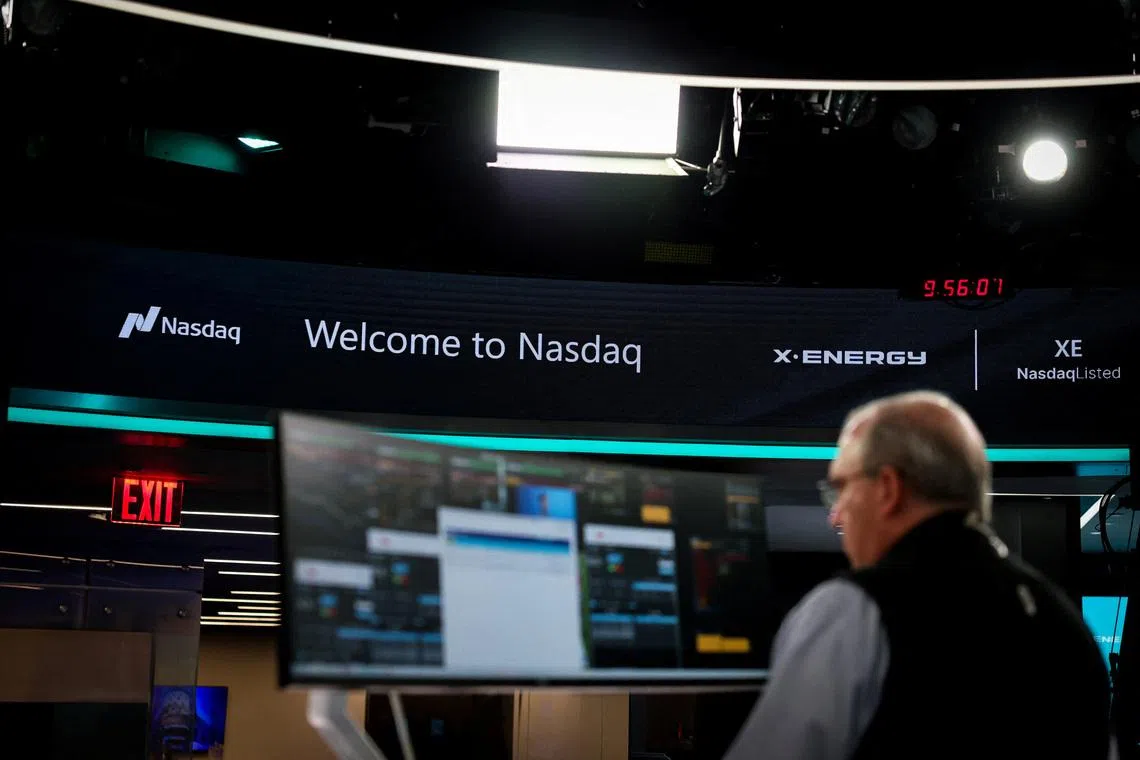
SINGAPORE – Companies that want to list in both Singapore and the United States will need to prepare only a single set of documents, if new rules and changes proposed on April 30 are implemented.
The proposals aim to make it easier for companies to list on the Singapore Exchange (SGX) and Nasdaq.
Among other rules, eligible companies have to have a minimum global market capitalisation of $2 billion.
On April 30, the Monetary Authority of Singapore (MAS) announced a framework that can help issuers list easily on the Global Listing Board (GLB).
The initiative by SGX and Nasdaq facilitates cross-border capital-raising for companies and gives investors access to a wider range of listings.
GLB was announced in November 2025 and is targeted to launch in the middle of 2026.
Mr Tan Boon Gin, chief executive of SGX’s regulatory arm SGX RegCo, said: “The GLB was conceived in response to market feedback that companies – especially growth-oriented companies with an Asian nexus – want to tap the large, liquid pools of capital in the US while still being easily accessible to retail and institutional investors in their home markets.”
MAS and SGX sought feedback in January from the industry on how the dual listings would work.
The MAS framework will be put in place if an amendment Bill is passed in Parliament in May.
Under the framework, the rules and processes for listing will be harmonised so companies need to prepare only one set of offering documents to list simultaneously on the SGX and Nasdaq.
Listing timelines, processes and practices in the US and Singapore will also be aligned.
MAS said it will include US disclosure requirements for the prospectus and offer information statements.
“US disclosure requirements are in line with international standards, offering a level of investor protection that is aligned with these standards,” MAS said.
Companies will also be allowed to conduct pre-marketing outreach with accredited and institutional investors in Singapore before they lodge their preliminary prospectus.
“Early engagement of these investors will allow GLB issuers to gauge market interest of a potential listing at an earlier stage in the IPO process, subject to safeguards,” MAS said.
MAS also responded to suggestions that Singapore incorporate safe harbours that are allowed in the US. Safe harbours refer to legal provisions that protect the company from liability if it meets certain conditions.
MAS said it will permit three safe harbours for companies – when they publish forward-looking statements, when they want to undertake share repurchases, and when they execute pre-determined trades.
It added that these three safe harbours are commonly used by issuers, so MAS has proposed to incorporate them into Singapore law to facilitate such trading activities.
SGX RegCo also announced a new set of listing rules for the GLB on April 30.
The rules are subject to the amendments being approved in Parliament when the Bill is passed, as well as related regulations. If those go through, the rules are expected to be effective in the middle of 2026.
Broadly, the new listing rules help to harmonise listing timelines and submission processes with Nasdaq.
When a company has been approved by Nasdaq, SGX will issue a no-objection letter to give the company early certainty.
Trading on SGX will also start in the Singapore market session following the company’s first day of trading on Nasdaq.
The rules also set minimum fund-raising and market capitalisation admission requirements.
SGX RegCo agreed with concerns raised during the consultation process that a company that wants to list on the SGX and Nasdaq needs to have a large enough pool of potential liquidity in Singapore to be able to trade on both exchanges.
At the point of admission, a company needs to have a minimum global market capitalisation of $2 billion.
SGX RegCo will also require issuers to raise funds in Singapore of at least 15 per cent of the global initial public offering (IPO) value, or $75 million, whichever is higher.
Rules have also been made to help retail investors to participate in GLB listings, by requiring a minimum share allocation to be made available through retail brokers.
SGX RegCo’s Mr Tan said: “Retail and institutional investors based in this region have a keen interest in home-grown names and would like to invest and trade these counters here.”
In response to queries from The Straits Times, he added that local investors have indicated desire to participate in the IPOs of well-known companies from the region that are listing in the US, but they cannot get an allocation at the IPO.
“We have tried to close that gap by providing for a retail allocation because we believe retail investors should be able to participate in primary offerings and not just secondary trading,” he said.
He added that the GLB is about balance: “It is about making our market more connected without making it less inclusive.”
Hence, 5 per cent of the Singapore tranche of an IPO has to be reserved for retail brokers, or $50 million, whichever is lower.
For instance, if an IPO is worth $1 billion, at least $150 million raised will have to be in Singapore as the Singapore tranche. Of this, at least $7.5 million has to be reserved for retail broker allocation.
“Issuers must meet this threshold where there is sufficient demand from retail brokers,” SGX RegCo said. Any shortfall in demand may be reallocated.
Lastly, the new rules also require material disclosures in the US to be released on SGX in a timely manner.
Trading will also be halted on the SGX if trading is halted on Nasdaq.

