


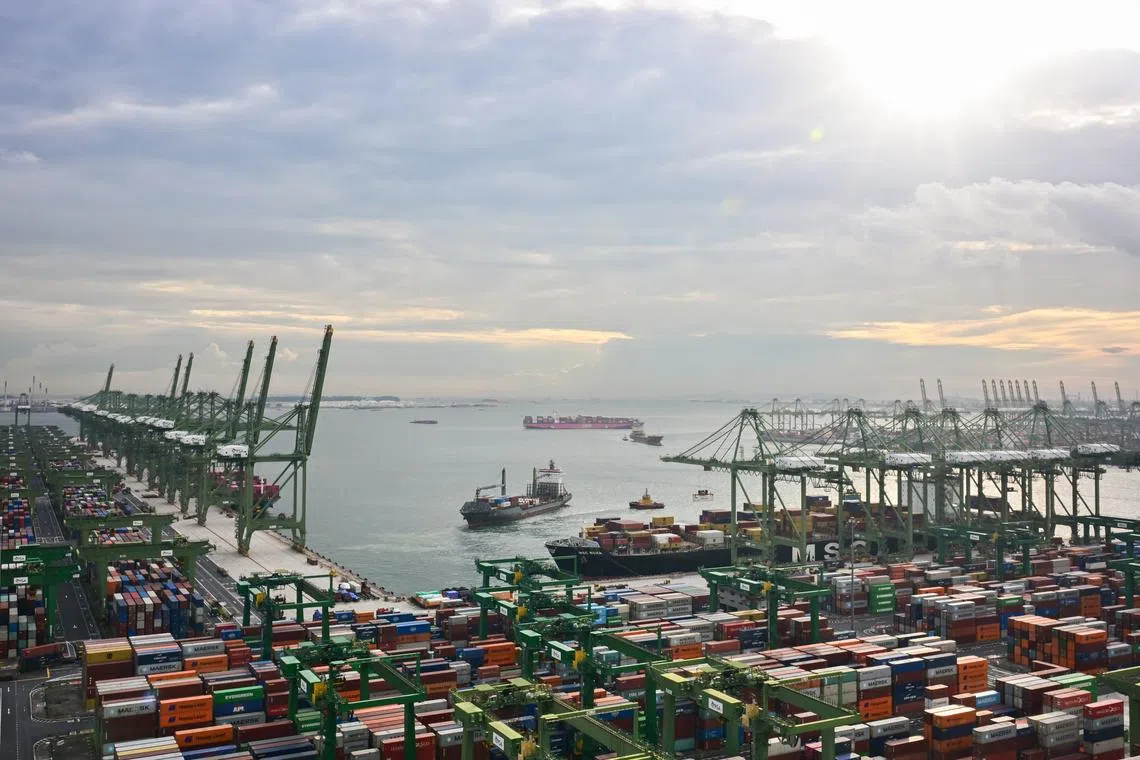
SINGAPORE – Shipping companies are deploying an old strategy called ‘slow steaming’ in response to soaring marine fuel prices, which is likely contributing to fewer vessels calling at port in recent weeks, including at Singapore.
While this may be good news for port operators, it could spell other risks for the global economy such as disrupting the flow of trade.
Waiting time at ports across Asia, including Singapore, has eased recently, ship trackers told The Straits Times.
At the Singapore port, ships’ waiting time peaked at 3.5 days in early March but has now eased back to just one day or less, they added.
Yet some ships are observed to have extended transit times, indicating that they are moving at slower speeds in what is called ‘slow steaming’, according to two Singapore-based supply chain managers who spoke to ST.
Slowing a ship’s speed cuts fuel consumption but increases journey time, which essentially puts a drag on global trade and in turn world economic growth – on which export-driven economies such as Singapore depends a lot.
That means global seaborne trade – which represents about 90 per cent of global goods trade – will decline from the record high of over US$35 trillion it reached in 2025.
PSA Singapore said in response to queries that port operations here have remained stable, supported by proactive planning and close coordination with shipping lines and partners.
“Despite the evolving situation in the Middle East since late February, PSA has not experienced congestion at our terminals,” said the port operator.
Container volumes, in particular, have been strong since the start of the year. From January to March 2026, PSA handled 11.2 million 20-foot-equivalent unit (TEUs), a 6.4 per cent increase compared to the same period last year. TEU is a measure of cargo capacity.
“We continue to monitor global developments closely and remain in regular communication with our shipping line customers, engaging them early to anticipate and address any operational adjustments arising from the evolving geopolitical landscape,” said PSA Singapore.
The priority remains to ensure reliability, operational efficiency and seamless connectivity for all container vessels calling at PSA, it said, adding: “We have also offered bespoke solutions to beneficial cargo owners and supply chain stakeholders who may require support for shipments affected by the global disruptions.”
The reason for fewer vessels calling at port is the price of marine fuel, referred to by the shipping industry as bunker.
However, bunker prices remain high even as they retreat from recent peaks.
Price of very low sulphur fuel oil (VLSFO) in Singapore peaked at US$1,450 per metric tonne on March 9, up about 182 per cent from US$515 on Feb 27 – a day before the US and Israel started to bomb Iran.
More recently, the bunker price has dropped below US$1,000 although still significantly higher than the pre-conflict price.
High-sulphur fuel oil (HSFO) in Singapore peaked at US$1,200 per metric tonne on March 9, up from US$439 on Feb 27 – again about 173 per cent higher. The price is now about US$700.
Shippers recover part of the higher fuel cost by charging bunker surcharges. But customers will not pay for blank sailings. Many ships that were supposed to pick up cargo from ports in the Persian Gulf had to return empty or reroute to other ports.
As a result, shippers try ways to shield themselves from getting burnt by their single-largest expense: fuel. But if all shippers use the strategy at the same time, slow steaming can disrupt the global supply chain.
The International Monetary Fund (IMF) earlier this month is already predicting global goods and services trade volume will grow more slowly than the world economy’s expansion this year.
IMF said trade will increase 2.8 per cent in 2026, less than the 5.1 per cent advance last year. Meanwhile, global GDP is estimated to be 3.1 per cent this year, down from 3.4 per cent in 2025.
Slow steaming is an old trick that shippers have used intermittently since the global financial crisis of 2008. It became more common in 2020 when the International Maritime Organization (IMO) mandate for lower sulphur fuel came into effect.
The rule made IMO-compliant fuel – for example VLSFO – more expensive, which shipping companies tried to offset by slowing the speed of their ships.
Experts believe that if ultra-large container vessels halve their maximum speed from 30 knots (55.5 km/hour) to 15 knots, it can easily add between 10 and 15 days to the trip from Asia, the world’s top exporting region, to Europe.
Ironically, the longer it takes, the better it is for shipping companies’ bottom lines.
Longer transit times effectively mean fewer available vessels, and raises freight costs. Ocean freight costs have climbed by as much as 20 per cent on average since the start of the Middle East conflict.
Companies desperately trying to secure crude oil, refined fuels, chemicals, fertilisers and other essentials like grains and processed food are paying even higher freight rates.
While there is hope that the US-Iran situation may turn into a more durable truce, supply chains are unlikely to untangle overnight.
Even if the Strait of Hormuz opens fully in the coming days, the backlog of stranded ships – including those stuck in the Persian Gulf and those trying to get in – could take weeks to clear.
Also, containers destined for the Middle East have piled up at ports across Asia.
The Singapore port is better equipped to handle high cargo volumes, but some supply chain firms estimate that shipping yard utilisation in Singapore has reached between 80 per cent to 90 per cent.
This refers to how efficiently storage space and handling equipment, such as cranes, is being used at a port facility.
The situation is much worse in China, the world’s biggest exporter, where container pileups are causing operational issues at some ports.
Supply chain experts say that for every day of disruption, it takes about three days for shipping lines, dockworkers and other transport services to catch up.
Given the Hormuz disruption is in its ninth week, it will take about 27 weeks to get shipping services back to normal.
Meanwhile, the infrastructure damage to oil and natural gas producing fields, pipelines and refineries from attacks in recent weeks could take months, or even years in some cases, to repair.
It will also take time to restart production at facilities that curtailed or shut-in output.
The International Energy Agency (IEA) recently warned that oil prices do not yet reflect the severity of the unprecedented supply crisis.
About 13 million barrels a day of oil supply have been halted by the war, with the Paris-based agency describing the supply disruption as the biggest in history, saying a recovery could take as long as two years.
-
Additional reporting by Annabelle Liang

