


Bengaluru – Artificial intelligence “agents” that can carry out complex tasks with minimal human intervention are attracting heavy investment as giant technology companies look beyond chatbots to develop more autonomous systems.
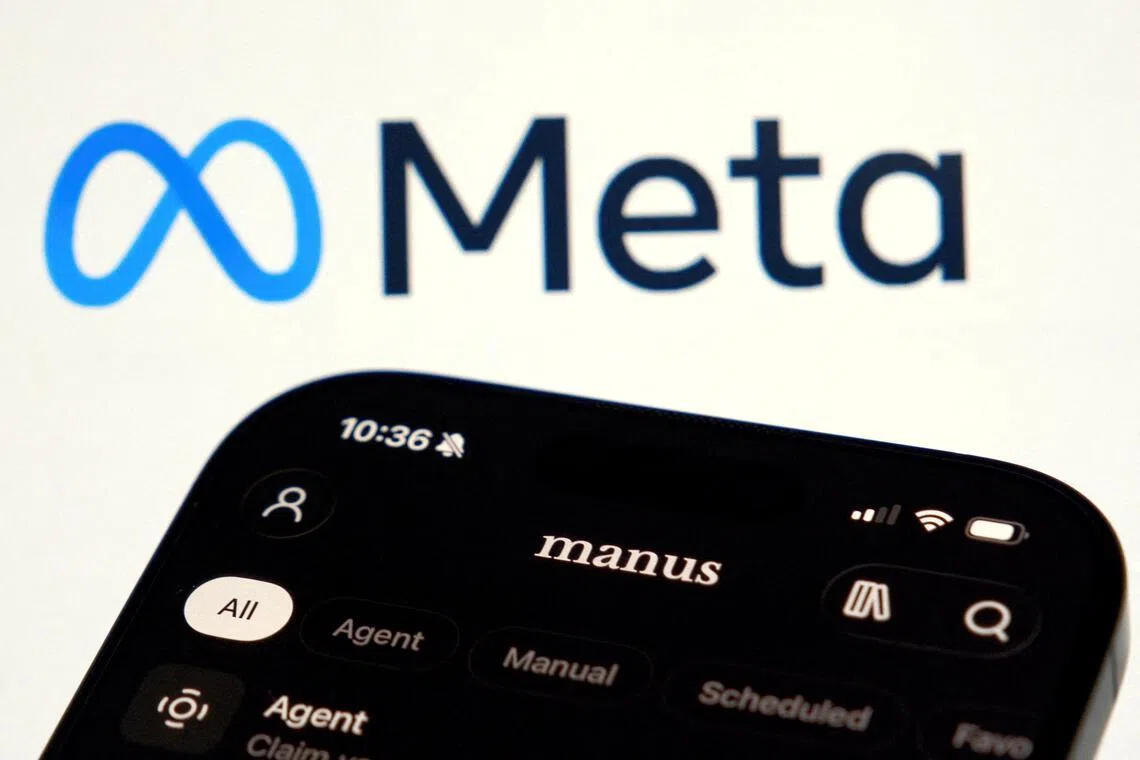
One of the most prominent examples is Manus. The platform’s advanced capabilities caused a sensation when it was launched by a Chinese start-up in early 2025. In December, Meta Platforms, the owner of Facebook and WhatsApp, agreed to acquire it for more than US$2 billion (S$2.6 billion).
The future of Manus is now up in the air after the Chinese government said it would block the takeover. The decision comes amid an intensifying race between China and the US for leadership in AI. With much of the work to fold Manus into Meta already complete, it’s not clear exactly how the deal could be unwound.
What’s significant about Manus?
Whereas regular chatbots usually provide a user with information, agents can complete multi-step tasks by interacting with other apps and tools and making independent decisions on the user’s behalf after being given the necessary passwords and permissions.
Many AI agents still require human oversight. Manus is designed to be more autonomous, meaning it can self-direct a series of assignments from start to finish to achieve a goal.
It was developed by start-up Butterfly Effect, which secured backing from major Chinese investors including Tencent Holdings, as well as US$500 million in funding from Silicon Valley venture firm Benchmark.
Technology companies are racing to deploy agents because they can potentially take over a wider range of tasks from humans and complete them faster and at a lower cost. This makes “agentic” AI strategically important for companies and governments. Manus drew particular attention because its arrival suggested advanced AI agents were emerging faster than expected, and not just from US labs but from China as well.
What tasks can Manus perform?
Manus has demonstrated that it can handle work typically done by a junior analyst, freelance developer or research assistant – often simultaneously and without step-by-step human instructions. It can independently browse the web, write and run code, and manage files. In customer service, it can handle calls, verify user data, run background checks and deliver tailored responses.
The system gained attention through demonstrations of multi-source stock research, generating investment summaries, booking travel through live websites and building functional websites from a single prompt. Over time, it can learn user preferences, acting more like an ongoing collaborator than a one-time assistant.
Testing suggests the platform has certain limitations. Manus can be inconsistent under pressure, sometimes getting stuck in loops – repeating the same cycle of actions without making real progress toward its goal – or failing at complex tasks.
How did Meta end up buying Manus?
The takeover was agreed after Butterfly Effect relocated from China to establish itself as a Singapore-based company. The acquisition aligned with Meta founder Mark Zuckerberg’s ambition to build advanced, personalised AI tools. The US tech giant took just days to strike the deal, seeing it as a rare opportunity to quickly integrate advanced agentic technology into Facebook, Instagram and WhatsApp and their advertising platforms.
Manus’s rapid growth added to the appeal: It reached more than US$100 million in annualized revenue within months of its launch, making it one of the fastest-growing AI start-ups in history. The takeover was to make Meta a more formidable force in AI alongside Alphabet’s Google, ChatGPT mker OpenAI and Claude maker Anthropic.
Meta said it would keep Manus as a standalone service while also integrating the technology across its platforms. It said there would be no ongoing Chinese ownership and that its services in China would be discontinued.
Why has China said it’s now blocking the deal?
On April 27, China’s National Development and Reform Commission abruptly ordered the Meta-Manus transaction to be unwound, issuing a brief directive that barred foreign investment in the company and required all parties to withdraw. The statement didn’t give a detailed explanation for the decision.
The move was striking because the deal had effectively been completed, the target company had relocated to Singapore and shut its China operations and the buyer had committed to eliminating all Chinese ownership ties. Beijing’s intervention suggests it’s willing to reach beyond its borders to reassert control over a company it still considers Chinese-origin.
Manus’s founders honed the technology in part in China, where the company is seen widely as a homegrown success story despite its subsequent move to Singapore.
The government announcement didn’t come as a total surprise. Signs of official resistance to the takeover emerged earlier in 2026, when Chinese authorities opened a review of the potential national security implications and Manus’s co-founders, Xiao Hong and Ji Yichao, were summoned for questioning in Beijing. The two were barred from leaving the country during the probe.
China’s decision reflects intensifying competition with the US in AI, with both governments viewing the technology’s hardware, talent and intellectual property as strategic assets. Washington has restricted China’s access to advanced AI chips, while Beijing appears determined to prevent key technology and expertise from moving abroad.
So can China really stop the Manus deal?
Although it isn’t clear whether the Chinese government can force Meta to reverse the deal, it’s decision has left the acquisition in legal and operational limbo.
China’s leverage over Meta is limited. But Manus’s founders and many of its core team members are Chinese nationals. This gives China’s government ways to exert pressure on the companies.
Parts of the deal have already been executed. Manus’ employees have already moved into Meta offices in Singapore, and technology and capital have been transferred. But the Manus team are an important element of the acquisition, and their continued presence is required in order to build new products and services related to the technology, complete product roadmaps and meet targets tied to the deal.
It could take some time for Meta executives to ascertain whether China’s government is open to some kind of settlement that allows the US company to retain the Manus staff, such as a potential licensing or partnership arrangement with a Chinese entity.
The implications of China’s move reach beyond Meta and Manus. Its intervention challenges a strategy in which start-ups from the Chinese mainland relocate to places such as Singapore to access global capital while distancing themselves from Chinese oversight. The US government will be watching closely to see whether Beijing’s move effectively freezes other Chinese AI deals with foreign entities.
“Any Chinese-origin AI company considering the same path – build domestically, move offshore, sell to a Western acquirer – now has to assume Beijing can and will reach into the deal,” Bloomberg Economics analysts Michael Deng and Adam Farrar wrote in a research note. BLOOMBERG

