


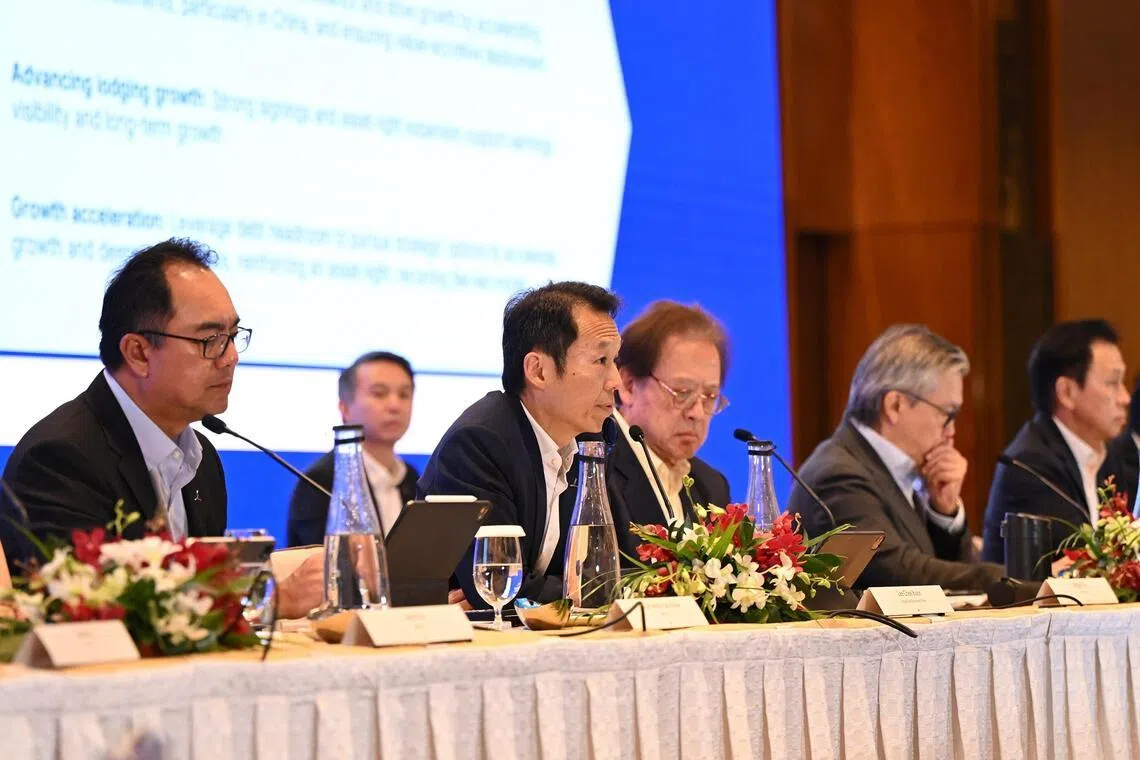
SINGAPORE – CapitaLand Investment responded at length to a shareholder’s question on a rumoured acquisition of Mapletree Investments, reiterating that it would not pursue deals simply to meet its $200 billion funds under management (FUM) target by 2028.
Speaking at its annual general meeting on April 28, the real asset manager said any merger and acquisition (M&A) would have to deliver clear benefits to shareholders.
More than 800 shareholders attended the meeting at the Sands Expo and Convention Centre.
The Wall Street Journal first reported on Nov 3, 2025, that the two asset managers were exploring a merger. Since then, neither has confirmed the talks or provided any updates.
But group chief executive Lee Chee Koon had told the media at CLI’s financial year 2025 results briefing on Feb 11 that the company was assessing numerous deals on their affordability and ability to be integrated into CLI.
The shareholder who posed the question noted that Mapletree, which has $80.3 billion in assets under management as at March 31, 2025, may not be the right fit for CLI.
He said that while the real estate investment firm has expanded into data centres and purpose-built student accommodation, these segments have also seen impairments, where losses are booked when assets are worth less than expected.
The shareholder added that Mapletree’s asset strategy appears to be “vertically siloed” with its two real estate investment trusts (REITS) – Mapletree Investment Trust (MIT) and Mapletree Logistics Trust (MLT) – focusing on industrial and logistics assets.
A merger of these assets could run counter to CLI’s risk diversification strategy through CapitaLand Ascendas REIT (CLAR), its biggest industrial REIT.
“I hope we don’t do things just to grow the FUM,” the shareholder said. “This is something that really troubles a lot of us.”
Analysts had previously rated a potential merger as a positive move for CLI to expand its scale, allowing the merged entity to compete against global giants in real estate and asset management such as Blackstone and Brookfield.
In response, CLI’s chairman Miguel Ko reassured shareholders that CLI has not wavered from its commitment to pursuing meaningful M&As. “We are here to ensure that all of you in this room are well protected.”
Independent director Anthony Lim said in any deal it seeks to complete, the board would not only have to address the views of its minority shareholders but those of its majority shareholder, Temasek, too.
CLI would assess the reasons for acquiring any company, and weigh its worth against its price, as well as the payment structure.
Mr Lee added that there is no perfect deal, and CLI would assess how it can address any shortcomings in a company it acquires.
Mounting pressures in China’s real estate market were also a key concern for CLI’s shareholders.
They raised questions about the real asset manager’s strategy in China and how it plans to monetise its assets, as plunging valuations drove its profit down from $479 million to $145 million for the 2025 financial year.
Mr Puah Tze Shyang, chief executive of CLI China, said that the company has the greatest exposure to commercial real estate, and rents in the country have been declining over the last three to four years as a result of a slowdown in the Chinese economy and domestic consumption.
It is hoping for a stabilisation in the property market and a recovery in consumption sentiment, before rents begin to improve.
Mr Lee added that weaker performance at CLI’s business parks in China was partly due to an oversupply of commercial space in several cities, as well as fewer foreign firms expanding there and local companies adopting a “wait-and-see” approach.
However, it is beginning to see green shoots of recovery, particularly in the retail sector, which has shown the most resilience. The hotel and rental apartments sectors are also expected to recover more quickly, although business parks and offices would take longer, he said.
A representative of non-profit research house Corporate Monitor asked the board how it intends to improve the company’s return on equity (ROE), which has been below 5 per cent over the last six years.
ROE measures how well a company uses shareholders’ money to generate profit.
Chief financial officer Paul Tham acknowledged that the China business had “dragged down” the company overall. Its ROE, averaging around 4 per cent over the last two years, would have gone up to 6.7 per cent in financial year (FY) 2024 and 6.9 per cent in FY 2025 if not for the Chinese market downturn.
He noted that a double-digit ROE figure remains the target. As fee income-related businesses continue to grow and the company continues to divest assets, it should hit an ROE of 8 per cent to 9 per cent – excluding the China business – in the coming years.
Despite ongoing challenges in the China market, CLI is preparing to launch its second China REIT (C-REIT), first announced on Feb 11, in the late second quarter or early third quarter of 2026.
The asset manager successfully listed its first C-REIT, known as CapitaLand Commercial C-REIT, on the Shanghai Stock Exchange on September 29, 2025.
It is now aiming to combine both C-REITs into a “single flagship C-REIT that combines scale”, subject to regulators’ guidance and support, said Mr Puah.
This would not only allow CLI China to recapitalise some of its stabilised China assets, but also afford it greater scale and diversity of asset classes, which are factors that lead to a “more robust performing C-REIT.”

