Learn more about Singapore’s Best Employers 2026 here.
The biotechnology industry is changing fast. Artificial intelligence, automation and digital tools are reshaping how teams work, make decisions and deliver medicines around the world.
But at Amgen, a global biotech company focused on developing innovative medicines for serious diseases, the question was never what the technology alone could do; it was what people could do with it.
Mr Sugan Ramasamy, 34, is a case in point.
In his role supporting operational planning at Amgen’s Singapore operations, Mr Ramasamy’s work focuses on coordinating complex schedules to ensure cross-functional activities run smoothly and on time.
For years, this was managed entirely through spreadsheets – painstaking and time-consuming work that is vulnerable to human error.
So Mr Ramasamy explored how digital tools could be used differently. Using enterprise automation tools available at Amgen, he developed workflows that previously took hours of manual coordination.
The solution helps consolidate information, streamline scheduling tasks and flag potential issues earlier – freeing him and colleagues to focus on decisions that actually require human judgement.
“Having leaders who believe in your potential and give you opportunities to grow makes a huge difference. That support gave me confidence to step forward and take on new challenges,” says Mr Ramasamy, who has a master’s in biomedical engineering.
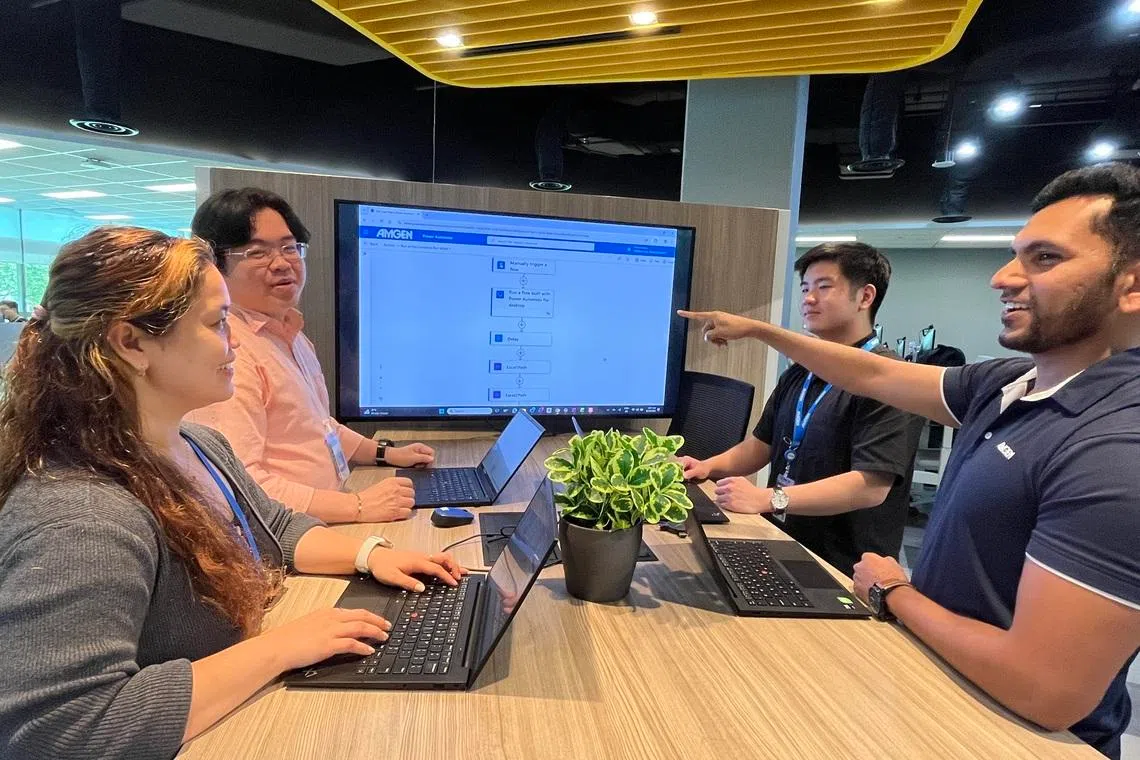
Mr Sugan Ramasamy (far right) collaborates with colleagues to leverage digital tools to streamline workflows and drive data-driven decision-making.
PHOTO: AMGEN
His experience is part of a wider culture of continuous improvement at Amgen, where different teams collaborate to test and improve how digital tools can be applied more efficiently in day-to-day work.
Prior to his current role, Mr Ramasamy worked with his manager in a process-focused role to use Robotic Process Automation to handle repetitive tasks such as data entry and data checks across multiple systems. This freed up staff to focus on higher-value work, including interpreting results and investigating anomalies.
This focus on applied learning – where staff are given the space to explore and apply digital tools to solve real-world problems – is how the company prepares for the future.
Having such a supportive environment is just one of the reasons why Amgen is consistently ranked as one of Singapore’s best employers by global research firm Statista and The Straits Times.
Ms Shobha D’Sa, the company’s human resources director, says: “The pace of change from digital tools, automation and data-driven decision-making has accelerated. We’ve focused on making learning much more applied and continuous – through structured pathways, rotations, mentoring and career conversations that help people grow with the work, rather than chase change after it happens.”
The priority, she stresses, is not just adopting the next wave of tools, but also bringing its people along.
As it turns out, this is not something that happens alongside a technology roll-out. At Amgen, a culture of trust and collaboration has to be in place long before the new tools arrived.
Only then do employees speak up, support one another and take ownership as the pace of change accelerates.
Take senior manager Charlene Peh, for example. When she noticed that new hires were struggling to stay engaged during classroom-based health and safety training sessions, she worked with external partners and cross-functional colleagues to help develop an immersive safety experience using gamification and virtual reality.
Since early 2026, new hires in Singapore have been able to explore realistic work environments virtually and practise safety responses through simulations and interactive modules on their screens.
Says Ms Peh, 41: “Here, employees are trusted to step forward with ideas, and managers help create the space for those ideas to grow.”
Underpinning that trust is what the company calls an “Active Caring” culture, built on regular monthly check-ins where managers listen to their team, spot employees’ potential and help them plan their next career move.
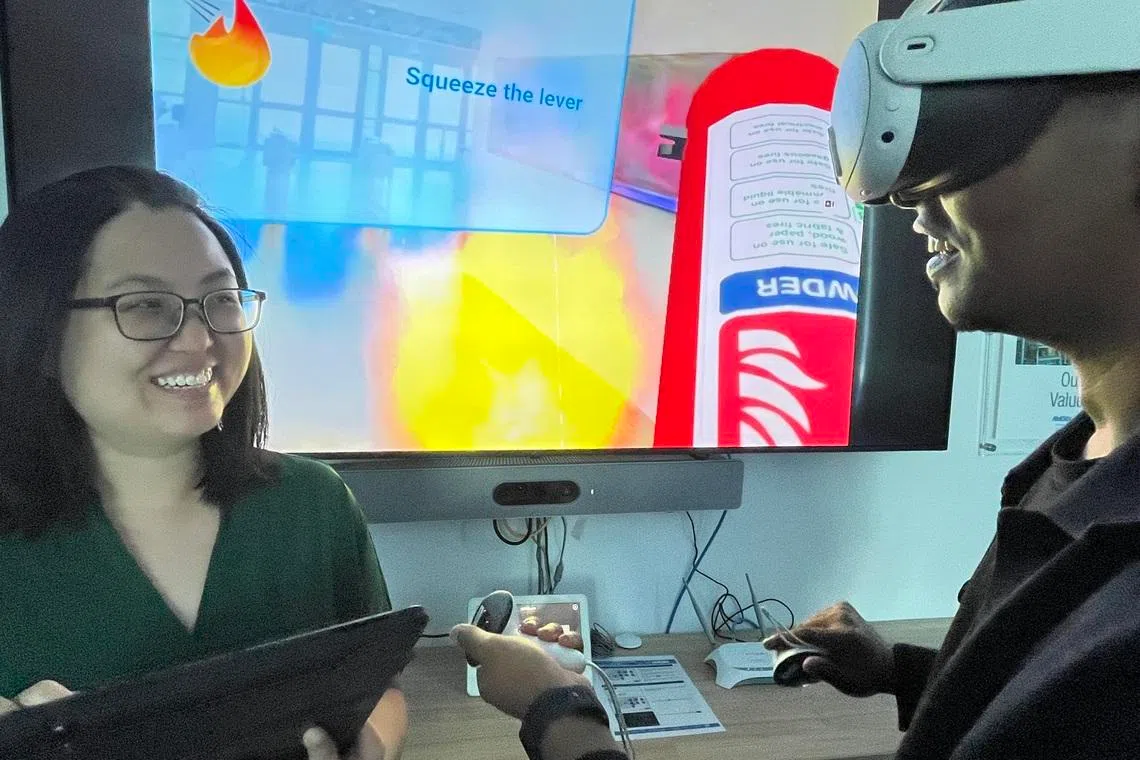
Ms Charlene Peh (left) engages with a colleague during an immersive safety training session by using digital and augmented reality tools to enhance hands-on learning and real-world readiness.
PHOTO: AMGEN
For Ms Peh, those same check-ins led to a different kind of support. Her manager connected her with mentors who helped her strengthen her communication and presentation skills, including through a leadership course on handling tough conversations and listening more effectively. She now brings these skills into her leadership role.
“Leadership, to me, is defined not by title but by responsibility and psychological safety,” she says.
“When you feel safe enough to step up, ask a question, drive a change or guide a colleague, that’s when you become the kind of manager people can rely on.”
For Mr Ramasamy, regular chats with his manager encouraged him to apply for the company’s FUEL Emerging Talent Rotational Program, which places employees in different departments over 26 months to learn how various parts of the business work together.
He says: “Managers here take the time to know you and your work, then encourage you to try new things while giving you the room to grow.”