


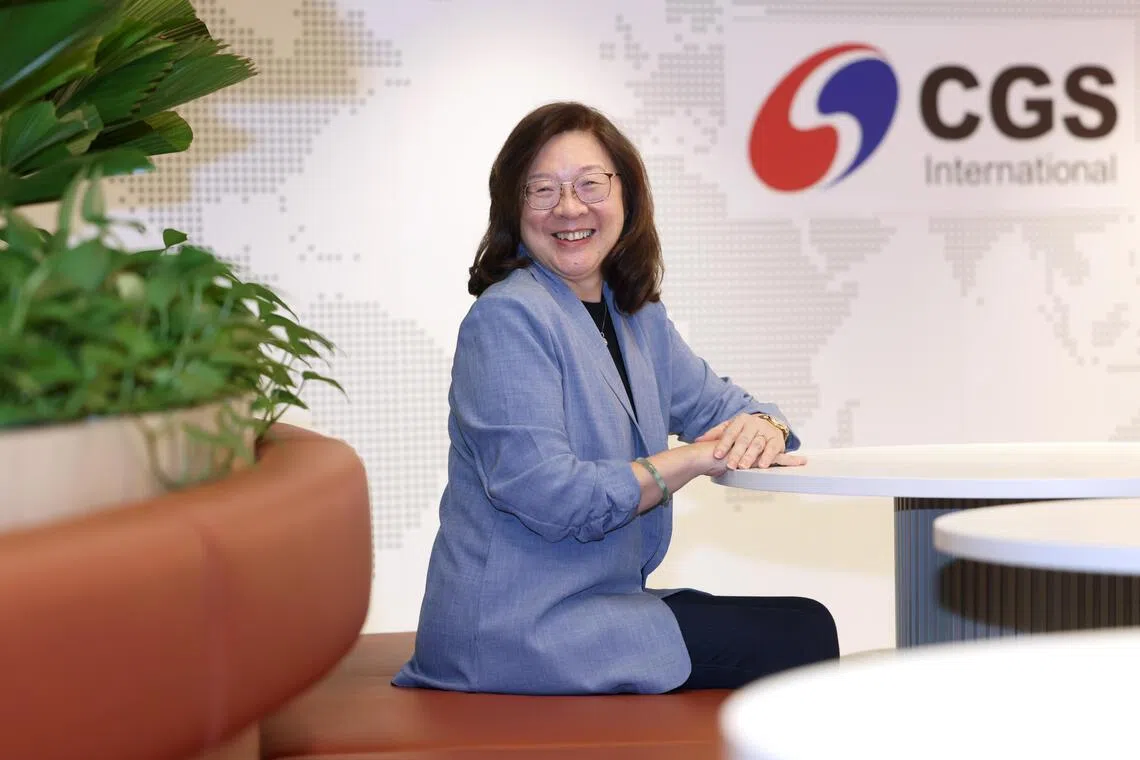
SINGAPORE – As trading on the Singapore stock market picks up, sustaining that momentum will depend on attracting a broader mix of companies, and ensuring they are high-quality firms with strong growth stories.
Over the next two to three years, many of these are likely to come from China, with the number of Chinese listings potentially rising fivefold from just a handful over the past year, Ms Carol Fong, chief executive of CGS International, told The Straits Times.
Her firm had earlier estimated that only about five Chinese and Hong Kong firms could come to list on the Singapore Exchange (SGX) through dual listings or share placements.
“Five is now conservative,” she said.
Singapore-based CGS International a wholly-owned subsidiary of China Galaxy Securities (CGS), one of the country’s largest state-owned brokerages. The financial services provider was formed after CGS fully acquired Malaysia’s CIMB Group in 2024.
Ms Fong, who began her career at CIMB Group, has more than 30 years of experience in capital markets.
The industry veteran told ST that while measures to revive the Singapore stock market have worked well to raise demand and draw investor participation, ensuring there is a strong corresponding supply of companies for them to invest in is key to sustaining interest.
“You can’t just keep pushing valuations higher. At some point, you need more companies, more sectors, more opportunities.”
Ms Fong said Chinese firms, spanning advanced manufacturing to domestic consumption and technology, are looking not just for capital, but for international branding and access to a bigger pool of investors.
“They want to internationalise and need to get non-renminbi funding,” said Ms Fong, adding that her firm is in talks with some of these companies about listing in Singapore in the next few years.
Singapore has already seen a handful of China-linked listings in recent years, including bar chain operator Helens International, video graphics card maker PC Partner and green energy provider Concord New Energy.
Still, Ms Fong noted that these firms were “technical listings”, or secondary listings without fresh capital raising, which are “not enough to move the needle”.
“The focus now is to bring companies with fund-raising. That’s where you get liquidity.”
Liquidity, in turn, drives analyst coverage, investor participation and ultimately valuations, creating a virtuous cycle, said Ms Fong. “Without it, listings risk becoming symbolic rather than transformative,” she said.
The push to bring more firms from China to SGX also comes at a time when there has been a surge of mainland firms rushing to list in Hong Kong, creating a long queue. Some estimates suggest it can take well over a year to complete the process.
That’s spurred some of these firms to look at Singapore, where the regulatory pathways to an IPO are now shorter and “less cumbersome” for eligible companies, provided they meet requirements and secure approvals from Chinese regulators, said Ms Fong.
She added that Singapore’s positioning as a neutral financial hub appeals to companies looking to raise international capital without geopolitical friction.
Not every Chinese company can be enticed here though.
But while mega-cap firms such as Alibaba and BYD are likely to favour Hong Kong or US markets for their deeper liquidity, mid-sized companies valued at about US$500 million (S$638 million) to US$1 billion could increasingly turn to Singapore.
These firms risk being “small fish in a big pond” in Hong Kong, and may find Singapore more suitable, especially if they are looking to expand within the region, Ms Fong said.
She added that companies with existing ASEAN operations in Indonesia, Malaysia or Singapore are prime targets for an SGX IPO, as listing in Singapore can strengthen their regional identity and pitch to investors.
Larger firms can also be expected to list their overseas operations here. In 2024, for example, South Korea’s Hyundai Motor listed its Indian unit, Hyundai Motor India on the Bombay Stock Exchange and National Stock Exchange, raising more than US$3 billion.
Similarly, Chinese companies with significant ASEAN manufacturing footprints could list those operations in Singapore, creating a new pipeline of listings, Ms Fong said.
The renewed push to attract Chinese listings to Singapore may dredge up bad memories among local investors of the S-chip saga.
Between the late 2000s and early 2010s, a wave of Singapore-listed Chinese companies – dubbed S-chips – ran into governance and accounting issues. These firms, often operating in China but incorporated offshore, faced accusations of financial fraud, including phantom factories and missing cash, leading to massive investor losses.
Many of these firms have since collapsed, been delisted or remain suspended, while those that remain are thinly traded with little investor interest.
Examples include FerroChina, which went bankrupt; China Sun Bio-Chem, which was delisted following accounting irregularities and missing assets; and China Fishery Group, which collapsed amid fraud allegations.
Ms Fong, however, argues that the risk of a repeat of the S-chip saga is significantly lower today.
In the past, Chinese firms could list in Singapore with relatively limited oversight from regulators. Some of these companies were later found to have weak controls or questionable practices, which led to losses for investors and a prolonged period of scepticism towards China-linked listings.
The listing framework has since been tightened considerably. Chinese companies seeking to list overseas must secure approval from the China Securities Regulatory Commission, in addition to meeting Singapore’s regulatory requirements.
This effectively introduces dual oversight, with both jurisdictions involved in vetting the companies before they come to market, Ms Fong said.
The process is also more selective and time-consuming, with greater emphasis on due diligence and disclosure standards. As a result, listings are expected to be fewer but of higher quality, which is key to rebuilding investor trust.
Against this backdrop, the current push to bring more Chinese companies to Singapore is being positioned not as a return to the S-chip era, but as a more measured effort to attract firms with stronger governance, clearer growth strategies and a genuine international expansion story, Ms Fong said.
Ultimately, attracting Chinese listings is just one way to keep supply supported though.
The bigger task is to rebuild Singapore’s listing pipeline by attracting domestic champions that can anchor the market and other regional ASEAN firms seeking an international platform on top of Chinese companies looking to expand beyond their home base, said Ms Fong.
For now, the stars are aligning.
“Chinese firms are looking outward and Singapore is positioning itself as a gateway. At the same time, stock valuations here are recovering and liquidity in the local stock market is improving,” said Ms Fong.
“But windows do not stay open forever,” she said, noting that execution will determine whether the market can grow from five to 25 listings.

