


SINGAPORE – From make-up to skincare, consumers may soon be able to try products virtually, place an order and receive them on the same day, said the chief operating officer (COO) of e-commerce firm Shopee.
As a Shopee user himself, Mr Terence Pang’s sees a future where same-day deliveries become the norm, especially for everyday purchases.
“There is something meaningful about being able to decide you need something in the morning and having it arrive by the end of the day. That immediacy makes e-commerce feel truly integrated into daily life,” he told The Straits Times in an interview.
Mr Pang said e-commerce could become even more embedded in everyday life within the next five to 10 years.
“It won’t feel like a separate activity where you sit down to ‘go shopping’,” he said.
“Discovery will happen through content, recommendations and communities, and buying will be a lot more intuitive. Behind the scenes, platforms will continue to make shopping faster, more affordable, and more reliable, so buyers get what they need with less effort and more confidence.”
Shopee has come a long way in providing a full e-commerce experience for users since its beginnings as a mobile app.
The platform, which is owned by US-listed company Sea, started in 2015 as a mobile app for consumers to buy items online in six Asean markets – Singapore, Malaysia, Indonesia, Thailand, Vietnam, and the Philippines – as well as Taiwan.
Back then, consumers typically shopped online on their computers or directly on shops’ websites, Mr Pang said. Shopee filled the gap by allowing people to shop mobile-first.
In the first year of operations, Shopee generated US$1.8 billion (S$2.3 billion) in gross merchandise value. In 2025, gross merchandise value rose to US$127.4 billion.
Fast-forward 10 years and Shopee is now one of the go-to apps when people want something without having to go to a physical store.
It has also expanded its footprint to Brazil.
The app has expanded from offering just consumer items to fresh groceries, for instance.
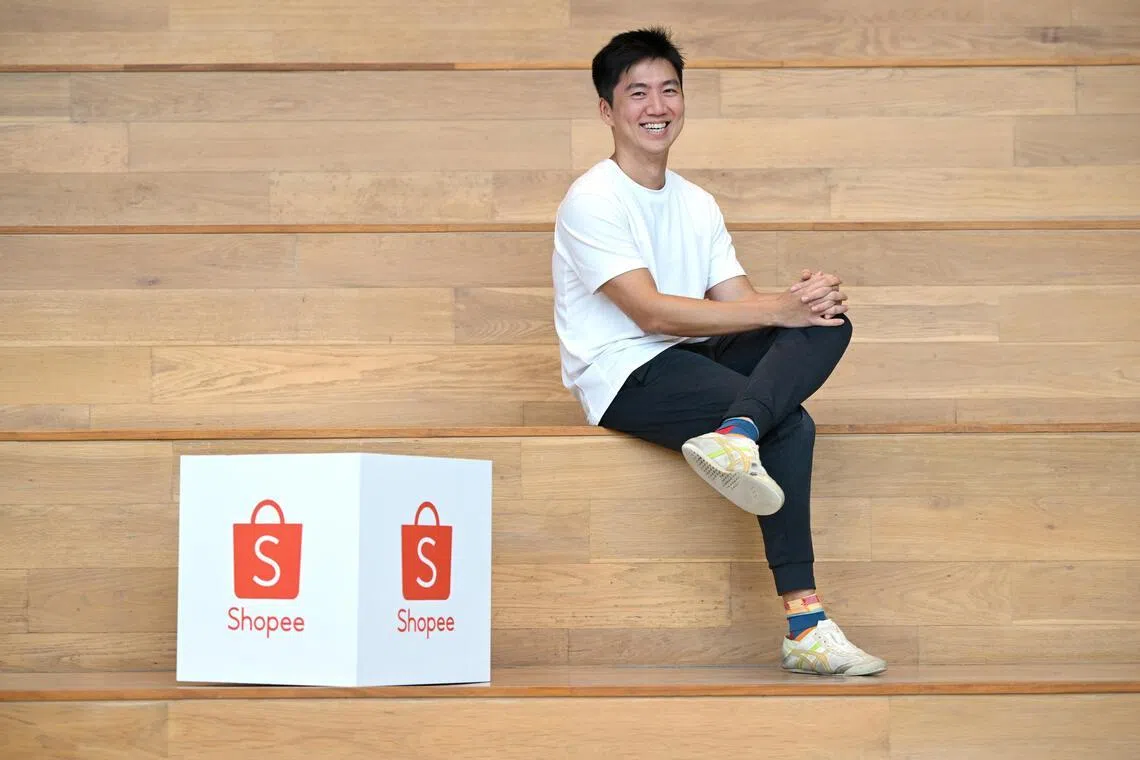
Shopee’s COO Terence Pang noted that users in Singapore show a strong demand for daily necessities.
ST PHOTO: NG SOR LUAN
Mr Pang noted that users in Singapore show a strong demand for daily necessities, with Shopee responding by partnering retailers like Don Don Donki, Guardian, Scarlett and Redman by Phoon Huat.
Meanwhile, users in Taiwan are interested in items like face masks. In Brazil, there is strong demand for bedding, while in Thailand, daily-use products such as soft wipes are popular.
“These examples show that people rely on e-commerce not just for occasional purchases, but for items they regularly need and trust us to deliver reliably,” Mr Pang said.
Rather than just a website for sellers to list their wares, Shopee calls itself a marketplace that allows sellers to list for free, but takes fees from the transactions that are made on the platform, and when an order is successfully completed.
It also helps sellers to engage consumers through shopping campaigns, promotions and shop vouchers.
Shopee also works with logistics providers to help sellers to arrange shipments through the app, so they do not need to find their own delivery providers.
Even Mr Pang is not immune to its charms. He uses the app to buy children’s essentials for his young sons, as well as educational toys like building blocks.
The delivery and collection process is also important to him, and he uses collection points like lockers to get his parcels on the way home from work.
There was a time when the locker near him was under maintenance, which meant Mr Pang had to use an alternative for two weeks and change his usual routine.
“This experience was a useful reminder that even small operational changes can affect how people organise their day around such services,” he told ST.
His own experience led to Shopee working with logistics partners to ensure that there are alternatives offered to users whenever there is downtime at a collection point.
“Technology will continue to play a role but the real progress will come from removing friction and making the experience feel effortless,” Mr Pang said.
With buying on the app becoming increasingly commonplace, the future for e-commerce is bright, buoyed by developments like artificial intelligence (AI), he said.
“For buyers, AI helps reduce uncertainty when shopping online,” he said.
Such tools can now help to replicate parts of the in-store experience digitally, such as analysing a shopper’s skin concerns and recommending suitable products.
AI also allows users to virtually try on makeup shades before buying, for instance.
On the side of the sellers, Mr Pang said micro enterprises in particular are using e-commerce as a way to expand into overseas markets without having a physical presence there.
Singapore sellers can now reach buyers in markets such as Malaysia, Thailand, Philippines and Taiwan without having to set up overseas operations, he said.
“This regional connectivity continues to create new avenues for growth even as the local market matures.”
AI also helps sellers improve productivity, giving them suggestions on how to boost listing quality and supporting customer engagement through AI shop chatbots to help sellers respond more efficiently.
Mr Pang also noted that research shows how e-commerce revenue in Singapore is expected to show an annual growth rate of 3.86 per cent, resulting in a projected market volume of US$6.81 billion by 2030.
“There is still meaningful room to expand e-commerce adoption, particularly among underserved or under-penetrated segments, as well as opportunities to grow wallet share as consumers become more comfortable buying a wider range of products online, from daily essentials to higher-value purchases,” he said.
In the future, there might also be higher engagement between sellers and buyers, as trends like TikTok streaming opens ways for brands to reach out to consumers in increasingly personal ways.
Shopee is also building its own community of livestreamers and content creators, who can be anyone from students to homemakers and full-time creators.
It launched a Shopee Live Academy to train aspiring livestreamers. It also offers cash incentives for those who meet monthly goals.
With these developments, Mr Pang is confident that e-commerce will continue to be an important part of how people shop in the years ahead.
“More broadly, this pattern isn’t unique to Singapore,” he said.
“Across South-east Asia, Taiwan and Brazil, we see e-commerce at different stages of maturity, but driven by the same fundamentals of improving access, growing confidence, and better experiences for buyers and sellers.”

