


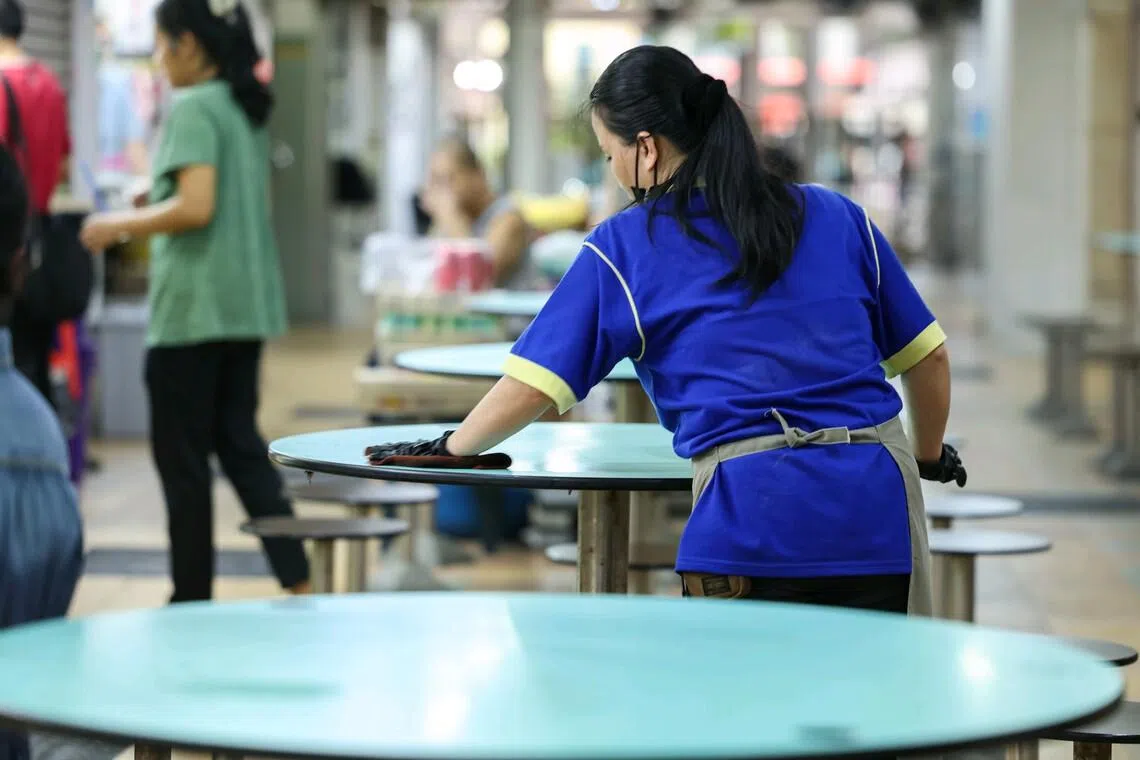
SINGAPORE – Tougher times could lie ahead for cleaning services firm LS 2 Holdings, as the phased withdrawal of a government scheme that co-funds wage increases for lower-wage workers is expected to raise costs for the Singapore Exchange (SGX)-listed group as support tapers off.
“While the group’s core operations are expected to remain resilient, the removal of Progressive Wage Credit Scheme (PWCS) support is likely to result in some moderation of reported earnings going forward,” LS 2 said.
It added that although it has begun adopting some technologies to raise productivity, the group has yet to develop a strategy to integrate artificial intelligence into its operations, which remain reliant on manual labour.
LS 2 was responding to questions from the Securities Investors Association (Singapore) submitted in response to its 2025 annual report, and ahead of its annual general meeting on April 24.
The questions, disclosed on SGX on April 19, revealed concerns about how LS 2’s operating costs and margins would be affected when the PWCS ends.
Under this scheme, the Government provides transitional wage support for employers by co-funding wage increases for lower-wage workers covered by the Ministry of Manpower’s Progressive Wage Model (PWM).
The scheme had been slated to end in 2026 but was extended to 2028 in Budget 2026. Co-funding support will drop from 40 per cent in 2025 to 30 per cent in 2026 and 2027, and a further reduction to 20 per cent will take place in its final year.
SIAS noted that LS 2 had recognised $1.2 million in grant income from the PWCS in FY 2024, and $1.6 million in FY 2025.
Meanwhile, the group’s profit was $2.5 million in FY 2024 and $3.1 million in FY 2025.
In its response, LS 2 said it expects the phasing out of the PWCS to have a manageable impact on its underlying operations.
It added that margins will not be significantly affected, as it has already priced in the higher labour costs associated with PWM wage adjustments into existing and renewed contracts.
However, the group did not disclose the number or value of its contracts, making it difficult to assess how effectively it can pass on higher costs, although its annual report noted it serves more than 200 clients.
In his statement in the annual report, LS 2 executive chairman Tan Hoo Kiat said demand for cleaning and maintenance services across public infrastructure, commercial buildings, hospitality establishments and educational institutions in Singapore is expected to remain stable over the next 12 months.
Still, he added that the operating environment is expected to remain challenging as the industry will continue facing cost pressures arising from progressive wage increases, foreign worker levy adjustments and manpower constraints.
LS 2’s annual report showed that employees wages, excluding grant income from various schemes, had risen 7 per cent over the previous year to $45 million in FY 2025, due to higher foreign worker levy expenses and performance-based bonuses.
Around 1,150 employees, making up about 62 per cent of its staff, are covered under the PWM, it disclosed in its response to SIAS.
SIAS also asked about the group’s initiatives to improve workforce productivity and efficiency after the PWCS ends.
LS 2 replied that it is focusing on sustainable productivity improvements to offset rising labour costs, given that PWM-related wage increases are expected to be permanent.
Initiatives implemented include the deployment of advanced cleaning equipment to reduce reliance on manual labour and improve productivity per worker, while its digital workforce management system enhances scheduling efficiency, reduces idle time and optimises its manpower allocation across contracts.
It will also invest in workforce upskilling and multi-skilling programmes to enable employees to perform a wide range of tasks, thereby improving labour flexibility and efficiency.
“The Group will continue to invest in productivity enhancements to mitigate the impact of the withdrawal of government support.”
SIAS also asked LS 2 about its strategies for digitialisation and technology integration.
The company replied that it has progressively reduced its reliance on manpower to deliver its services, through the adoption of technology and mechanisation.
For example, it has introduced exoskeletons to ease the physical demands on its ageing workers, which make up a significant portion of its workforce, and extend their working ability.
It added that the deployment of new technologies enhances the attractiveness of roles to bring in a younger pool of workers, while it views automation as a complement to, rather than a replacement for, human labour.
“Overall, management believes that while manpower will remain a core component of operations, technology adoption will continue to optimise workforce utilisation and support sustainable productivity improvements.”
Despite its focus on technology, LS 2 revealed that AI has yet to play a meaningful role in its business strategy, as the company is still undertaking feasibility studies to assess how AI can be effectively integrated into its operations.
The group said it plans to focus on several potential “high impact areas”, including workflow optimisation, predictive maintenance, resource planning, and service quality monitoring.
It said that it intends to first establish a strong foundational platform before introducing AI capabilities. “This approach ensures that any future AI deployment is built on accurate, consistent and scalable operational data, thereby maximising its effectiveness and sustainability.”
Shares of LS 2, which listed on the Catalist board in 2022, was trading on April 21 at 8.2 cents.

