


In this series, The Straits Times offers practical answers to candid questions on navigating workplace challenges and getting ahead in your career. Get more tips by signing up to The Straits Times’ Headstart newsletter.
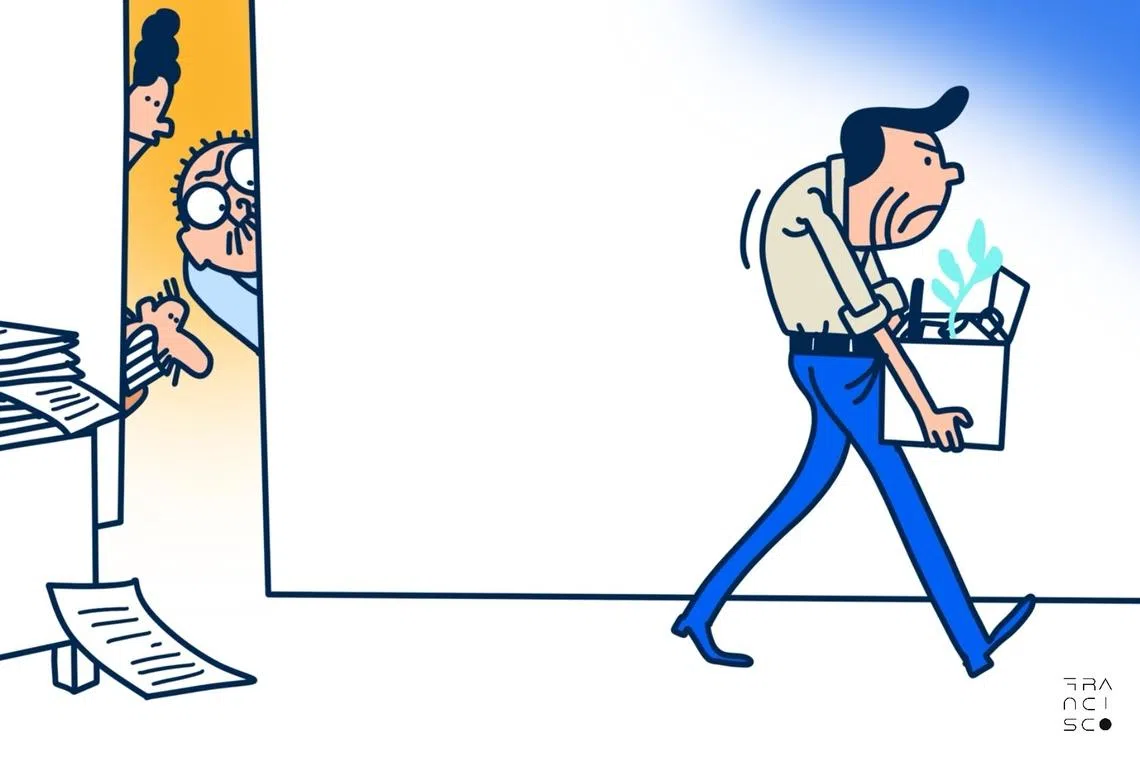
On social media, “quiet firing” refers to a situation where employees are sidelined in a way that may lead them to resign rather than be formally dismissed.
It often does not begin with a clear signal.
Instead, it may unfold gradually, with fewer opportunities, exclusion from meetings and repeated rejection of work.
In Singapore, the term is not defined in law.
“Quiet firing is a social phenomenon that has not been clearly defined,” said a spokesman for the Tripartite Alliance for Dispute Management (TADM) and the Tripartite Alliance for Fair and Progressive Employment Practices (TAFEP), adding that such cases are assessed based on existing employment laws and tripartite guidelines.
Under the Employment Act, employees are protected against wrongful dismissal, defined as dismissal without just or sufficient cause.
The Tripartite Guidelines on Wrongful Dismissal further state that involuntary resignation can amount to wrongful dismissal, said the TADM and TAFEP spokesman.
This means that even if an employee resigns, the law may treat it as a dismissal if the resignation was effectively forced.
However, not all forms of perceived “quiet firing” are unlawful, noted Mr Nicolas Tang, managing director at Farallon Law Corp.
Mr Tang said a distinction has to be made between whether an employer’s behaviour is lawful and whether the employee feels that the situation is unfair.
He added that employers generally retain discretion over decisions such as bonuses, increments and job scope. Actions such as reducing responsibilities, assigning less desirable work, or limiting salary increases may be perceived as unfair, but are not necessarily illegal.
“The company may be able to justify that, citing reasons such as a change in market conditions, structural changes within the company, or poor performance of the employee,” he said.
Employees who suspect they are being pushed out should raise their concerns early, said the TADM and TAFEP spokesman.
The spokesman added that employees should first use their company’s grievance handling channels for prompt and effective resolution.
“However, if internal resolutions still do not work, employees who are working for unionised companies can reach out to their specific affiliated unions to seek mediation,” said Mr Rumi Mohd, director of sales, marketing and technology at Randstad Singapore.
National Trades Union Congress assistant secretary-general Patrick Tay said employees should document changes in workload, instructions, performance, feedback and responsibilities, as well as any instances of exclusion from projects or opportunities.
“Employees may wish to review their employment contract or staff handbook for grievance handling procedures, and raise concerns early with the relevant parties, such as their HR team,” Mr Tay said.
Employees who believe they have been wrongfully dismissed may file a claim with TADM to seek reinstatement or monetary compensation.
TADM may arrange mediation between the employer and employee, and if no agreement is reached, the case may be referred to the Employment Claims Tribunals for adjudication.

