


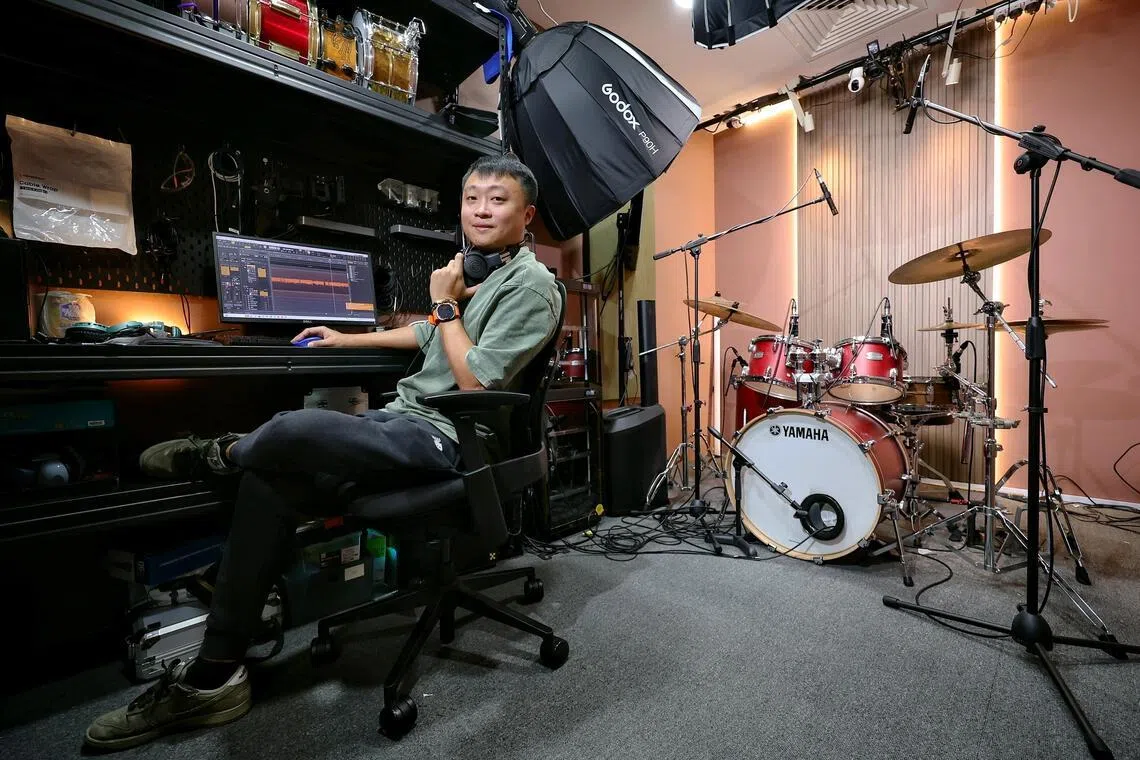
SINGAPORE – When drum instructor Dane Tan was young, the strong percussive beats of lion dance performances that attracted him were loud.
But louder still was his calling to a career in teaching music.
Mr Tan, 35, said: “During my polytechnic days, my heart told me to choose a music course, but my sceptical and ‘logical’ mind successfully discouraged myself. I eventually chose chemical engineering because of its monetary potential.”
At the end of each school year, he thought seriously about transferring to the music course, and even recorded works for his friends in the course. But he did not find the courage to switch to a path he loves, eventually graduating from Singapore Polytechnic with a diploma in chemical engineering.
He continued to have this mindset when he entered the workforce as a financial adviser. But he discovered that he could not find fulfilment in the job.
“Over the years, my belief in the industry eroded, and it started to drain me mentally. I was having difficulties having genuine conversations with people I met. It resulted in me being withdrawn, and a downward spiral began,” Mr Tan confessed.
After four to five years in the financial sector, he returned to his first love and opened DrumTannery, which now has two studios, in Dhoby Ghaut and Marine Parade, that provide individual drum lessons.
Mr Tan is also a dealer for most drum brands available in Singapore and provides equipment consultation for students and the public.
“With every small success that my friends and I on this path have achieved, it has slowly reaffirmed this thought: that every career is a viable career,” he said.
“I believe success is not defined by the path you take, but the choices you make while walking it.”
Mr Tan is married with a three-year-old son. His wife is a regional sales manager for a professional audio brand.
A: My largest investment would definitely be in my business. Apart from that, I do invest in some equities, more on-trend trading than long-term holdings.
However, I am exploring investments that are for the longer term and are more stable, and that also require less attention and maintenance. This could possibly be a mixture of gold, Singapore Savings Bonds and exchange-traded funds, or ETFs.
A: My first exposure was when I was studying to be a financial consultant. Excluding savings policies, I believe my first investment was in Tesla, before the stock split.
A: It was definitely cryptocurrencies. Although I did not lose a lot of money initially, some of the things I invested in resulted in me losing all my money.
This was largely due to me hopping on trends without a proper understanding of why they work.
A: It has been to bide my time and not rush to open an outlet without proper foundations and planning. Because the business built up a following and a customer base before we opened our first outlet, we broke even and lesson slots were fully registered in just six months.
I learnt this lesson from my previous failed businesses when I was much younger – a tuition agency and a music events company. My friends and I would go into businesses without a proper market strategy. We believed that we should just dive in head-first and figure it out later. This is a good mentality at times, but without proper experience and understanding of how things work, this resulted in the business heading nowhere.
I believe in a balance of fast action but with proper planning.
A: I grew up in a modest middle-income home. Money was not something that was a constant issue, but also not something that we had an abundance of.
My father, who was a financial adviser, has a huge influence on how I handle financial situations now. Some significant lessons that were drilled into us include thinking two steps ahead to plan to achieve our goals, and to have patience and persistence once things are set in motion.
These lessons proved to be useful when I entered the workforce, as that was also the time when finances in the family became highly unstable. My father started to be less productive at work due to his age, while my brother and I were struggling in the financial advisory business. We started out strong but I hit rock bottom in just four years, with my lowest income being just $800 per month.
Luckily for me, I managed to pick myself up with the encouragement of my wife, regrouped, and was patient and persistent like my father taught me. When the time was right, I put in every dollar that I had and took on two different loans to open my first drumming outlet.
My father was a “preacher” instead of a “punisher”. Whenever we did something wrong, our punishment was to listen to him with his teachings for two to three hours straight, without so much as a water break.
A: When I was younger, I wanted to be a professional touring drummer, representing Singapore and appearing on the world stage.
However, as I got to know myself more, I realised that performing is not really my thing. I prefer to stay in the background, share my experiences and guide people to achieve their goals. Teaching is that perfect avenue for me.
A: I live with my mother-in-law in an HDB three-room flat. We had been looking for a flat in our block to move into as we have multiple relatives living in the same cluster – it’s like a little “kampung” for us. We finally found it this year and it is currently being renovated.
A: I drive a Peugeot 3008. It’s a great SUV at a really low cost and is perfect for a small family.
I am really fighting against an urge to upgrade my car. Although I do enjoy luxury cars, logically I don’t think I like one enough or see its value enough to upgrade at this point.
A: It would start with dropping my son off at school, then beginning work at 9am and being productive for the rest of the day – this is very important to me.
I would also like to take a 30-minute nap in the afternoon before picking him up at 5pm, taking him out for a nice walk and see him learning new things, and then going out for dinner and drinks with my wife.
A: I would give a portion of it to my family, expand my business to the point that it makes sense to hire professional mid- to high-tier specialists for every single role, invest a portion of it into other assets, and maybe use the remainder of my time that has been freed up and some money to start non-profit/community-building organisations.
A: I would budget it out to see how long I can survive on that, and use that to plan my next short-term goals to build myself back up. It could mean basic buying and selling with second-hand items in my area of expertise, or maybe even using that money to start off a page offering my services in a freelance capacity.
In the meantime, I would also be actively looking for jobs to bring in money, in order to save up more capital.

