


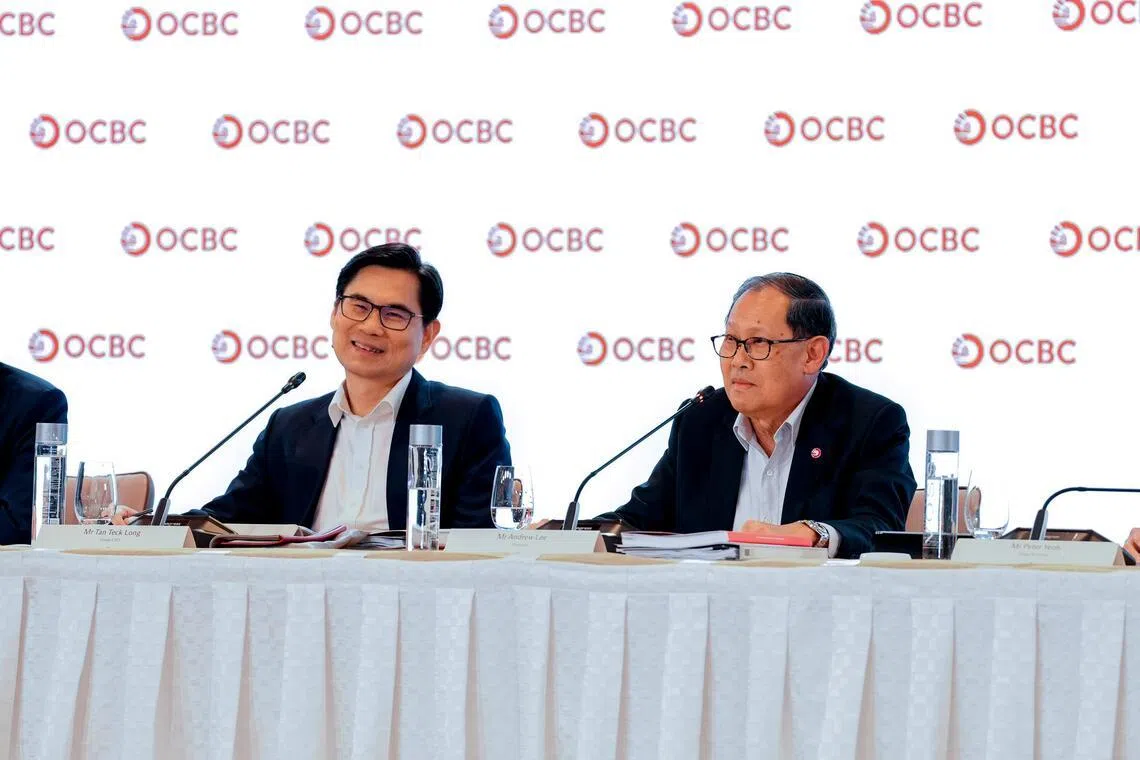
SINGAPORE – Over 1,800 shareholders flocked to the Sands Expo and Convention Centre on April 16 to hear from OCBC about its performance and dividends, and to eat the tuna onigiri and mini apple pies that were part of the bento box offerings at the bank’s annual general meeting.
One shareholder asked why OCBC could not have a higher share price like the other local banks, UOB and DBS. He also wanted more dividends and called OCBC’s current dividend offerings “chicken sh*t”, which OCBC chairman Andrew Lee refuted.
OCBC had breached the $100 billion market capitalisation mark on April 2 as its shares hit a record high, crossing the $22 mark per share for the first time, he said.
Mr Lee added that if shareholders look at their total shareholder return over a five-year period, they would be up 2.5 times for every dollar invested. Over a 20-year period, they would be up 7.5 times.
“Of course, everyone wants a better share price, but this is also linked to our performance, and also the external world situation,” he said.
He noted that OCBC had been flagging global risks since 2023, citing the Ukraine war, which disrupted food supply chains and contributed to the surge in global inflation.
Even back then, US-China tensions were impacting global trade flows, he added.
Mr Lee noted that US President Donald Trump announced another round of tariffs in April 2025, adding that policy flip-flops have continued since.
He also pointed to the Middle East conflict, which dates back to 2023 but has since escalated, raising the risk of an energy shock as about 20 per cent of global oil, gas and chemicals flow through the disrupted Strait of Hormuz, with much of it bound for Asia.
But he also assured shareholders that the bank’s exposure to the Middle East is “not very large”, with exposure standing around 2 to 3 per cent of its total loans.
The bank is also stress testing at different levels to determine the immediate impact on customers affected by the regional war, but also the indirect, broader impact if the war causes a stagflation – a situation of high inflation but slow economic growth.
Mr Lee spoke at length about OCBC’s logo, which depicts a “sailing ship slicing through the waves”, or in more traditional understandings, a Chinese junk, which was one of the most advanced ships of its time.
He noted that OCBC had seen signs of an incoming storm as early as 2023. “So we have been working to prepare our ship – the bank – for all these events. For the last three, four years, we have been quietly doing a few things,” he said.
One of the decisions OCBC took was to defer the redevelopment of OCBC Centre at 65 Chulia Street, which would have cost $5 billion.
Of the $5 billion saved, half was paid to shareholders through dividends as well as deployed into share buybacks, Mr Lee said.
“So with hindsight, it was a wise decision,” he said, likening the bank’s call to avoid taking on an additional $5 billion in “cargo” to not weighing the ship down as it sailed into a storm.
Responding to multiple shareholders’ questions on dividends, Mr Lee said that the bank signalled in February that it would return to its 50 per cent payout policy after it has completed the $2.5 billion capital redistribution plan.
“What does it mean in terms of the shift? We are reserving the provisions necessary if we need to sail into a storm,” he said.
The board recommended a final ordinary dividend of 42 cents per share for 2025. It also recommended a special dividend of 16 cents per share, amounting to 10 per cent of the group’s 2025 net profit.
In total, 2025 dividends will be 99 cents per share. OCBC is also aiming to finish paying out the remaining $800 million of its $2.5 billion capital return plan by financial year 2026.
This means 2025’s dividends are slightly lower than the $1.01 paid out in 2024, but a jump from the 82 cents paid in 2023 and 53 cents in 2021.
Mr Lee said OCBC’s failed bid to take Great Eastern private over the past two years was like “taking in cargo that fits in nicely into the ship”, in line with the bank’s aim to be an integrated financial services group.
He also responded to a shareholder who asked if there would be a third chance to cast their vote regarding Great Eastern.
Mr Lee said: “You have no third chance, or you have missed your chance.
“But there is the open market where you can buy and sell Great Eastern shares, and that’s where we stand.”
He noted that OCBC had wanted Great Eastern to do better, although he said its recent performance has been “quite good”, with profit of around $1.2 billion, of which OCBC has a near 94 per cent stake.
Group chief executive Tan Teck Long said at his first AGM that the bank still sees a growing Asia, despite the globally complex and uncertain environment.
“Trade and investment flows in Asia are still on the rise. There are also similar mega trends such as digitisation and AI, sustainability and changing demographics, including an aging population in Singapore,” he said.
OCBC will continue to invest in ASEAN domestic markets like Indonesia and Malaysia, and its twin hubs of Singapore and Hong Kong.
OCBC shares closed flat at $22.72 on April 17.
OCBC’s AGM came a day before that of United Overseas Bank (UOB), the last of Singapore’s three local banks to hold its meeting on April 17. DBS Group held its AGM earlier on March 31.
Shareholders at UOB’s AGM raised similar concerns, including dividend payouts and the bank’s exposure to the Middle East.
When asked whether UOB would set aside provisions for small and medium-sized enterprise (SME) clients affected by the conflict, chief executive Wee Ee Cheong said: “I hope not,” but added that the bank’s balance sheet is strong enough and it would step in to provide support if needed.
On UOB’s strategy in ASEAN, Mr Wee said the bank’s $4.9 billion acquisition of Citigroup’s consumer banking businesses in Indonesia, Malaysia, Thailand and Vietnam is now “paying off”.
The deal, first announced in 2022, has doubled UOB’s customer base across the four markets, he said.
“We must continue to invest in infrastructure to capture customers,” Mr Wee added, noting that ASEAN markets are diverse, with differing languages and customer needs.
More than once, he reiterated the importance of running the bank “with discipline” for its long-term growth.
“We remain committed to returning $3 billion of surplus capital from 2025 to 2027, and this reflects confidence in our balance sheets, liquidity position and our long-term strategy.”
Shareholders also asked whether UOB would consider offering scrip dividends – where investors can opt to receive shares instead of cash payouts.
Chief financial officer Leong Yung Chee said the bank last offered scrip dividends in 2020 and has since stopped the practice.
He noted that UOB instead returned $3 billion to shareholders in February 2025 through a mix of share buybacks and special dividends.
Decisions on capital returns, including buybacks, scrip dividends or bonus issues, are part of a broader capital management strategy, Mr Leong said.
This takes into account shareholder returns, the bank’s long-term growth needs and the importance of maintaining a sustainable balance sheet, he said.
Among the resolutions passed was the approval of non-executive directors’ fees amounting to around $4.5 million, which was 25.3 per cent higher than in 2024. This drew several questions from shareholders before the vote was called.
One questioned if there was any criteria like key performance indicators that would determine the directors’ fees. He asked: “Is it better to give them lesser so that you can give us shareholders more dividends?”
Ms Tracey Woon, independent director and chairman of UOB’s remuneration and human capital committee, said that the fees were calculated based on the prevailing market rate, and having the right fee structure would allow the bank to “attract the right board members” to look after shareholders’ interests.
In response, the shareholder noted that the bank could be overpaying for directors who do not perform up to expectations, and it was critical that the bank hired the “right talent”.
Shares of UOB closed 0.3 per cent lower on April 17 at $37.40.

