


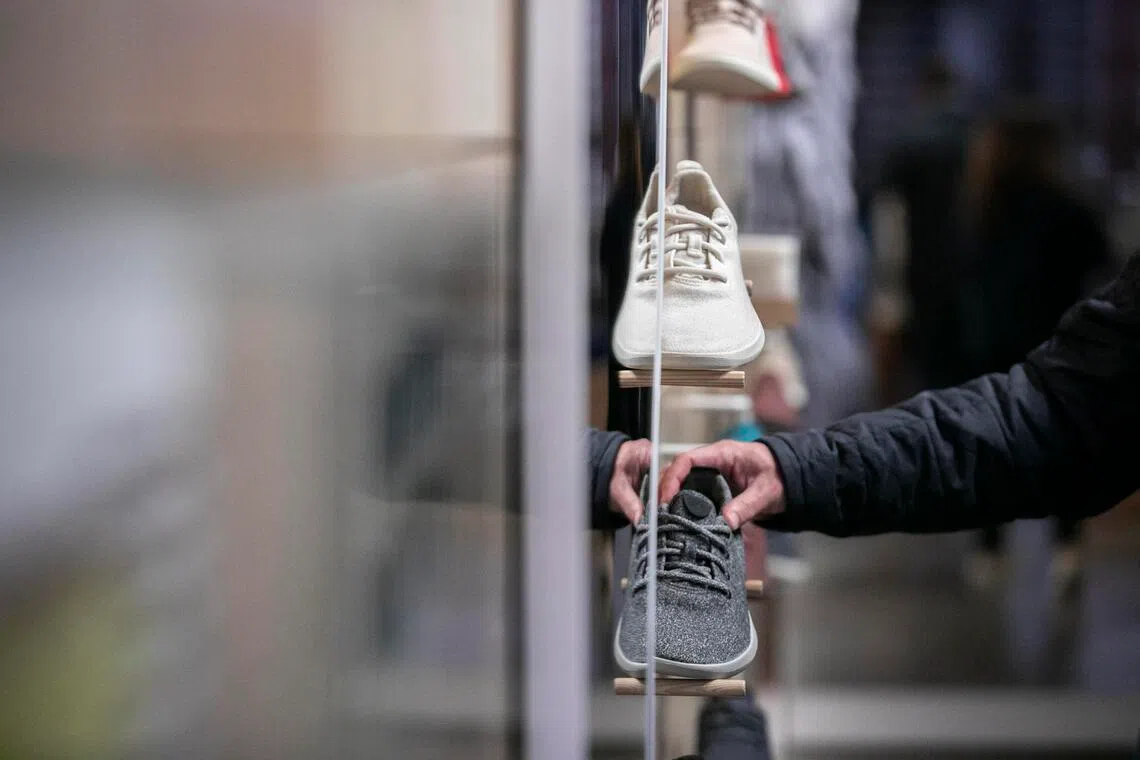
SAN FRANCISCO – Allbirds, the once-buzzy maker of wool sneakers valued at more than US$4 billion (S$5.08 billion) in its heyday, announced a new business plan just days before it was set to close down for good: AI computing infrastructure.
And in a stock market that’s reacted in knee-jerk fashion to just about anything related to artificial intelligence, it did just that – sending Allbirds shares up 582 per cent by the time the trading day ended on April 15.
The response underscored the intensity of the speculative mania around AI, which has fuelled stampedes into would-be winners and panicked pullbacks from any industry that seems at risk of being undone by the competitive threat.
Allbirds, which plans to rechristen itself as NewBird AI, is not the first struggling company to try to get another lease on life by seizing on the hot new thing.
Such name changes were legion during the dot-com bubble. Long Island Iced Tea rebranded itself Long Blockchain during the early days of the crypto craze.
Bitcoin miners are now going AI. And in February, a tiny former karaoke company’s stock soared – and triggered a fierce selloff across the logistics industry – when it trumpeted its AI tool for trucking companies.
“Developments like this are a sign that froth is in the market,” said Mr Matt Maley, the chief market strategist at Miller Tabak + Co, who said it was not surprising, given how stocks have been rallying. “But it’s still something that should give investors some pause.”
But investors have been prone to jettisoning such caution, hoping to ride even inexplicable stock pops higher, wagering that others will keep piling in. That is what has driven the meme-stock trend that has flared in corners of the market, off and on, ever since the pandemic.
Roundhill Investments, which has a meme-stock exchange-traded fund (ETF) that was rolled out to capture such moves, was one buyer of Allbirds stock at the start of the trading day.
“A shoe company rebranding as an AI compute infrastructure play is the kind of narrative shift that ignites retail enthusiasm,” said Mr Dave Mazza, chief executive officer at Roundhill.
“The spike in retail sentiment, coupled with a sharp increase in trading volume and elevated volatility around BIRD following its AI pivot, are exactly the signals the MEME ETF is designed to capture in real time.”
Allbirds said it is planning to sell up to US$50 million of debt, which is convertible into stock, to finance its new business plan.
The company said it will use the money to buy computer gear and implement a “long-term vision to become a fully integrated GPU-as-a-Service (GPUaaS) and AI-native cloud solutions provider.”
The company did not respond to a request for comment.
Allbirds had previously agreed to sell all of its assets and intellectual property to American Exchange Group for about US$39 million.
Because the process of an initial public offering is a difficult one, failed publicly traded companies sometimes use their old stock listings to bring a new concept or company straight to the market.
“The public listing is an asset,” said University of Florida finance professor Jay Ritter.
“Over the years we’ve seen reverse mergers where most of them have had kind of a negative connotation given that most of the companies that have gone public via a reverse merger have been low quality companies and public-market investors haven’t done all that well.”
Despite the fact that there is no obvious overlap between shoemaking and cutting-edge computer science, Allbirds has roared higher. The company previously seized on the business zeitgeist with its eco-friendly shoes, which were once a Silicon Valley favourite.
Allbirds made its stock market debut in 2021, when near-zero interest rates were pushing up speculative stocks of all stripes, only to see its shares tumble every year since. By April 14, it had a market value of about US$22 million.
The stock-price pop recovered a little of the lost ground: It was worth nearly US$150 million when markets closed on April 15. BLOOMBERG

