


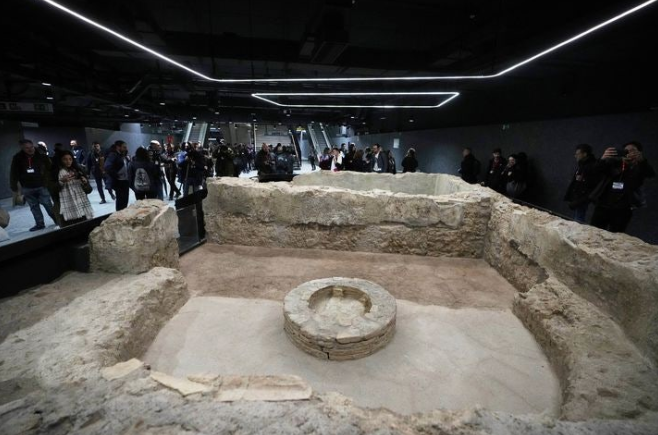
As large-scale ancient ruins were excavated one after another during the construction of the Rome Metro C line, an “archaeological subway station” that combines subway functions and exhibition space appeared.
According to the BBC, the Colosseo-Pori Imperiali station, which opened in December last year, is considered a representative example. Inside the station, ancient Roman pottery and bathhouse relics excavated from nearby excavations are on display, and visitors can watch only with a subway fare without a separate reservation.
The Metro C construction project, which has been in progress for about 20 years, is revealing more artifacts as it approaches the center of Roman history. Ancient wells, farms, military barracks, and 16-room residences were discovered in the three recent station sections, and more than 500,000 artifacts, including ceramics, coins, and Jangshin-gu, were excavated together.
As a result, even the expression “Metro C is not a subway, but a line running on an archaeological excavation site.”
In fact, Rome’s city is built on about 3,000 years of historical remains, and ancient relics are repeatedly found during subway construction. For this reason, excavation and preservation work are carried out in parallel, and construction is often delayed or lines are adjusted.
In particular, during the construction of the Porta Metronia station, the Roman army barracks and residential spaces in the 2nd century were identified and the design was changed. The ruins will be preserved and re-installed inside the station. Archeologists estimate that this could be a new model for simultaneous preservation of remains and urban infrastructure construction.
However, the enormous construction cost remains a challenge. The central section of Roman history on the Metro C line is estimated to cost about 1 billion euros (about 1.73 trillion won) per 1 km. In the past, it was criticized for its cost, but the evaluation has recently changed as the line is connected to major tourist destinations.
Metro C will be extended to the Vatican in the future, and the “historical experience infrastructure” model using Rome’s underground space is expected to expand further. Experts said, “Rome is a place where another city exists not only on the ground but also underground,” adding that this case is an opportunity to shed new light on the city’s historical value.
JULIE KIM
US ASIA JOURNAL

