


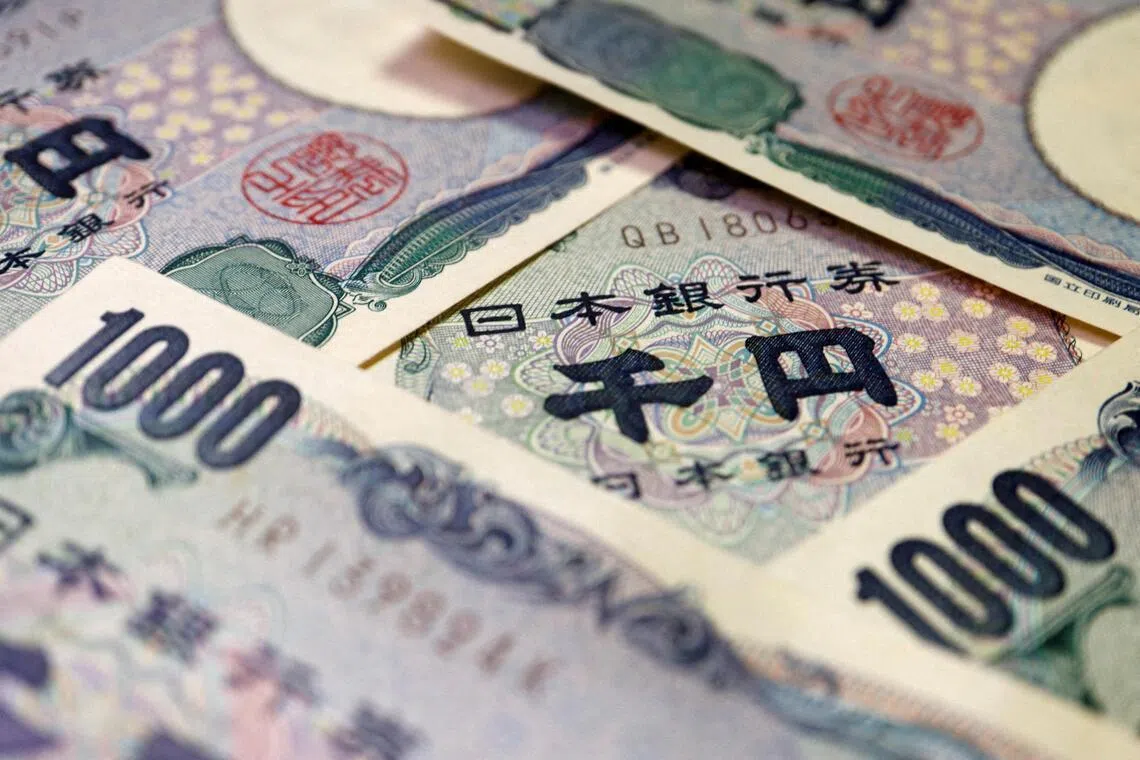
SINGAPORE – The Japanese yen slid to a fresh low against the Singapore dollar, giving Singaporeans the most yen per Singdollar in over a decade, with analysts expecting the currency pair to remain near current levels through 2026.
The yen weakened to a new low of 125.33 yen per Singdollar on April 13 amid oil price volatility linked to the Iran war, before recovering slightly to about 124.91 on April 15.
The Japanese currency, which fell 5.6 per cent against the Singdollar in 2025, has weakened another 2.6 per cent so far in 2026, according to Bloomberg data.
The yen’s recent weakness comes as the Monetary Authority of Singapore (MAS) tightened its monetary policy stance to curb inflation, allowing for a stronger currency to dampen import costs in the face of soaring oil and natural gas prices.
MAS said on April 14 that it will slightly increase the pace at which the Singapore dollar is allowed to strengthen against a basket of currencies.
The central bank also raised its inflation forecasts for 2026 to an average of 1.5 per cent to 2.5 per cent, up from an earlier projection of 1 per cent to 2 per cent, and noted that Singapore’s economy will slow in the coming quarters.
Mr Oriano Lizza, sales trader at CMC Markets Singapore, said the Singapore dollar-yen pair is likely to remain at or above current record levels through 2026.
Even if the yen stabilises against the US dollar, continued tightening by the MAS and appreciation in the Singapore dollar nominal effective exchange rate should keep the pair elevated, he said.
He noted that structural factors, including strong trade surpluses, AI-driven electronics exports and wealth management inflows, are expected to continue supporting the Singapore dollar.
Mr Jeff Ng, head of Asia macro strategy at Sumitomo Mitsui Banking Corporation, estimates the Singdollar will rise by about 1 per cent a year, up from 0.5 per cent previously, reflecting a faster pace of Singdollar appreciation against a basket of currencies.
The analysts noted that higher oil prices could further support the local currency, given Singapore’s role as an energy hub and re-exporter.
“The Republic is one of the world’s top refining centres, allowing it to capture value from price dislocations. The MAS also has the tools to channel imported inflation into further Singapore dollar appreciation, and that is exactly what it has just done,” said Mr Lizza.
In contrast, the yen faces more headwinds – while the Bank of Japan has raised interest rates to 0.75 per cent, the highest since 1995, monetary policy remains loose.
“Another rate hike is likely at the Bank of Japan’s April 27 to 28 meeting, although the Iran war could complicate the central bank’s balancing act between inflation control and growth,” Mr Lizza said.
“The key downside risk is a rapid resolution of the Iran conflict… This could drive oil prices lower and remove the energy-driven divergence between the two currencies,” he added.
Ms Charu Chanana, chief investment strategist at Saxo, said the yen’s decline reflects structural weakness amid higher oil prices, alongside a stronger Singapore dollar backed by safe-haven flows.
“Japan remains highly vulnerable to higher oil prices and markets are still uncertain about how much support the Bank of Japan can offer,” she said.
“At the same time, investors still want geopolitical havens like the Singdollar, because even though a peace deal would ease the immediate shock, it would not remove the deeper demand for safety in a more fragmented world.”

