


SINGAPORE – Major courier companies operating in Singapore and Asia are banking on alternative transport methods and artificial intelligence (AI) to reduce reliance on petrol as prices of fuel remain elevated amid the ongoing Middle East conflict.
Delivery providers such as DHL, FedEx and J&T Express told The Straits Times that green initiatives that were implemented prior to the war have also helped to ease reliance on petrol.
These include using more electric vehicles (EV) and tapping AI software to map out more efficient delivery routes for couriers to lower fuel and energy consumption, they added.
Part of the costs is being passed down to customers in the form of existing fuel surcharges, which fluctuate and are currently higher compared to before the Iran war.
Pre-war, jet fuel prices in the Asia-Pacific were as low as US$85 a barrel. By the end of March, prices hovered around US$200 a barrel.
Mr Eric Tan, FedEx Singapore’s managing director, said: “We have been steadily expanding our fleet in Singapore, where about 30 per cent of our delivery vehicles are now electric, following additional EV deployments last year. This aligns with our global goal of achieving carbon-neutral operations by 2040, which includes electrifying our entire pickup and delivery fleet worldwide.”
The company has over 2,000 collection points and more than 1,500 drop-off locations for customers in Singapore to choose from, which reduces the need for couriers to travel door-to-door for each delivery.
Despite the increasing fuel prices after the US-Iran war broke out on Feb 28, FedEx said it recorded “strong growth in March” in terms of shipments in Singapore, which was “driven by activities across Asia, the EU and trans-Pacific”.
While FedEx was not able to share specific figures, the growth is in comparison to the same month in 2025, and to shipments in Feb this year.
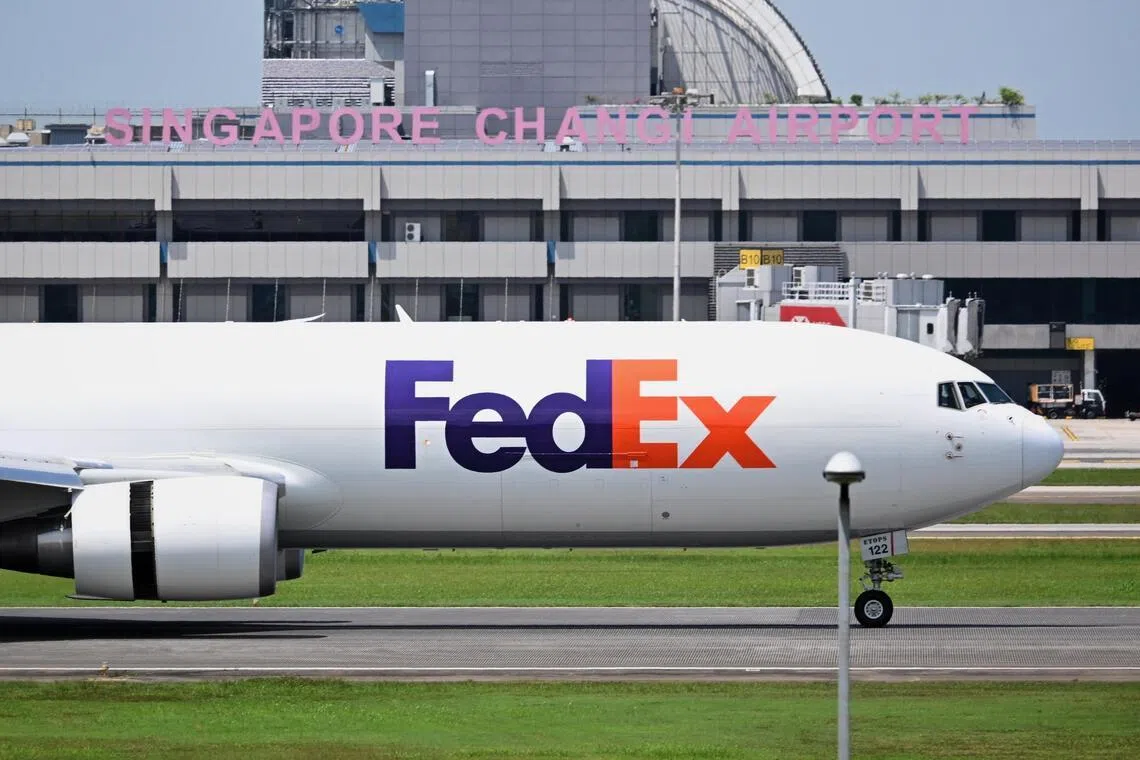
US-based FedEx, which manages nearly 700 planes internationally and has its Asia-Pacific headquarters and South Pacific regional hub in Singapore, has a fuel surcharge on international shipments for its planes, which helps manage costs and keep operations running.
This surcharge, which has been in place long before the current petrol crisis, is adjusted according to global fuel price movements and based on a fuel index that is updated weekly. The surcharges are borne by the customer, and is typically added on top of the base shipping rate.
The index on FedEx saw the spot price for kerosene-type jet fuel at its highest for 2026 so far – it is US$4.073 a gallon for the week of April 13 to April 19, with an international fuel surcharge of 46.75 per cent. In comparison, it was US$1.873 a gallon for the week of Jan 19 to Jan 25, with a fuel surcharge of 28.25 per cent.
A spokesperson for DHL said the company has seen its fuel rates increase by 25 per cent from Jan to March this year for its ground fleet, though the increased use of electric vehicles over the past few years has helped reduce the company’s reliance on conventional fuel.
DHL is a global delivery company that also owns and operates a fleet of 300 aircraft. It also owns several airlines through its division DHL Aviation and has a delivery network of more than 220 countries and territories.
Like FedEx, DHL Express also has a fuel surcharge, which is listed on its website. Fuel surcharges for the month of Feb 2026 was 28.75 per cent. It is 46 per cent for the week of April 13 to 19, and will increase to 47.75 per cent for the week of April 20 to 26.
DHL Express is the high-speed international courier division under the broader DHL group, and deals with urgent deliveries.
“We currently operate a large commercial fleet of electric vans in Singapore, with 100 EVs making up over 30 per cent of our total ground fleet. We began converting our ground fleet to EVs for last mile pickup and deliveries in 2022 to reduce greenhouse gas emissions,” said its spokesperson.
Solar panels installed at DHL facilities in Singapore also generated sufficient electricity in 2025 to cover the annual operational electricity demand of its EV delivery fleet, based on consumption figures, he added.
The company, which is based in Germany, also encourages its DHL Express vendors in Singapore to convert to EVs to “collectively negotiate for a preferential lease rate” for those interested in changing their vehicles. This has led to vendors in Singapore transitioning 16 diesel vehicles to EVs prior to the Iran war, said the DHL spokesperson.
Global logistics provider J&T Express said it was closely monitoring developments and market conditions, and that they are managing operating cost pressures related to petrol consumption.
This is done by optimising delivery routes using AI, and continually reviewing delivery network efficiency to “reduce unnecessary vehicle run time”, said its spokesperson.
EVs are deployed on routes where there are more charging points available.
“We are actively exploring further EV adoption, with plans to scale our fleet progressively as operational conditions and infrastructure in Singapore continue to develop,” the J&T Express spokesperson added.
The base shipping fee for J&T Express’s international express shipments out of Singapore remain unchanged, though business customers who ship via air or sea out of Singapore have to pay a fuel surcharge for express packages.
The company said that it has not revised local delivery fees as of April 15: “J&T Express recognises that our customers and partners are also navigating a challenging environment, and we do not take pricing decisions lightly. Where adjustments are required, they are considered carefully in light of market conditions and operational requirements.”
The company, founded in Indonesia in 2015, has a network of 13 countries which include Singapore, and has benefited from tapping on strong growth opportunities by working with global e-commerce platforms such as Shein and AliExpress.
In a press release on April 13, J&T Express said it increased its automated sorting lines from 64 to 73, and now has over 6,000 line-haul vehicles in South-east Asia.
For the first three months of 2026 ending 31 March, parcel volume handled by the company in South-east Asia rose by 79.9 per cent year-on-year to 2.77 billion, with average daily parcel volume reaching 30.8 million.
At Lalamove, an on-demand logistics provider that was founded in Hong Kong in 2013, the company is closely monitoring and evaluating the impact of increase in fuel prices on their driver partners and small-medium enterprise users.
“As driver partners are the backbone of our platform, we understand their concerns and will continue to explore possible ways to provide support, while remaining mindful of maintaining flexible, affordable delivery solutions for our SME users to stay afloat during periods of uncertainty,” said its spokesperson.
Food and grocery delivery provider Foodpanda said its delivery fleet has a range of transport methods that do not rely on petrol. These include bicycles, power-assisted bicycles – which uses a combination of pedaling and a rechargeable electric motor – and walking.
“Delivery partners have full flexibility to choose the mode of transport that best fits their individual needs,” said the Foodpanda spokesperson.
The spokesperson added that the homegrown company promotes “delivery efficiency across the platform to optimise resources”.
“For example, features such as order stacking allow delivery partners to complete multiple orders within a single trip, helping to reduce overall travel distance, time per order and fuel consumption.”
Foodpanda said it was closely monitoring the situation and will review initiatives to support more efficient and practical deliveries across the platform.

