


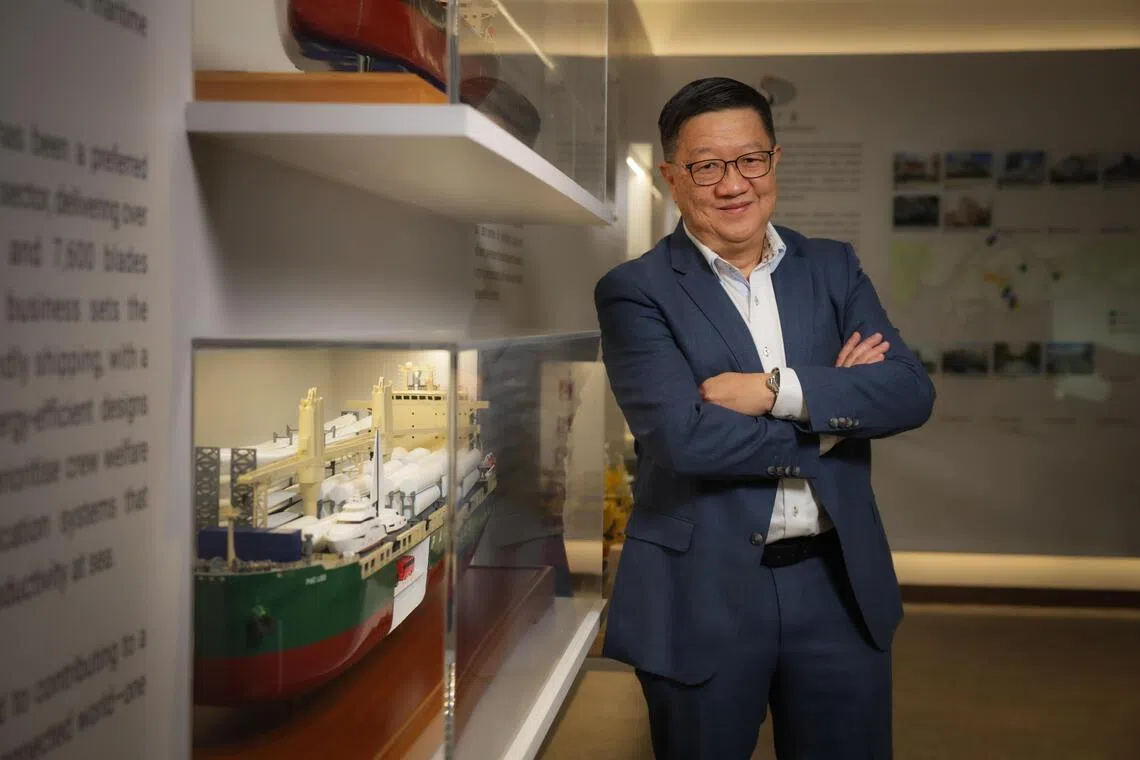
SINGAPORE – Singapore is one of the world’s top maritime hubs, but it needs fresh talent to stay afloat and ride the waves of change as data analytics and decarbonisation become increasingly important to the sector.
Yet, recruitment for the industry is a challenge, something Singapore Maritime Foundation (SMF) chairman Hor Weng Yew is all too aware of.
Noting that the industry is of vital importance to Singapore and the global economy, he hopes to change the impression of the maritime industry among Singaporeans.
“Maritime, frankly, is not so well understood,” he told The Straits Times in an exclusive interview.
“It’s not a natural go-to job or something you’ll tell your kids to do: Hey, please go to maritime, yeah? You could be a doctor or a banker, but are you going on board the ship? Or be a port worker?” he said.
“But it’s actually really about an unseen, invisible system, a high level of commercial and technical orchestration… that is about facilitating trade and livelihoods. There’s a purpose to it.”
The maritime sector contributes to more than 6 per cent of Singapore’s economy and provides about 140,000 jobs, according to a maritime lecture in 2025.
When there is disruption to trade and shipping in geopolitical crises, Singapore plays an even more vital role, not just in enabling the nation’s supplies, but also in ensuring global supply chains keep moving – it sits at the centre of trade routes and is connected to more than 600 ports globally.
It is one of the top container ports in the world and the world’s largest ship fuel bunkering port, where ships can refuel or buy fuel.
Singapore is also a large transshipment port, where goods arrive here on larger ships before being transported elsewhere, Mr Hor said.
He noted in particular that there has been dwindling interest among people in being seafarers, roles on board ships that have traditionally been filled by workers from countries in the region like the Philippines, Indonesia and China.
But shipping is not just about being on board ships, Mr Hor said. It involves an ecosystem of people, including those in finance to make investments and close deals, people in data and technology, and even those in sustainability.
In the last 20 years, SMF has been trying to meet the maritime industry’s manpower demand through partnering local institutions to get young people interested in maritime.
SMF is working with the National University of Singapore to develop new skills in the sector like data analytics, artificial intelligence and sustainability.
It even goes to primary and secondary schools to get the young thinking about the industry earlier in their decision-making process.
Since 2007, SMF has partnered companies in the industry to award maritime scholarships to more than 700 recipients. In 2025, some 39 sponsoring organisations awarded $1.48 million to 60 scholarship holders.
SMF also gives young people a taste of the industry through internships.
“Internships are like trophies nowadays – everybody wants more and more of them,” Mr Hor quipped. SMF started offering internships in 2022, and has since seen over 350 interns in three years.
Mr Hor said other goals for the industry are to attract mid-career workers and to retain the workers currently in maritime. This can be done through constant education and retraining.
The industry should attract more people because of how dynamic it is, he said.
“It’s a fantastic industry because it’s as global as you can get. It is as dynamic as you can get… and you need to be continuously informed, aware and upgraded as well.”
Being in the maritime industry also means being at the very edge of new developments, especially in a turbulent global landscape.
Mr Hor noted the geopolitical disruptions in the last few years that have resulted in greater uncertainty around shipping routes and plans, such as the US tariffs.
But the maritime industry is also about constant recalibration and change, he said.
“In shipping, we are inevitably affected by all these movements,” Mr Hor said. “But let’s also not forget about fundamentals, which are still about demand and supply.
“Cargo needs to move because we all need to eat and need to live, and so shipping will find its way,” he added.
Circumstances have indeed become more volatile in recent years, Mr Hor admitted, but he said it is still nothing unusual.
“Shipping goes through cycles and global trade disruptions, such as the oil shocks in the 1970s and, more recently, the Covid-19 pandemic and geopolitical dynamics.” he said.
“Through each disruption, shipping has remained resilient and committed to its fundamental purpose of carrying essentials, commodities and energy across the world.”
Mr Hor added that Singapore’s maritime sector is also built on fundamentals that have not changed.
“Our strengths are a trusted system, being a good place to do business and where companies feel safe,” he said.
“It is not just about risk but also opportunities. When things change and are volatile, the system can see potential new opportunities. It’s not static or just the ‘standard operating procedure’ of the last 20 years.”
Mr Hor also finds the maritime industry particularly exciting because of the changes wrought by technology, such as a shift towards a data-driven approach of working, ships using the internet of things, and systems on land that optimise routing, ship maintenance and safety.
Another trend is decarbonisation, which for the industry encompasses changing the types of fuel used, the standards of sustainability and building new capabilities.
All these developments make maritime far from being the traditional industry that people think it is, said Mr Hor, who has been in the industry for over 30 years.
“Some people have this perception that maritime is a sunset industry for the older generation, but that’s far from the truth,” he said.
“Maritime is going through a transformation, of bringing in new talent, new ideas, new perspectives. There are new opportunities for you to play a little part, by bringing in your skills and passion to build the industry and leave a footprint in something that’s still evolving.”
The industry veteran said maritime is agile.
“It will find its solutions, although things change. It’s a bit like water itself. It will always find its natural course.”

