


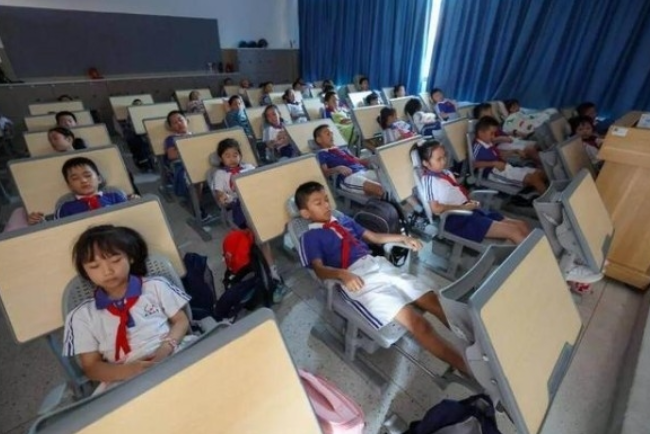
The desk you were studying suddenly turns into a bed. The so-called Transformer desk is changing the nap culture of Chinese students.
Chinese Foreign Ministry spokesperson Ma Ning also stepped up in person. Recently, interest in the book exploded after it was introduced on social media.
According to Chinese media 163.COM, spokesperson Ma Ning unveiled the nap desk introduced in Chinese schools through his X account. He said it is a structure designed for students to lie down and rest for a while during lunch, and stressed that a short nap helps increase concentration in the afternoon class.
In China, nap times have long been operated to improve students’ concentration. However, in the past, there was an inconvenience of sleeping on your stomach on a desk or moving to a separate resting area. The desk that appeared this time is designed to lie down and rest directly in the classroom.
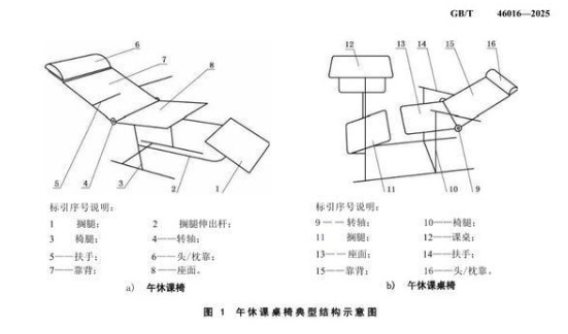
Its structure is also simple. It is a combination of a desk and a chair, which are usually used like ordinary desks, but when a button or lever is operated, the backrest and footrest are unfolded and changed to a bed shape. The angle can be adjusted from 135 degrees to 160 degrees Celsius, which can be used according to a student’s body shape and growth stage. China’s Ministry of Education recommended that elementary, middle and high school students take nap time through the so-called “sleeping policy” in 2021. Although the mandatory hours were not unified nationwide, they were allowed to operate according to the region and school conditions.
On top of that, with the implementation of the ‘Technical Standards for Elementary, Middle, and Nap Desk Chairs’ from February 2026, an environment in which you can actually lie down and rest began to be systematically provided. It has led to a flow of changing the structure of the classroom itself, beyond simple recommendations.
Currently, a nap time of 30 to 45 minutes is guaranteed for elementary school students and at least 30 minutes for middle and high school students.
Online responses are mixed. Foreigners responded by saying, “We need to introduce it to Korea,” and “We take good care of students’ welfare,” while Chinese people also said positively, “I hope it will be expanded nationwide,” and “It is much better than lying down.”
On the other hand, some point out the cost burden. Some point out that there is a realistic limit to the application of all schools. Some also pointed out the fundamental problem, saying, “The structure requires a nap because Chinese students go to bed late on average.”
JENNIFER KIM
US ASIA JOURNAL

