


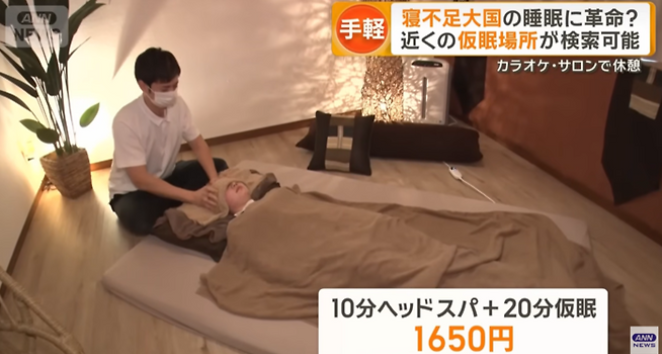
As sleep has become scarce due to overtime and long hours of work, “sleeping properly, even for a short time,” is now becoming a consumption.
In Japan, “pay nap” has already become a trend. According to Asahi TV, nap-related services are rapidly increasing in business districts such as Shibuya, Tokyo.
One of the most popular massage parlors has launched a 10-minute head spa + 20-minute nap package (1,650 yen). Instead of a 90-minute full-body massage (13,000 yen), the store has opted for a short, powerful break for office workers.
Karaoke room has also changed. A karaoke room in Shibuya offers personal space, blankets and chargers for 60 minutes and 704 yen, and is used as a “sleeping space.” This strategy aims at the fact that a dark and quiet environment is suitable for sleeping.
A platform has also emerged where visitors can find and reserve such places at once. More than 1,500 nap places are registered in the mobile app BitSleep.
The background of this phenomenon is clear. According to the OECD’s “average sleep time” for 33 member countries in 2021, Japan has the lowest average sleep time of 7 hours and 22 minutes, which is about 30 minutes shorter than Korea’s. In addition, a survey conducted by Japan’s Ministry of Health, Labor and Welfare found that 40 percent of Koreans sleep less than six hours a day.
In the end, lack of sleep has led to consumption of “paying for sleep.” In fact, according to a GMO study conducted in February last year, 71.5 percent of office workers said they want a nap. And nearly half said they want to sleep properly, even if they pay for it. The situation in Korea is not much different. According to the “2026 Korea Sleep Report” by A-Sleep, a sleep tech company, Koreans actually sleep only five hours and 25 minutes. It is about two hours short of the recommended sleep time (7 to 8 hours).
This is the largest study in Korea that analyzed sleep data of more than 370,000 people over two years from 2024 to 2025. This means that lack of sleep is a structural problem.
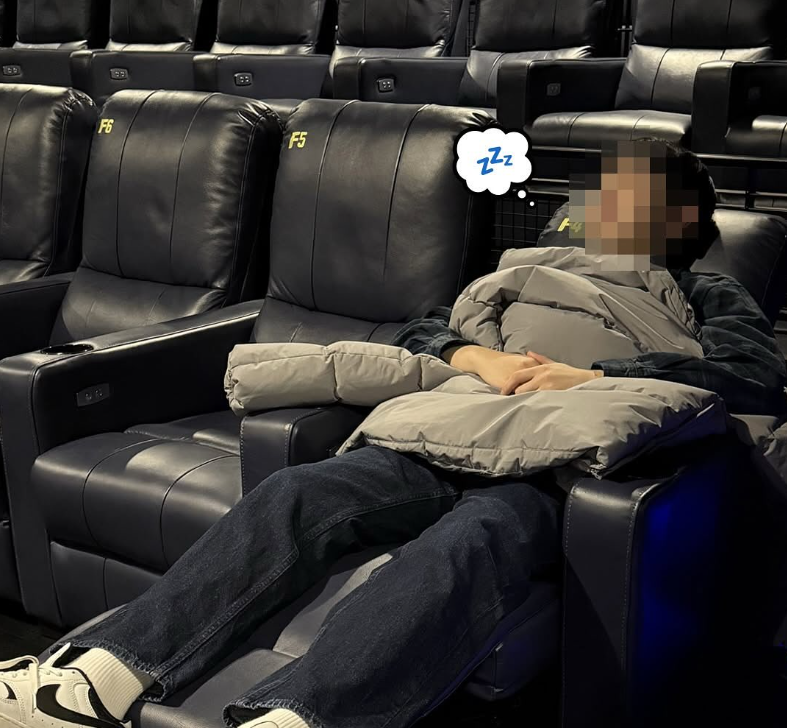
It is the “lunch nap market” that has dug into this gap. A representative example is the Megabox “Mega Comma” event. The service, which is underway at the East Pole branch of Megabox Gangnam and Guui, allows you to take a nap for 3,000 won from 12 p.m. to 2 p.m. (up to 2 hours). In addition, recliner seats, white noise environments, sleep masks, and coffee are provided and are made through reservations.
The actual user reviews are also noticeable. “It is the best resting place in the world where there is no place to take a nap,” “I rested well for lunch and became more focused on my work,” and “I hope it will be done for a long time, not for events.”
There is one common phenomenon in both Korea and Japan. The sleep market is growing in a sleep-deprived society.
According to the Korea Sleep Industry Association, the domestic sleep market has grown more than 10 times from 480 billion won in 2011 to about 5 trillion won in 2025.
The global market is even bigger. The “Sleeponomics” market is expected to expand to 40 trillion won.
SALLY LEE
US ASIA JOURNAL

