


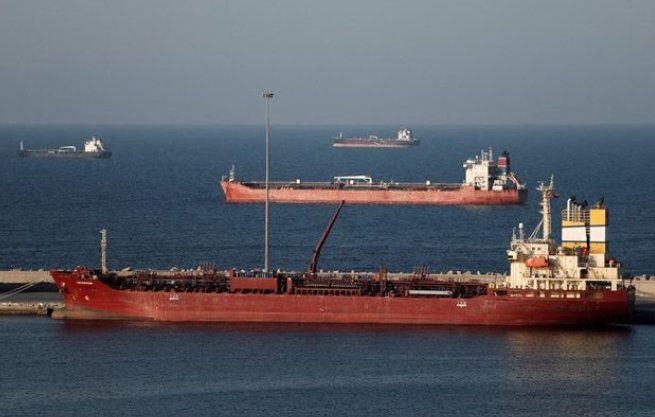
It is observed that the issue of free navigation in the Strait of Hormuz will emerge as a key issue in the end-of-war behind-the-scenes negotiations between the United States and Iran.
According to the Associated Press, Iran is receiving money by setting up a kind of “tolgate” for ships trying to pass through the Strait of Hormuz. At least two ships are said to have paid tolls in Chinese yuan. Many global shipping companies have submitted detailed documents to Iran’s Revolutionary Guard since the 13th, recording cargo, ship owners, destinations, and crew lists, and have been approved for passage through the strait, according to Lloyd’s List Intelligence, a data company specializing in shipping.
Approved ships are given a unique code, and under the protection of the Revolutionary Guard, they pass through the northern route between Larak Island and Kesum Island, not the normal route in the center of the strait. This route is closer to the Iranian coastline. Bloomberg reported, “It appears to be Iran’s ‘approval route’ and Iranian authorities are strengthening control here.”
Currently, Pakistan, Thailand, and Malaysia have officially stated that they have received permission to navigate ships from the Iranian government. Pakistan’s Foreign Minister Ishaq Dar said on social media (SNS) X on the 28th, “The Iranian government has approved the passage of 20 more Pakistani-flagged ships in the Strait of Hormuz,” adding, “Two ships will be able to pass through the strait every day.”
Up until the war, one-fifth of the world’s oil and gas shipments passed through the Strait of Hormuz. However, as Iran blocked the Strait of Hormuz, ship traffic fell to its lowest level ever. Before the US and Israeli airstrikes on Iran, an average of 120 ships per day passed through the Strait of Hormuz, but now more than 3,000 ships are said to be waiting without passing the strait.
Iran has also begun to institutionalize the “toll” system. Currently, the Iranian parliament is working on the bill, and a plan to charge about $2 million per ship is mentioned. Iran’s semi-official Tasnim News Agency estimated that ship tolls could earn more than $100 billion a year.
However, critics say that Iran’s move could violate international law. The U.N. Convention on the Law of the Sea guarantees “the right to pass without sea” for free passage, as long as it does not harm public order in waters bordering on international waters.
Salvatore Mercoliano, a professor of marine history at Campbell University in the U.S., said, “There is no provision in international law that allows a ship to be set up to be seized by setting up a toll collection center,” adding, “Iran is using its only card, the control of the Strait of Hormuz.” Azum Mohammed al-Budaiwi, secretary-general of the Gulf Cooperation Council, also condemned Iran’s toll collection as “violation of the United Nations Convention on the Law of the Sea.” However, Iran has only signed the agreement and has not ratified it.
JULIE KIM
US ASIA JOURNAL

