


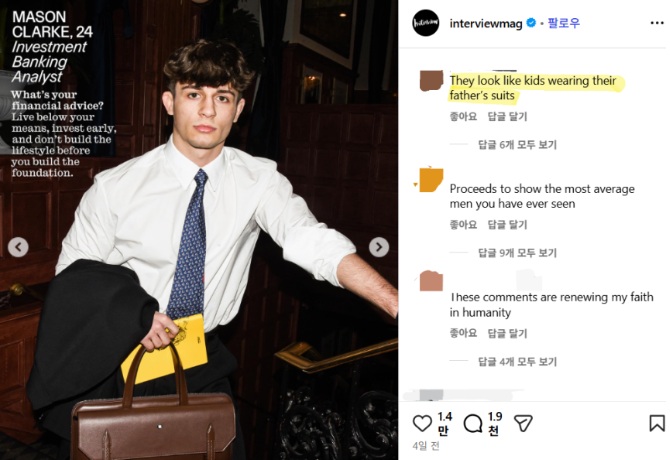
The New York financial sector is embroiled in an unexpected controversy over a fashion pictorial featuring four young Wall Street financiers. It is not just a pictorial controversy. It is because it broke the “fashion taboos” on Wall Street.
According to the Wall Street Journal (WSJ), “Meet the Finest Boys in Finance,” a pictorial recently released by Interview Magazine, drew great attention on social media (SNS).
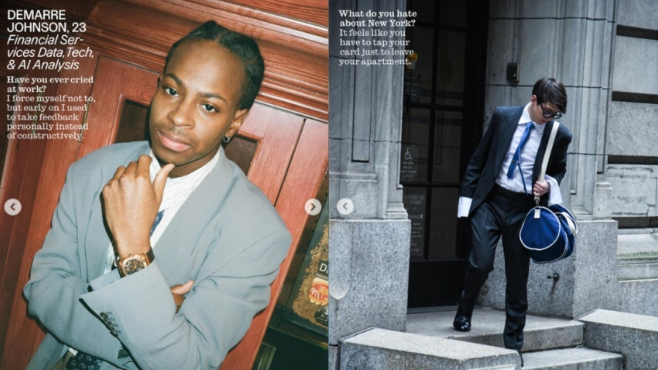
The young financial men in the pictorials were seen wearing loropia, suits, Hermes ties and a Bulgari watch. However, the reaction was cynical.
There were mocking comments on social media, saying, “You look like children in father’s suits.”
The problem was not just a simple style. There was something else that made Wall Street people more uncomfortable. They broke the tacit fashion rules of Wall Street.
There is an old taboo on Wall Street. In particular, it is considered taboo for junior employees to over-expose luxury goods. In fact, Wall Street also has an “invisible dress code” that applies to junior employees. Shirts are blue or white, no Ferragamo ties, no Gucci loafers with suits, no French cuffs shirts.
Jessica Cadmus, a fashion stylist whose clients include Wall Street financiers, explained that the strict hierarchical culture of Wall Street is reflected in fashion as well. “The style of showing off one’s wealth in a noticeable way generally doesn’t look good. This is especially true for junior employees,” she said. “It is important for first-year employees such as analysts and Associates to look neat and tidy, but it is better to avoid styles that show off their brands excessively.”
Women have more options, but the basic principles are similar. “If you want to carry a Chanel, Yves Saint Laurent or Hermes bag at work, you have to be a manager at least,” Cadmus said.
However, the WSJ reported that this “fashion ranking” is also becoming increasingly blurred as the fashion culture in the financial industry has become very casual since COVID-19.
Models featured in the photo shoot were recruited from LinkedIn. Two of them are employees of Goldman Sachs. However, some insiders are puzzled.
A Goldman Sachs employee told the WSJ, “No one wears that way at Goldman,” adding, “They only wear suits when they’re in the private wealth management department or when they have customer meetings, and most of them wear them much more comfortably.”
“Even people with hundreds of millions of dollars of assets wear ordinary blue suits,” he added.
DeMare Johnson, one of the people in the picture, said of the controversy, “It was actually a satirical production to introduce us as beginner associates and put on a thousands-dollar watch. I think that’s why the controversy has grown.”
WSJ said, “Dressing up too much at work can be a rather intrusive behavior,” and pointed out that it is especially true for junior employees. Bosses might think, “Why do you need a promotion and raise your salary when you’re already showing off like that?”
A menswear industry official explained the basic principles of Wall Street in this way, saying, “These days, Wall Street doesn’t wear as many ties or suits as it used to.”
“You shouldn’t dress up better than the person you meet at work.”
And I added about the costume in the pictorial.
“What’s for sure is that those clothes didn’t come from their closets.”
SALLY LEE
US ASIA JOURNAL

