


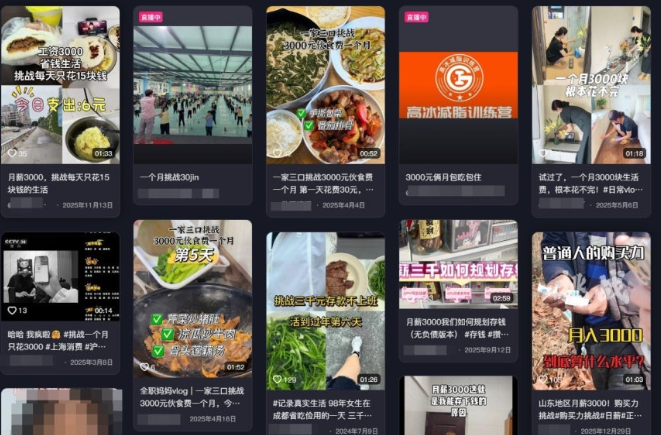
According to Hong Kong’s South China Morning Post (SCMP), a new trend has emerged among young Chinese people in recent years, comparing life difficulties with each other or boasting cost-effective consumption, away from the culture of wealth and success like previous generations.
A Chinese netizen posted, “My roommate bought two bags of laundry detergent for just 0.01 yuan. I couldn’t sleep for two nights because of that fact,” receiving 52,000 “likes.” Another user posted, “I despaired after learning that my friend bought 100 sheets of A4 paper for 0.99 yuan,” recording 9,000 “likes.” In addition, contents introducing how to live on 3,000 yuan a month in a large city are also gaining popularity on social media in China. There is an atmosphere among young people where they not only share cheap consumption experiences but also actively share the difficulties they face in their lives and workplaces.

In particular, when visiting their hometowns during holidays such as Chinese New Year, more and more posts honestly share realistic concerns such as “decrease in bonus,” “increase in housing tax,” and “difficulty in finding a job” with their families are increasing. Local media evaluated this as a change in contrast to the “golden welcome” culture, which used to show off its success by visiting hometowns during holidays in the past. According to the Chinese media Shin Min-wanbo, 55 percent of the respondents said this phenomenon is due to changes in consumption values. Thirty-five percent said it is because they prefer low-cost, high-quality products.
Experts analyzed that this consumption behavior is not only a simple change in taste but also a phenomenon coupled with realistic factors such as limited income and economic pressure on young people.
Gu Junhui, a business strategist in Guangdong, said, “The economic structure is changing, so the income potential of young people is not high. However, young people still seek high quality of life if conditions are possible.”
Yang Xueyan, a professor at Xian Transportation University’s Graduate School of Public Policy, analyzed that this “reverse comparison” culture shows the younger generation’s cool, self-satirical, and defensive social attitudes.
“Young people are gradually getting out of consumerism because they are under tremendous pressure,” he said. “Showing off wealth in a highly competitive society can lead to jealousy and criticism, so showing a humble attitude can be a way to protect yourself and lower the expectations of others.”
SALLY LEE
US ASIA JOURNAL

