


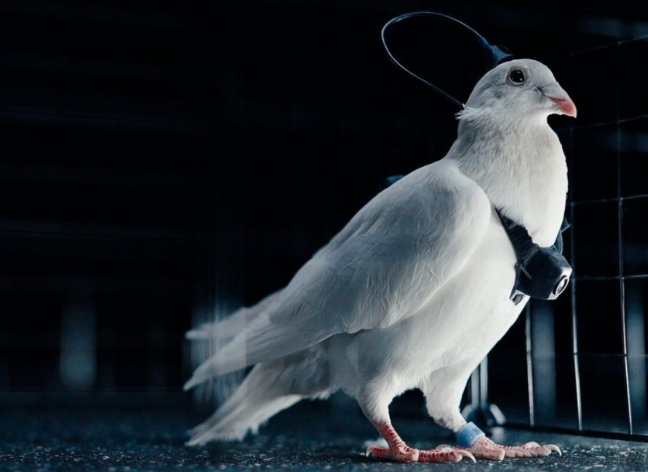
Russian scientists are known to be developing a cyborg pigeon drone that can be used for war or surveillance. The key to this drone is a technology that can be remotely controlled by implanting nerve chips into the brains of living pigeons.
According to the British daily Telegram, a new Russian neurological technology company, the Neery Group, is developing the technology through a project named PJN-1.
A small electrode is inserted into the pigeon’s skull and connected to a stimulation device mounted on the head, so that the controller controls the pigeon from side to side with a remote control. A camera is installed on the pigeon’s chest and a solar-powered flight control device is installed on the back.
The Nairy Group emphasized that the pigeon drone can travel up to 300 miles per day and reach difficult-to-reach places. As a result, it claims to outperform conventional mechanical drones.
The Nairy Group promotes the project as a civilian infrastructure monitoring tool, but experts warn that the technology could be easily exploited for military purposes. There are also suspicions that the company is connected to the Russian government, as well as questions about the source of the funds.
“We currently use pigeons, but we can also apply the technology to other birds that can carry heavy objects or camouflage,” said Aleksandr Panov, CEO of Nairi Group.
James Giordano, a professor of neurology at Georgetown University and a scientific advisor to the U.S. Department of Defense, argued that “such drones can be used as biochemical weapons carriers that spread diseases deep into enemy lines.”
Russia has already used trained dolphins to defend naval bases in the war in Ukraine, or has installed Starlink terminals on horses to provide internet connectivity in frontline areas, according to the media.
“If the Nary Group’s experiment is successful, Russia will be one of the few countries to develop practical biometric drone technology,” the Telegraph said. “Last year, Chinese scientists used ultra-light brain controls to create cyborg honeybees that control insect flight.”
When concerns arose that pigeon drones could be used for military purposes, Nairi Group said, “We are making every effort to ensure that our drones are not used for covert or other purposes, but for civilian purposes only. In particular, we are thoroughly confirming the intentions of all partners and counterparties.”
JENNIFER KIM
US ASIA JOURNAL

