


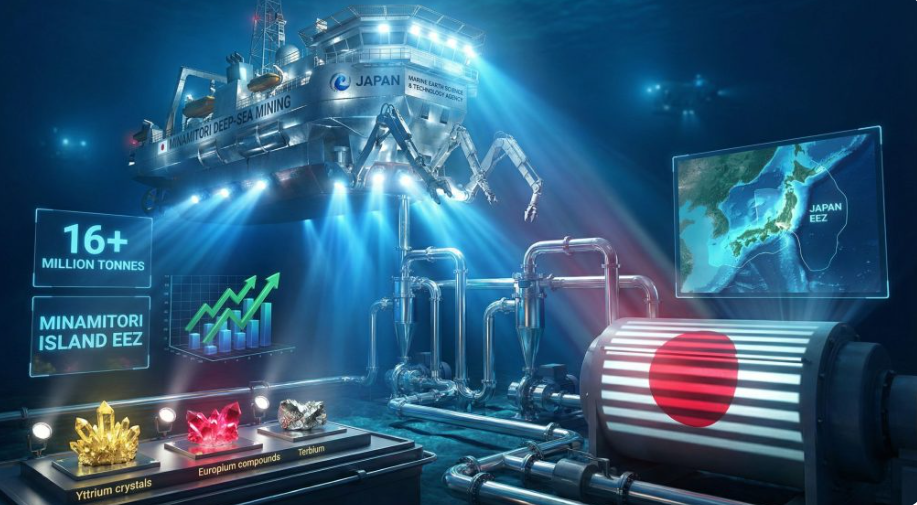
Japan succeeded for the first time in drilling mud containing rare earths in the deep Pacific Ocean, about 1,800 kilometers from Tokyo. According to local media such as the Yomiuri Shimbun and the Nihon Keizai Shimbun, the Ocean Research and Development Organization’s probe “JQ” succeeded in pulling up mud containing rare earths from the deep sea near Minamitori Island at a depth of about 5,700 meters.
The Jikyu probe departed from Shimizu Port and arrived at the drilling area in about five days on June 12. Afterwards, a huge pipe was connected to the bottom of the sea, and mud was pushed onto the ship by using the “riser system” based on the undersea oil and natural gas excavation method. It is the world’s first known case of mining undersea sediments with a depth of 6,000 meters.
The drilling is part of the Strategic Innovation Creation Program (SIP) led by the Japanese Cabinet Office. The Japanese government has invested about 40 billion yen to develop mud-splitting devices and special pipes. It is evaluated as a technological advancement in that it succeeded in inhaling mud at a depth of about 2,400 meters in 2022 and confirmed that the equipment is operating normally at a depth more than twice as deep.
In addition, the seabed of Minamitori Island is an area that Japan has long noted as a ‘rear earth report’. Researchers at Tokyo University and JAMSTEC discovered a mud layer containing high levels of rare earths in the area in 2013 and published the results of their estimation that at least 16 million tons of rare earths are buried in the area. This is the third largest in the world after China (44 million tons) and Brazil (21 million tons) in terms of reserves by country.
The Japanese government plans to begin test-mining of up to 350 tons of mud a day from February next year, and complete a commercial analysis report including mining costs by March 2028. Meanwhile, China is also behind Japan’s efforts to develop rare earths in the deep sea. In 2012, Japan suffered a direct blow to key industries such as automobiles and electronics due to China’s restriction on exports of rare earths during the territorial dispute over the Senkaku Islands. Since then, Japan has diversified its supply chain to Australia and other countries to reduce its dependence on China from 90 percent to 60 percent, but analysts say that the level is still high.
Recently, after Japanese Prime Minister Takaichi Sanae mentioned the possibility of military intervention in the event of an emergency in Taiwan, some observers say that China is again using rare earths as a means of pressure. In this situation, the Yomiuri Shimbun also evaluated that “the success of drilling is a big step toward localization at a time when China, which holds most of the world’s production, uses rare earths as a ‘diplomatic card’.
SAM KIM
US ASIA JOURNAL

