


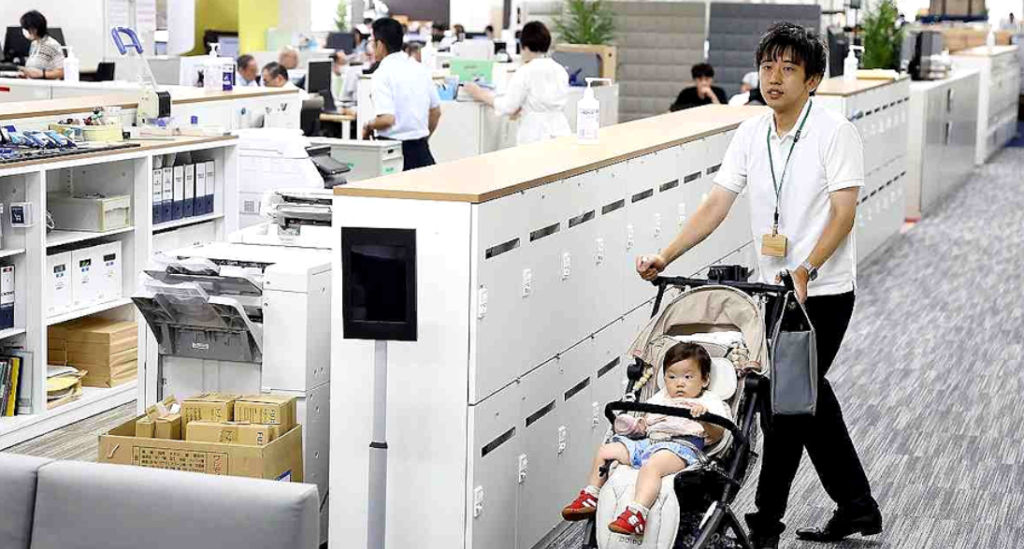
Companies and local governments are scrambling to reform the way they work in Japan. Child-rearing-friendly systems are spreading, such as allowing people to go to work with their children during vacation amid a sense of crisis over a serious shortage of manpower.
Japan’s Nihon Keizai Shimbun introduced a construction company that operates a “parent-child commuting system.” Sakai Estek, a construction company in Fukui City, Fukui Prefecture, operates a “parent-child commuting system” that allows children to go to work when necessary, such as during vacation.
A female employee who is using this system says, “I feel that the company is flexing and raising it dearly. Career options have expanded.”
She joined the company as an office worker in 2019, and is now in charge of piping and duct drawing while raising two elementary school children. After the introduction of the system, there was an option to bring children to work when after-school care was not available.
The company also has a kids’ room. Parents can work in the same space as their child if necessary, and when they are away for a while, a co-worker may take care of the child. During the summer vacation, there are cases where they go to work with their children and stay at work until rush hour. He is said to have obtained various technical certificates while raising children and working.
Regarding the background of the system, the CEO of the company explained, “It is because of a lack of manpower.” “If I can’t work because I have children and housework, I wanted to match him with the company,” he said. “If I didn’t do that, I couldn’t ask him to come to the company.”
The company began a review of its work method in 2018 and hired 28 people over the five years until 2024. The number of employees has almost doubled, and there have been three cases where interest from outside the prefecture has led to recruitment.
Such a move is not limited to companies. In Japan, there are also a series of reports on local governments that operate a system to go to work with children. The Mainichi Shimbun reported the case of Minoshi, Gifu Prefecture, in August 2024.
Mino City Hall is implementing “work with children” that allows desired employees to go to work with their children in time for the summer vacation of schools and kindergartens. It opened some spaces in the building to hold workshops such as woodworking classes and plastic crafts, and set up a study room to provide space for summer vacation homework. Local government officials’ children’s accompanying work was introduced in May 2023 by Toyoake City, Aichi Prefecture, and in Gifu Prefecture, Takayama City and Gifu City were introduced in January and March 2024, respectively.
Japan is in a situation where it is difficult to secure manpower in general, but the burden is greater in the provinces. In 2024, Tokyo is the highest at 1.76 times, followed by local regions such as Fukui (1.73), Ishikawa (1.53), and Gifu (1.52). The effective recruitment ratio is an indicator of the number of job openings of companies per job seeker, and the higher the figure, the more difficult it is for companies to secure manpower.
Against this backdrop, companies and local governments are making a series of attempts to change the way they work, such as adjusting the number of working days and allowing their children to come to work together.
JULIE KIM
US ASIA JOURNAL

