


AI trainers, which train artificial intelligence (AI) to give better answers in China, are rapidly emerging as the next promising job.
According to the state-run Xinhua News Agency, a total of 16,300 people took the AI trainer certification exam in Shanghai last year, of which 16,900 passed the final examination. The city is making great efforts to cultivate related personnel by increasing subsidies for certification curriculum by about 30 percent. Yang Ying, director of the Shanghai Human Resources and Social Security Bureau, said, “It will provide a solid human resource base for Shanghai to become a global science and technology hub.”
AI trainers are an emerging profession listed in China’s occupational classification system in 2020. It plays a role in improving the performance of AI to provide better answers through data labeling, prompt design, and adjustment. As the use of Generative AI increases rapidly, the demand for related personnel is also increasing rapidly. The city of Shanghai also included AI trainers on the list of “high-skilled workers who are urgently needed” as industry demand surged more than 30% year-on-year.
As AI transformation (AX) in industrial sites is accelerating, there is a strong craze for obtaining certificates among office workers in recent years. “The convergence of AI and bio industries is emerging as an important trend in the industry,” a man working at a pharmaceutical company told Xinhua. “We decided to prepare for certification because we want to accelerate the R&D process by utilizing AI.” “The curriculum consists of 30 percent theory and 70 percent practice. Considering that most of the students are office workers, classes are usually held on weekends,” said Pan, general manager of the Shanghai Shanxi Convergence Technology Development Center. The AI industry is shaking the Chinese labor market. Of the 72 new jobs announced by China’s Ministry of Human Resources and Social Security over the past five years, more than 20 were related to AI, which are expected to create 300,000 to 500,000 jobs each in the short term.
This is due to the rapid growth of China’s core AI industry, with 1.2 trillion yuan last year and the number of companies exceeding 6,000. In fact, Chinese AI-related companies are on a roll alone with the full support of the authorities despite severe sluggish domestic demand. According to the Nihon Keizai Shimbun, semiconductor companies’ net profit soared 50% year-on-year in the first nine months of last year, despite one out of four listed companies in mainland China having a deficit. In particular, sales of local AI chip producer “Cambricon” increased 43 times in the first half of the year compared to the previous year as authorities issued a restraining order on the use of Nvidia AI chips.
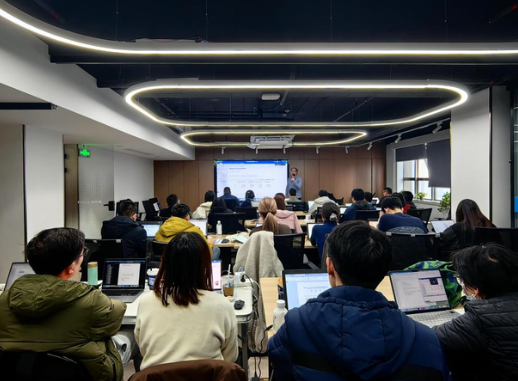
Universities are also undergoing major department restructuring in line with the AI era. According to Chinese educational evaluation agency Micus, as many as 621 universities have newly established AI-related departments from 2018 to 2024, when AI majors first appeared. Along with humanoid robots, there were a total of 120 majors related to the low-tech economy (air taxis, drones), which is considered a key field of “physical AI,” accounting for more than half of the 239 undergraduate majors newly established last year. On the other hand, majors that lack demand in the industry, such as language and arts, are rapidly disappearing. In 2024 alone, 1,428 undergraduate majors were abolished, 25 times more than in 2014 (57). This year, major universities such as Jilin University, Hwadong University of Education, and Nanchang University abolished their majors in the art field one after another, making headlines.
Despite the swift restructuring, the youth unemployment rate has not improved. Although the youth unemployment rate declined for four consecutive months to 16.5 percent in December last year, it is still more than double that of Korea (6.1 percent). Analysts say this is because the job creation effect of the AI industry, which is centered on highly educated and technical workers, is significantly limited compared to the real estate sector, which once accounted for 25% of China’s gross domestic product (GDP). According to the U.S. market research firm Rhodium Group, high-tech industries such as AI, robots, and electric vehicles contributed only 0.8 percentage points to China’s GDP growth from 2023 to 2025. The British daily Telegraph pointed out, “The Chinese authorities poured enormous funds into certain industries for ideological and geopolitical goals, and as a result, the rest of the economy was severely distorted.”
EJ SONG
US ASIA JOURNAL

