


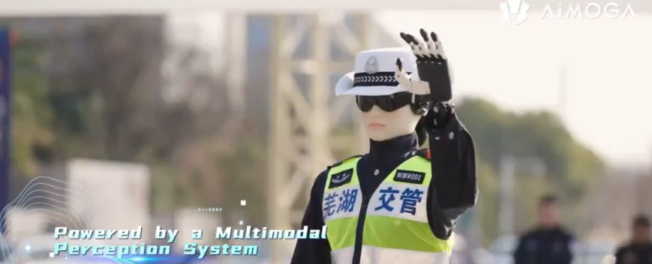
An AI robot traffic police was spotted on the road in Wuhu, Anhui Province, China, doing traffic patrols. The robot police performed the same tasks as humans, such as cleaning up traffic and monitoring illegal parking.
According to China’s state-run Xinhua News Agency on the 20th, “Intelligent Police R001,” the first robot police officer of China’s Cherry Group robot company AiMOGA, was spotted on a street in China on the same day.
This robotic cop is designed to take over simple, repetitive tasks that human traffic police avoid 24/7. It also synchronizes motion signals by linking them with traffic signal systems in Wufu City, and detects violations in real time through high-definition cameras and AI algorithms.
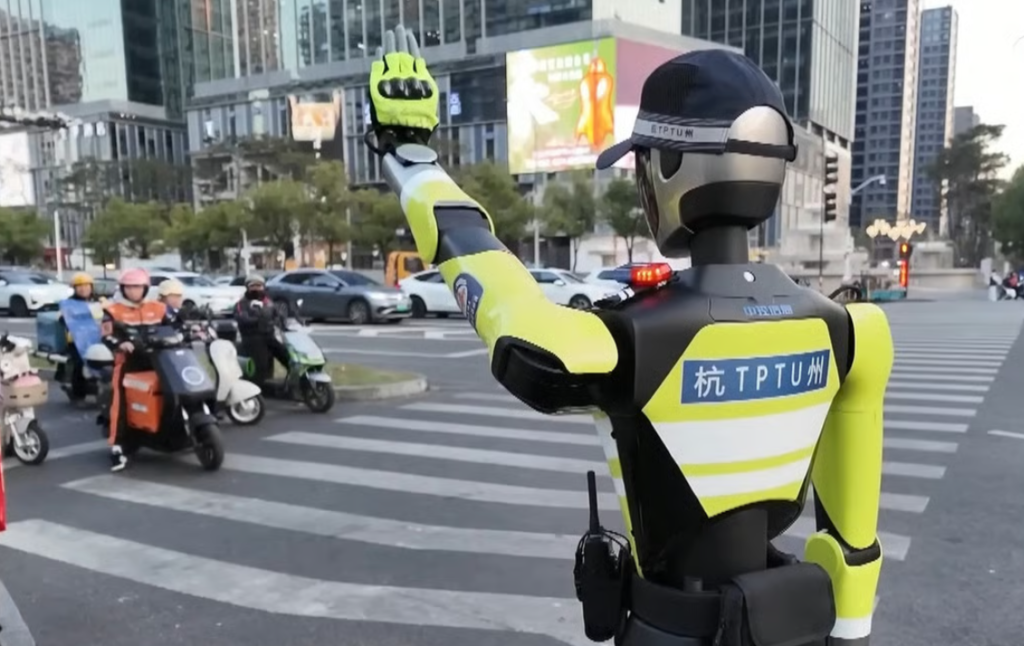
In the released photo, robotic cops wearing police uniforms, traffic vests, and white police hats guided vehicles through standard reception calls. From a distance, it looked similar to a policewoman. Passers-by often stopped and filmed the scene with cameras.
The robot police shouted, “For the sake of safety, get on the bike in the lane!” at a crowded intersection in Uhu.
Zhang Zihao, a traffic police officer, said about the robot, “It is our new colleague who can help us effectively.” The robot police officers handle repetitive tasks during congested times or in bad weather. This allows human police officers to focus on complex situations where judgment is required.
In addition, the robot police can move freely from a fixed position as well as to a designated position according to a command. It also includes a function to identify illegal parking and monitor real-time road conditions.
Earlier, in 2025 alone, AiMOGA supplied about 300 humanoid robots and 1,000 tetrapod walking robots across more than 30 countries. “We can achieve rapid development only by applying products to real-world environments,” said Zhang Guibing, the company’s general manager.
According to a report by the State Council Development Research Center, the market size of the rapidly growing intelligent device industry in China is expected to reach 400 billion yuan in 2030 and exceed 1 trillion yuan in 2035.
EJ SONG
US ASIA JOURNAL

