


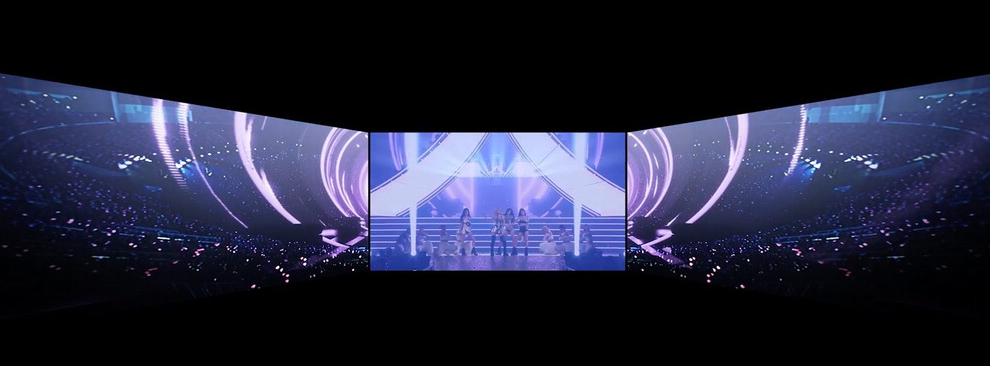
The movie theater, once a simple movie theater, has recently been transformed into a complex cultural space in China, helping to promote consumption.
A movie theater in Huzhou, Zhejiang Province, was crowded with moviegoers as well as people seeking unique experiences during the three-day New Year’s holiday. Audiences sat in individual booths, enjoying hot pot and watching movies unfold on the big screen.
As such, many movie theaters across China are enriching people’s cultural life by introducing a “Cinema+” model that combines various leisure activities such as movie screenings, concerts, exhibitions, and watching sports games.
Wong Yang, an associate professor at the Beijing Film Academy, said Chinese movie theaters are gradually evolving into a complex consumption space that integrates various forms of entertainment.
Experts analyzed that the increase in demand for immersive and exciting experiences is driving this change, which is leading to the expansion and diversification of consumption scenarios.
In the midst of a wave of consumer upgrades, some cinemas are using cutting-edge audiovisual technology to offer live streaming and live broadcasts ranging from live broadcasts of National Day celebrations to demonstrations of blockbuster games “Black Myth: Okong.”
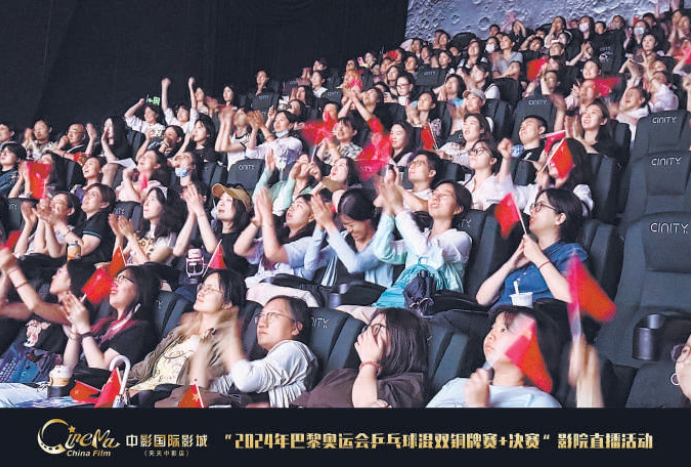
Sports competition is also one of the promising fields. With the “2024 Paris Olympics” gaining popularity, hundreds of movie theaters were crowded with people trying to watch the games. Industry insiders pointed out that in addition to movie theaters providing more entertainment options, the convergence between different industries has opened up new possibilities for movie theater revenue generation.
According to related statistics, the movie theater’s revenue from the live broadcast of the 2024 Paris Olympics amounted to about 2.44 million yuan.
Chen Xi, an associate researcher at the Macroeconomic Research Institute of China’s National Development and Reform Committee, analyzed that the Chinese film industry is shifting from a “box office economy” to a “multidimensional consumption ecosystem.” He added that the economic effect of the “Cinema+” model reflects consumption trends that encompass many fields, adding that movies are emerging as new consumption growth engines.
Now, many parts of China are actively using movie theaters to promote consumption. Some theaters in Yancheng, Jiangsu Province, attracted audiences by offering traditional music performances and local cuisine.
A piano concert was held on a temporary stage at a historic movie theater in downtown Beijing, and a video matching the subtle melody was displayed on the screen. The temporary stage narrowed the distance between the performer and the audience, adding to the charm of the performance, and about 200 audiences were able to experience a stronger sense of immersion.
Wichao, the director of the movie theater, said that it has hosted 110 performances and 30 live streams in a year, attracting various events including concerts since 2025. He said that piano concerts are held about every two months and have a high audience rate of more than 80%, adding, “The Cinema+ model is bringing more than just revenue.”
JENNIFER KIM
US ASIA JOURNAL

